Close Menu
 World
World
 Biography
 Health
 Education
 Business
 Lifestyle
 Sports
 Technology
 Animals
 History
 Food
Food
 Religious
 Startups
 Movies
 Politics
 Fashion
 Covid
Covid
 Diet
Diet
 Fitness
 Marketing
 Travel
 Science
 Reviews
 Social media
 Stories
 Facts
Facts
 Art
Art
 Entertainment
Yatin Samra

Technology
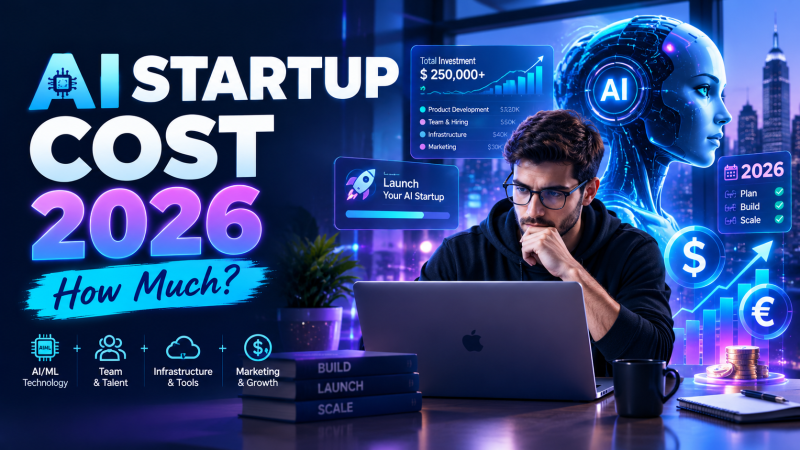
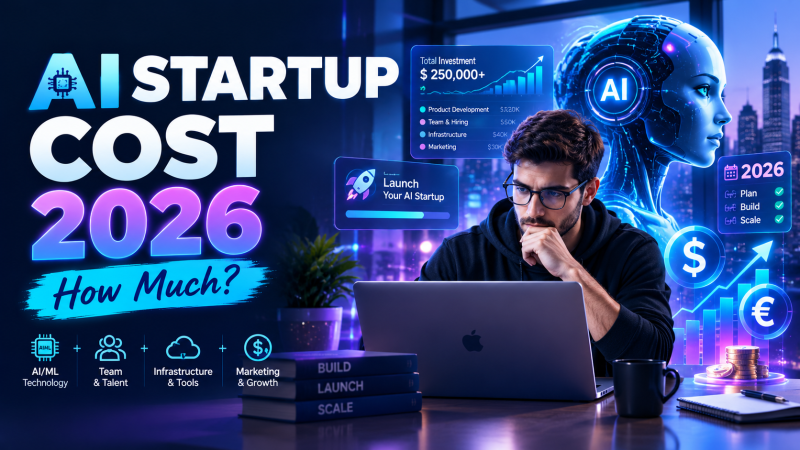
How to Plan the Cost of Launching an AI Startup in 2026
 Yatin Samra
The fast adoption of artificial intelligence has opened doors of opportunity for startups in various sectors such as customer service, business automation, healthcare, finance, retail, and education. Nonetheless, turning an idea about AI a product ready for the market entails investments in technology, people, data, infrastructure, and operations.
AI product development should thus be treated as a full cycle of product development rather than one-time software development. The price of starting up a company in 2026 varies depending on the kind of AI product, degree of customization, target audience, infrastructure, and business model.
For those interested in targeting the USA, understanding all these price elements may help in deciding on what needs to be created first, what to outsource/integrate, and what prices will come later.
Begin With the Business Problem
The first stage of an AI startup does not necessarily require complex development.
Before building the product, founders should establish:
- The problem being addressed
- The target audience
- The value AI provides
- Existing alternatives
- Potential revenue models
- Expected customer demand
This discovery stage can help prevent businesses from investing in technology before confirming that the underlying problem is worth solving.
For example, an AI platform designed to automate repetitive business tasks may have a very different development path from an AI product that generates specialized content or analyzes large datasets.
The Product Model Shapes the Investment
AI startups can follow different product models.
Some may offer AI-powered SaaS products, while others may develop mobile applications, enterprise platforms, AI agents, developer tools, or industry-specific solutions.
The product model determines the technical architecture and development requirements.
A simple AI application that relies on an existing model may require fewer resources initially. A platform with proprietary algorithms, complex workflows, and enterprise integrations may require a significantly broader development effort.
Choosing the Right AI Technology
One of the most important decisions is determining how much of the AI technology should be built internally.
A startup can potentially choose from:
Third-Party AI Services
Using established AI APIs can help startups develop and test their ideas quickly.
This approach can reduce initial engineering complexity, although ongoing usage charges need to be considered.
Open-Source Models
Open-source models can provide greater flexibility and control. However, businesses may need additional resources for deployment, optimization, security, and maintenance.
Customized Models
A startup with highly specialized requirements may develop or fine-tune models using proprietary data.
This approach can involve additional expenses related to data, computing, engineering, testing, and model monitoring.
The right option depends on the product's actual requirements rather than simply choosing the most advanced technology available.
Data Can Influence the Budget
AI systems are only as useful as the data supporting them.
Depending on the application, businesses may need to invest in:
- Data acquisition
- Data cleaning
- Data labeling
- Data storage
- Data transformation
- Data governance
- Data quality monitoring
A startup working with proprietary information may also need systems for controlling access and protecting sensitive datasets.
Data preparation can take considerable time, particularly when the AI solution requires highly specialized or domain-specific information.
Developing the MVP
A focused minimum viable product can help founders test the concept without building the entire long-term platform immediately.
An AI MVP might include:
- User accounts
- Core AI functionality
- Basic dashboard
- AI API or model integration
- Essential backend services
- Feedback collection
- Basic analytics
The objective is to demonstrate the product's primary value and gather feedback from actual users.
Advanced functionality can be introduced after the startup has more evidence about what customers actually need.
The Software Around the AI
The AI engine is only one component of the product.
A complete startup may also require:
- Web applications
- Mobile applications
- Backend services
- Databases
- APIs
- Authentication
- Payment processing
- Admin dashboards
- Notification systems
These components connect the AI capability with the customer experience and business operations.
Consequently, software engineering can represent a substantial part of the overall startup investment.
Infrastructure and AI Compute
Infrastructure costs depend on how the AI system operates.
A product using an external AI API may have relatively straightforward infrastructure requirements, while a startup hosting and running its own models may require more sophisticated computing resources.
Infrastructure expenses can include:
- Cloud servers
- GPU resources
- Database services
- Storage
- Networking
- Model hosting
- Monitoring
- Backup systems
A scalable infrastructure strategy can help startups increase capacity as their user base grows.
Security Should Be Included From the Start
AI applications can process sensitive customer information, business documents, conversations, or proprietary data.
Security planning may include:
- Secure authentication
- Authorization
- Encryption
- API protection
- Access controls
- Data monitoring
- Security testing
- Backup and recovery
For products serving customers in the USA, businesses should evaluate the privacy and security requirements relevant to their industry and the types of information their platform processes.
AI Testing Requires a Broader Approach
Testing an AI product involves more than checking whether the software functions correctly.
Teams may need to assess:
- Output accuracy
- Response consistency
- Model reliability
- Edge cases
- Hallucinations
- Unwanted outputs
- Performance
- User feedback
Evaluation should continue after launch because AI behavior can change as models, prompts, data, and integrations evolve.
Team Structure Can Affect Development Costs
The team required for an AI startup depends on the product's complexity.
A typical project may involve:
- Product managers
- AI/ML engineers
- Software developers
- Data engineers
- UI/UX designers
- DevOps engineers
- QA specialists
- Security professionals
A startup does not necessarily need a large internal team from day one. Some founders begin with a focused core team and use specialized external resources for particular areas.
The appropriate structure depends on the product roadmap, available resources, and long-term business strategy.
Third-Party Services Create Recurring Expenses
AI startups frequently depend on external services for essential functionality.
These may include:
- AI APIs
- Cloud platforms
- Payment providers
- Authentication services
- Analytics tools
- Communication platforms
- Data services
These tools can accelerate development, but their usage-based pricing should be included in financial planning.
For an AI application, increasing user activity may directly increase model-processing costs, making usage forecasting especially important.
Launch Expenses Go Beyond Development
Once the product is ready, the startup still needs to reach its target audience.
Launch-related spending can include:
- Branding
- Website development
- Content creation
- Marketing
- Search optimization
- Advertising
- Sales tools
- Customer support
- Product onboarding
The appropriate investment depends on whether the startup follows a direct-to-consumer, SaaS, enterprise, marketplace, or another business model.
Plan for Post-Launch AI Improvement
Launching the product is the beginning of an ongoing development cycle.
After release, the team may need to:
- Improve AI responses
- Optimize prompts
- Update models
- Refine datasets
- Reduce infrastructure costs
- Fix software issues
- Add customer-requested features
- Monitor system performance
This means the startup's financial plan should include an ongoing product and AI improvement budget.
A Better Way to Think About AI Startup Costs
Instead of estimating one large development figure, founders can divide their investment into stages.
Stage 1: Validation
Research the market, define the customer problem, and evaluate AI feasibility.
Stage 2: Product Design
Create user journeys, prototypes, technical architecture, and the MVP roadmap.
Stage 3: MVP Development
Build the essential software and AI functionality needed to test the concept.
Stage 4: Testing and Launch
Validate performance, security, AI quality, and user experience before going public.
Stage 5: Product Growth
Improve the AI system, expand infrastructure, add integrations, and introduce new features based on actual usage.
This structure can make investment decisions more manageable and reduce the risk of spending heavily before product-market validation.
AI Startup Development for the USA
The USA provides opportunities for AI startups across many industries, but each market segment has different customer expectations and operating requirements.
A startup targeting American businesses may need to consider enterprise integrations, security standards, data handling practices, customer support expectations, and industry-specific requirements.
Rather than building a generic AI product for a broad audience, founders can define a specific customer segment and develop the platform around its most important problems.
Final Thoughts
The cost of building a business venture that offers AI solutions in 2026 will depend on the way the product is developed, the degree of AI customization needed, the kind of data being used, and the scalability of the platform.
One way of addressing this challenge would be to identify a specific problem first, use appropriate technology for the task, create an MVP, and then grow the product with changing customer demands.
With proper planning regarding technology, security, infrastructure, workforce, and AI operations, American startups can develop a more sustainable route to build their products.
If you want to know more about the development of this platform, please visit the link provided below.
Source:
Click for the: Full Story
You might like