Close Menu
 World
World
 Biography
 Health
 Education
 Business
 Lifestyle
 Sports
 Technology
 Animals
 History
 Food
Food
 Religious
 Startups
 Movies
 Politics
 Fashion
 Covid
Covid
 Diet
Diet
 Fitness
 Marketing
 Travel
 Science
 Reviews
 Social media
 Stories
 Facts
Facts
 Art
Art
 Entertainment
Digital Vignesh

Technology
What Is Digital Business Transformation and Why Does It Matter?
 Digital Vignesh
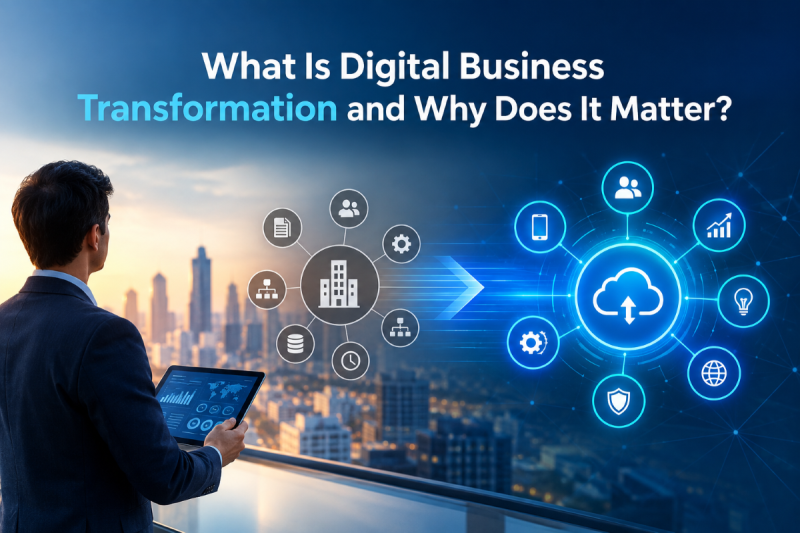
More apps. More platforms. More data. Yet the same business problems. That happens when technology is added without changing the underlying processes and systems. Digital business transformation focuses on changing how a business works, using technology to connect applications, data, people, and processes. From automation and cloud modernization to analytics, integration, and AI, these changes can improve operations and customer experiences.
What does this look like across a business? Let’s break it down.
Business Operations
Connecting applications and automating workflows can remove many repetitive manual steps. Employees spend less time entering or moving information between systems and more time on work that depends on their skills and input.
Customer Experiences
Customers may start an interaction on a website, continue through an app or portal, and use chat or email for support. Transformation connects these touchpoints to reduce friction and eliminate unnecessary steps along the journey.
Data and Decisions
Business information comes from many places, including sales, finance, operations, and customer service. Connecting these sources helps teams understand the business from a more complete perspective. Analytics and AI can then use this information to generate useful insights.
Applications and Infrastructure
Older technology can make it harder to scale or introduce new capabilities. Businesses can modernize applications, adopt cloud infrastructure, improve integrations, and update their architecture while keeping useful existing systems where they make sense.
Employee Workflows
Less friction in everyday workflows can make a significant difference to how employees work. Digital transformation enables this through collaboration tools, automated processes, shared data, and AI-assisted applications, reducing unnecessary work and helping teams access information and make decisions faster.
Digital Transformation vs. Adding New Technology
Consider a company that receives hundreds of customer requests every day. It purchases a new ticketing system. Customers can now submit requests online, but employees still copy information into other systems and manually assign every request. The company has digitized the process.
Now imagine the systems are connected. Requests are automatically categorized and routed. Customers can see their status. Managers have real-time dashboards. AI handles routine questions. That is closer to digital business transformation because the underlying process has changed. The difference is important. Digitization changes how work is done. Transformation changes how the business works.
Where Does AI Fit?
AI is playing a growing role in digital transformation, but it should not automatically be the first step in every initiative. Businesses can use AI to:
- Automate routine tasks
- Analyze large amounts of data
- Predict demand
- Support customer service
- Process documents
- Find information across business knowledge
- Assist software development
- Support business decisions
The important question is not, "Where can we add AI?" It is, "Where can AI solve a real business problem?" That requires good data, suitable infrastructure, secure systems, clear processes, and appropriate governance.
What Makes Transformation Difficult?
Technology is rarely the only challenge. Businesses may have legacy systems that cannot easily connect. Data may be spread across multiple platforms. Teams may follow different processes. Employees may be unfamiliar with new tools.
There can also be concerns around security, compliance, cost, and disruption to existing operations. This is why transformation needs to be planned around the business rather than around individual technologies.
How Should a Business Start?
A practical starting point is to look at where the business currently struggles. Ask:
- Which processes take too much manual effort?
- Where do customers experience friction?
- Which systems do not communicate with each other?
- Where is important data difficult to access?
- Which legacy systems are limiting growth?
- Where could automation or AI create measurable value?
From there, businesses can prioritize opportunities and decide whether to integrate, modernize, automate, or build. There is no requirement to transform everything at once. A focused transformation can start with one business problem and expand as the organization sees results.
Tetrahed views digital transformation through two connected lenses: business requirements and technology capabilities. Its capabilities include cloud, cybersecurity, AI/ML, network services, data analytics, identity and access management, and business consulting. These capabilities help businesses modernize their technology environments, connect applications and data, incorporate intelligent capabilities, and develop solutions that reflect their specific requirements.
Technology is treated as a means to address business needs, not as an objective by itself. The result is digital capability designed to solve today's business problems while supporting the needs that emerge tomorrow.
Frequently Asked QuestionsWhat is digital business transformation?
Digital business transformation is the process of changing how a business operates, serves customers, uses data, and delivers value through technology and redesigned processes.
Why is digital business transformation important?
It can help businesses reduce manual work, improve customer experiences, connect data and systems, modernize technology, and respond faster to changing business needs.
Is moving to the cloud a digital transformation?
Cloud migration can be part of digital transformation, but moving applications to the cloud alone does not necessarily transform the business.
What role does data play in digital transformation?
Data provides the foundation for analytics, automation, AI, and better decision-making. Connected and reliable data helps businesses understand what is happening and respond accordingly.
Can small businesses implement digital transformation?
Yes. Digital transformation does not require a large-scale technology overhaul. Businesses can start with specific processes or customer problems and expand their efforts over time.
What is the difference between digital transformation and digital business transformation?
Digital transformation broadly describes the use of digital technologies to change how an organization operates. Digital business transformation puts greater emphasis on changing business processes, customer experiences, operating models, and value creation
Source:
Click for the: Full Story
You might like