Close Menu
 World
World
 Biography
 Health
 Education
 Business
 Lifestyle
 Sports
 Technology
 Animals
 History
 Food
Food
 Religious
 Startups
 Movies
 Politics
 Fashion
 Covid
Covid
 Diet
Diet
 Fitness
 Marketing
 Travel
 Science
 Reviews
 Social media
 Stories
 Facts
Facts
 Art
Art
 Entertainment
Badal

Health
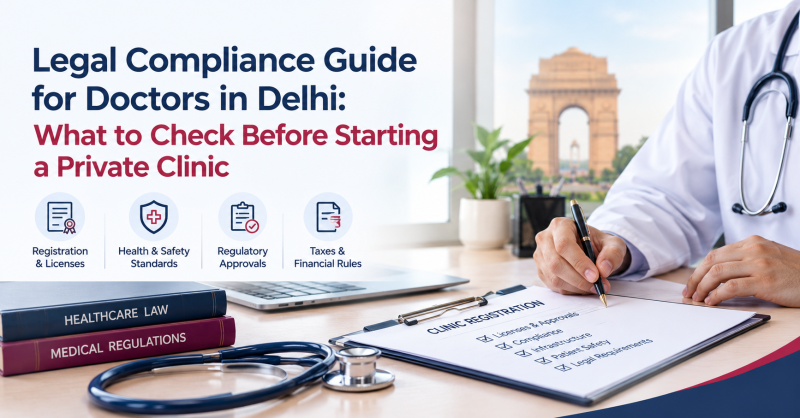
Legal Compliance Guide for Doctors in Delhi: What to Check Before Starting a Private Clinic
 Badal
Badal
Opening a private clinic is a professional milestone, but it is also the point at which a doctor becomes responsible for far more than patient care. Registrations, licences, records, staff, waste handling, and patient communication all carry legal and regulatory expectations. This legal compliance guide for doctors in Delhi explains what to check before you open your doors, so that gaps do not surface later as complaints, inspections, or disputes.
The requirements that apply depend on your specialty, the services you offer, the size of the clinic, and the rules in force at the time. This article is general information, not legal advice. Always confirm current requirements with the relevant authorities before acting.
Why Compliance Matters Before the First Patient
Most clinic-related disputes do not begin with a clinical error. They begin with something avoidable: a missing consent form, an unclear fee explanation, an unregistered service, or poorly kept records. A compliance gap can turn a minor disagreement into a formal complaint.
Compliance affects everyone connected to the clinic: the doctor-owner, employed clinicians, nursing and front-desk staff, and patients whose safety and privacy depend on sound systems. Building these systems early is far easier than repairing them after a problem arises.
A structured medico legal guide in Delhi can help doctors understand how everyday practice decisions connect to legal risk, particularly on consent, records, and complaint handling.
Legal Compliance Guide for Doctors in Delhi: The Core Checks
Use the following as a starting checklist. It is not exhaustive, and you should verify each item against current rules.
Professional registration and eligibility
- Confirm that your medical registration is valid and current, and that it covers the type of practice you intend to carry out.
- Keep your qualification certificates and registration documents readily accessible.
- If other doctors or allied professionals will work at the clinic, verify their registrations and qualifications as well.
Clinic and establishment requirements
- Find out which registrations or licences apply to your clinic, its location, and the services you plan to offer. Requirements can differ for a consulting room, a clinic with procedures, and one with a laboratory or pharmacy.
- Check that the premises are suitable for the intended use, including any local rules on commercial or residential property.
- Confirm applicable local business and establishment obligations, including any tax registrations.
Equipment, services, and specific regulations
- Certain services, such as diagnostic imaging, laboratory testing, or dispensing medicines, may be governed by separate rules or licences.
- Check whether any equipment you plan to use requires approval, registration, or periodic calibration.
- If you are unsure whether a service needs a separate licence, ask the relevant authority or a qualified professional before offering it.
Biomedical waste, infection control, and premises safety
- Understand your obligations for segregating, storing, and disposing of biomedical waste, and whether an authorisation is needed.
- Put simple written infection-control practices in place and train staff to follow them.
- Check fire and building safety requirements, and keep clear exits, basic emergency equipment, and a plan for medical emergencies.
Insurance and Professional Indemnity
Professional indemnity cover is a practical safeguard, not a legal shield. Read the policy carefully. Understand what it covers, what it excludes, whether it extends to staff, and what you must do if a complaint or notice arrives, including any reporting timelines.
Consider separate cover for the premises, equipment, and employees if relevant. Ask your insurer or a qualified adviser to explain anything unclear before you sign.
Documentation Every New Clinic Should Have in Place
Clear documentation is central to healthcare compliance and to any later defence of your care. Prepare these systems before you see patients.
Patient records
- A standard format for history, examination, diagnosis, investigations, treatment plan, and follow-up.
- Dated and signed entries, with a clear method for marking late entries.
- Secure storage for paper or electronic records, with controlled access.
- A policy on how long records are retained and how requests for copies are handled, consistent with applicable rules.
Informed consent
Consent is a conversation, not just a form. Patients should understand the condition, the proposed treatment or procedure, material risks, reasonable alternatives, and the option to decline. Document that this discussion took place, in a language the patient understands. Prepare procedure-specific consent forms where appropriate.
Fees, confidentiality, and patient communication
- Provide clear information on consultation fees, procedure charges, and follow-up policies.
- Record refusals of advice, missed follow-ups, and patients leaving against medical advice.
- Decide who can access records, how digital data is backed up, and how phone and messaging-app communication is handled.
- Train staff on what may and may not be shared with relatives.
Common Mistakes New Clinic Owners Should Avoid
- Assuming one registration covers everything. Different services may need different approvals.
- Starting services before licences are confirmed. Verify first, then begin.
- Using generic consent forms for every procedure without explaining specific risks.
- Keeping thin or templated notes that do not reflect the actual patient.
- Delegating consent or clinical decisions to staff without clear responsibility.
- Making unrealistic promises in advertising or conversation. Follow the ethics and advertising guidance applicable to doctors.
- Ignoring early patient concerns, which often grow into formal complaints.
- Not planning for complaints, notices, or adverse events until they happen.
A Step-by-Step Approach Before You Open
- List your services and identify the rules that apply to each.
- Verify registrations and licences with the relevant authorities, and keep copies.
- Arrange indemnity and insurance, and read the terms.
- Set up records and consent systems before the first appointment.
- Prepare basic protocols for infection control, waste, emergencies, and referrals.
- Train staff on records, confidentiality, and courteous handling of complaints.
- Create a complaint-handling process with a named person, a simple log, and a response timeline.
- Review annually, since rules and services change.
Following a legal compliance guide for doctors in Delhi in this order keeps the most consequential checks at the front and the routine ones in steady rotation.
When a Legal Guide for Doctors in Delhi Is Not Enough
A written resource can point you in the right direction, but some situations call for individual advice. Medico-legal guidance may be appropriate when you are unsure which registrations apply, when drafting consent and record formats, when structuring agreements with partners or staff, or when you receive a legal notice or complaint. Formal legal representation may be needed if a matter becomes contentious.
Dr Vimal Kant Goyal has written on these themes for medical professionals. A good legal guide for doctors in Delhi should combine clinical realities with regulatory awareness rather than treat them separately, and a reliable medico legal guide in Delhi will be clear about where general information ends and personal advice begins.
Conclusion
A well-prepared clinic protects patients and the practitioner alike. Confirm your registrations, understand which licences apply, put consent and record-keeping systems in place, arrange suitable indemnity, and plan for complaints before they arise. This legal compliance guide for doctors in Delhi is a starting point, not a substitute for current, situation-specific advice. Pair it with a trusted medico legal guide in Delhi, review your compliance regularly, and seek guidance early when something is unclear.
Frequently Asked Questions
1. What is the first thing a doctor should check before opening a clinic?Start by confirming that your medical registration is valid and that the services you plan to offer are permitted under it. Then identify which clinic-level registrations and licences apply to your premises and services.
2. Do all clinics in Delhi need the same licences?Not necessarily. Requirements can vary with the type of clinic, its services, and its facilities. A consulting-only practice may have different obligations from one offering procedures, diagnostics, or a pharmacy. Confirm current rules with the relevant authorities.
3. Is professional indemnity insurance mandatory?Requirements can depend on your employer, hospital arrangements, or other circumstances, so check the current position. Even where it is not required, many doctors consider it a sensible safeguard. It does not guarantee protection, so read the terms carefully.
4. How should a clinic handle patient complaints?Acknowledge the concern promptly, listen without defensiveness, record the complaint and your response, and try to resolve it through honest discussion. If a formal notice arrives, preserve records and seek guidance before replying.
5. Where can doctors find a legal guide for doctors in Delhi?Look for material that is practical, cautious, and clear about its limits. Official regulator websites, professional associations, and educational resources from experienced medico-legal professionals can all help, but none replaces advice on your specific situation.
Source:
Click for the: Full Story
You might like