Close Menu
 World
 Biography
 Health
 Education
 Business
 Lifestyle
 Sports
 Technology
 Animals
 History
 Food
 Religious
 Startups
 Movies
 Politics
 Fashion
 Covid
 Diet
 Fitness
 Marketing
 Travel
 Science
 Reviews
 Social media
 Stories
 Facts
 Art
 Entertainment
Badal

Health
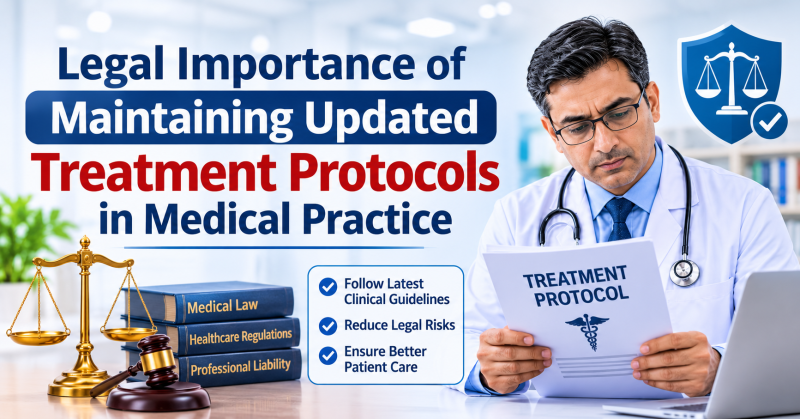
Legal Importance of Maintaining Updated Treatment Protocols in Medical Practice
 Badal
When a patient complaint reaches a medical council or a consumer commission, the first question is rarely "what did the doctor intend?" It is usually "what was the accepted standard of care, and did the treatment meet it?" Updated treatment protocols are how a practice shows that it did. Anyone looking for legal help for doctors in Delhi will find that outdated protocols are one of the most avoidable weaknesses in a defence. Keeping them current does not guarantee protection, but it makes clinical decisions easier to explain and defend.
Why Protocols Matter Legally
Indian law does not hand doctors a single statutory manual of treatment. The standard of care is assessed against what a reasonably competent practitioner in the same field would have done. In Jacob Mathew v. State of Punjab (2005), the Supreme Court held that criminal liability requires gross negligence, and that a mere error of judgment or a differing professional view is not enough. In civil and consumer matters the bar is lower, and a decision may be tested against the standard of care expected at the relevant time.
Protocols matter in that analysis because they are the visible evidence of what you considered the right approach at the time. They do not bind a court. A court or expert committee will usually look to medical literature, national guidelines and the opinion of specialists in the field. An established, regularly reviewed protocol is a strong sign of diligence. A protocol last revised a decade ago is a weak one.
Where Protocols Come From and How Much Weight They Carry
Not every document called a "protocol" carries the same authority. It helps to separate them.
Statutory and regulatory requirements
Some obligations are mandatory by law, such as biomedical waste handling, radiation safety for imaging equipment, and rules on notifiable diseases. These are not optional best practices.
Official and national guidelines
Bodies such as the Ministry of Health and Family Welfare, ICMR and national programmes publish treatment guidelines for specific conditions. They are persuasive and often the benchmark an expert will refer to, but they are generally guidance rather than law.
Professional society guidance and internal protocols
Specialty society recommendations and a hospital's own standard operating procedures sit below these. Their value lies in being documented, consistently applied and sensibly adapted to local conditions.
Note that the Indian Medical Council (Professional Conduct, Etiquette and Ethics) Regulations, 2002 expect doctors to keep abreast of developments in their field. The National Medical Commission issued newer conduct regulations in 2023 that were later placed in abeyance, so confirm on the NMC website which framework currently applies before quoting it in any policy.
How Outdated Protocols Create Risk
The danger is rarely a dramatic error. It is usually quiet drift. A protocol is written once, filed and never reopened, while clinical evidence, drug recommendations and national guidance move on.
The consequences differ by type, and they should not be blurred:
- Operational. Staff follow different versions, causing inconsistent care.
- Administrative. An accreditation or inspection may expose out-of-date documents.
- Professional. A council inquiry may ask why current guidance was not followed.
- Legal. In a negligence claim, an outdated protocol can weaken the argument that care met the expected standard.
None of these is automatic negligence. Courts examine causation and harm, not paperwork alone. But a gap between your written protocol and current accepted practice gives the other side something to build on.
A Realistic Scenario
This is a hypothetical illustration, not a reported case.
A multi-doctor clinic in Delhi uses a written protocol for managing a common chronic condition, drafted years ago by a senior partner. A newer associate follows current national guidance and prescribes differently. The clinic's own document, which a nurse still uses for patient counselling, says something else. A patient on the older advice has a poor outcome and files a complaint.
The errors are clear. The clinic had no review schedule, no version control and no process for reconciling internal documents with updated guidance. The complaint would be easier to answer if the clinic could show a dated revision history and a record of why a departure was made. What it should have done was assign an owner, set a review date and withdraw superseded versions.
Building a Protocol Review System
The following steps are practical rather than legally mandated, and suit a clinic or a hospital department.
- Appoint a named person responsible for each protocol.
- Set a review cycle, commonly annual, with earlier review when national guidance changes.
- Record the source for each protocol: guideline, date and edition.
- Use version numbers and dates, and withdraw old copies.
- Train staff on revisions and keep attendance records.
- Document reasons whenever a clinician departs from the protocol for an individual patient.
- Audit a sample of case files against the protocol.
The last two points are often missed. Departing from a protocol is not wrong if clinically justified, and a recorded reason turns a potential weakness into evidence of independent judgment. This is where informed medico-legal awareness helps. Practitioners such as Dr. Vimal Kant Goyal have emphasised that how a decision is documented often matters as much as the decision itself.
When to Seek Specialist Advice
Protocols that touch consent, high-risk procedures, outsourced services or data handling deserve a legal review before adoption. A medico legal consultant in Delhi can check that internal documents match current statutory requirements, and for broader reading on related issues, this medico-legal guidance for doctors is a useful starting point. Treat any outside review as a support to, not a replacement for, your own clinical judgment.
Conclusion
Updated protocols are evidence of diligence, not a shield against every claim. Know which documents are mandatory and which are guidance, assign ownership and review dates, control versions, and record the reasons for any departure from protocol. These habits are modest in cost and strengthen your position if care is ever questioned. Because regulations and guidelines change, verify current provisions with official sources or a qualified lawyer before relying on any single point here.
Frequently Asked Questions
1. Is a doctor legally required to follow a published guideline exactly?Generally no. Most clinical guidelines are advisory. You may depart from one when the patient's circumstances justify it, but record your reasoning. Some regulatory instructions, such as notification duties, are mandatory, so check which category applies.
2. How often should treatment protocols be reviewed?No single statutory interval applies to every clinic. Annual review is a common good practice, with prompt review when major guidance or drug recommendations change. Establishments with accreditation may have their own required intervals.
3. Do these requirements differ between a clinic and a nursing home in Delhi?They can. Delhi nursing homes are regulated under the Delhi Nursing Homes Registration Act, 1953, while a solo consulting practice may face lighter obligations. Check your category with the Directorate General of Health Services, Delhi.
4. Can an old protocol be used against me even if the patient was not harmed?A non-compliant document alone does not usually create a claim without harm and causation. It may still attract scrutiny during an inspection or inquiry, so keeping it current reduces avoidable friction.
5. Should I speak to a lawyer before a complaint arrives?It is sensible to. Early advice on documentation and protocol review is cheaper and calmer than advice taken after a notice arrives.
Source:
Click for the: Full Story
You might like