


 Close Menu
 World
 Biography
 Health
 Education
 Business
 Lifestyle
 Sports
 Technology
 Animals
 History
 Food
 Religious
 Startups
 Movies
 Politics
 Fashion
 Covid
 Diet
 Fitness
 Marketing
 Travel
 Science
 Reviews
 Social media
 Stories
 Facts
 Art
 Entertainment
Deepak

Health
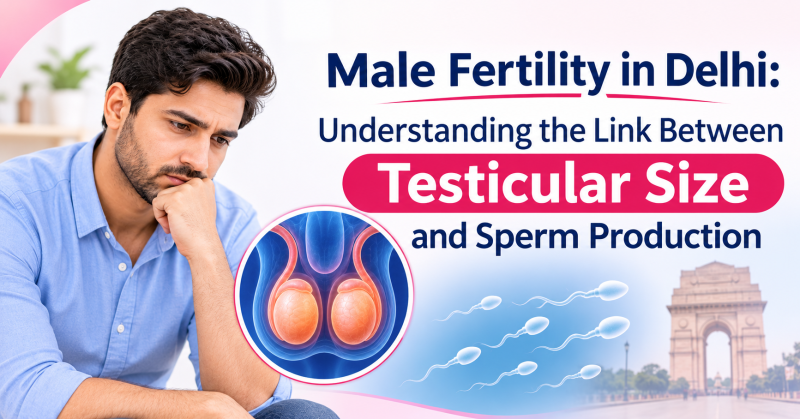
Male Fertility in Delhi: Understanding the Link Between Testicular Size and Sperm Production
 Deepak
Many men quietly wonder whether the size of their testicles says something about their fertility. It is a common worry, and rarely discussed openly. The honest answer is that testicular size can offer useful clues about sperm production, but it is only one piece of the picture. Understanding what size can and cannot tell you helps you decide when a medical check is worthwhile.
Why Testicular Size Matters
Most of the testicle’s volume is made up of tiny coiled tubes called seminiferous tubules, where sperm are produced. Supporting cells and hormone-producing cells fill the space between them. In general, more healthy sperm-producing tissue means a larger testicle.
That is why doctors pay attention to size during an examination. A testicle that is smaller or softer than expected may have less working tissue. Still, size alone does not measure sperm quality.
What Is Considered a Typical Testicular Size?
Testicular volume varies from man to man. Doctors usually measure it with an ultrasound or a simple comparison tool called an orchidometer. Typical adult volumes are often described as roughly 15 to 25 millilitres per testicle, though ranges differ between individuals and populations.
Some points worth knowing:
- It is normal for one testicle to be slightly larger or to hang lower than the other.
- A noticeable change in size over time deserves attention.
- Size is judged together with texture, position, and symptoms, not in isolation.
What Small Testicles May Suggest
Reduced testicular volume can sometimes be linked with lower sperm production. Possible reasons include:
- Hormonal conditions, such as low testosterone or raised FSH
- Undescended testicle in childhood
- Past injury, torsion, or infection, such as mumps orchitis
- Genetic conditions that affect testicular development
- Varicocele, an enlargement of veins around the testicle
- Certain medicines or past treatments, including chemotherapy
Many men with smaller testicles still have sperm in their semen, and some can conceive naturally. Others have very low counts. Only a semen analysis and examination can tell which applies.
Can Normal-Sized Testicles Still Have Fertility Problems?
Yes. A man can have normal-sized testicles and still face fertility challenges. Sperm movement, shape, DNA integrity, or blocked tubes can all reduce fertility without any change in size. Lifestyle factors such as smoking, heavy alcohol use, obesity, and prolonged heat exposure can also affect sperm health.
This is why size is a starting clue, not a verdict in either direction.
How Doctors Evaluate Testicular Size and Sperm Production
A thorough evaluation usually includes:
- Medical history: childhood conditions, surgeries, infections, medicines, and lifestyle
- Physical examination of the testicles, epididymis, and surrounding structures
- Semen analysis, often repeated because results naturally vary between samples
- Hormone tests: typically FSH, LH, and testosterone
- Scrotal ultrasound to measure volume and check for varicocele or structural changes
- Further testing such as genetic tests or sperm DNA fragmentation testing in selected cases
Not every man needs every test. The first results guide the next steps.
Why Both Partners Should Be Assessed
Conception depends on both partners, so looking at only one side can leave gaps. Dr. Poonam Goyal, a gynecologist and fertility specialist, reviews the history of both partners together. This helps ensure that a male factor is not overlooked and that the woman’s tests are not repeated unnecessarily. When a man needs input from an andrologist or urologist, a referral can be arranged. Couples looking for the best male fertility in Delhi often value this coordinated approach, where one plan covers both partners.
Couples who search for the best obstetrics and gynecology in Delhi to guide their fertility journey may also find it helpful to ask whether the male partner’s evaluation is included from the start.
Possible Treatment Approaches
Treatment depends on the cause. There is no single solution, and outcomes cannot be guaranteed.
- Lifestyle changes: Quitting smoking, limiting alcohol, managing weight, and avoiding excess heat may support sperm health. Sperm take around three months to develop, so changes take time to show.
- Treating the underlying issue, such as varicocele, infection, or a hormonal imbalance
- Assisted reproduction: IUI may be suitable when enough healthy sperm are present. IVF with ICSI may be recommended when counts or quality are low. If no sperm are found in the semen, surgical sperm retrieval may be considered.
When Should You See a Specialist?
Consider a consultation if:
- You have been trying to conceive for 12 months (or 6 months if the woman is 35 or older)
- One testicle seems clearly smaller, or you notice a change in size, a lump, or pain
- You had an undescended testicle, torsion, injury, or infection in the past
- A semen report shows low count, poor movement, or abnormal shape
For couples seeking male fertility in Delhi, an early and honest evaluation brings clarity and saves valuable time. Testicular size is simply one clue among many, and a doctor can help you read it in the right context.
Frequently Asked Questions
1. Does testicular size affect sperm count?
It can. Smaller testicles may contain less sperm-producing tissue, which can be linked with lower sperm counts. However, size alone does not decide fertility, so a semen analysis is needed to know your actual sperm parameters.
2. Is it normal for one testicle to be bigger than the other?
Yes, a slight difference in size is common and usually harmless. A sudden or noticeable change, or any pain or lump, should be checked by a doctor.
3. Can men with small testicles still father a child?
Many can. Some men with smaller testicles still produce enough healthy sperm for natural conception, while others may need assisted options. Testing shows which situation applies.
4. How is testicular size measured?
Doctors usually examine the testicles by hand and may use an orchidometer or a scrotal ultrasound to measure volume more precisely.
5. Can testicular size increase sperm production?
Size itself is not something to “treat.” If an underlying cause, such as a varicocele or hormonal imbalance, is found and managed, sperm production may improve in some men, though results vary.
Source:
Click for the: Full Story
You might like






You Might Like this