


 Close Menu
 World
 Biography
 Health
 Education
 Business
 Lifestyle
 Sports
 Technology
 Animals
 History
 Food
 Religious
 Startups
 Movies
 Politics
 Fashion
 Covid
 Diet
 Fitness
 Marketing
 Travel
 Science
 Reviews
 Social media
 Stories
 Facts
 Art
 Entertainment
Badal

Health
The Importance of Informed Consent Before Medical Procedures
 Badal
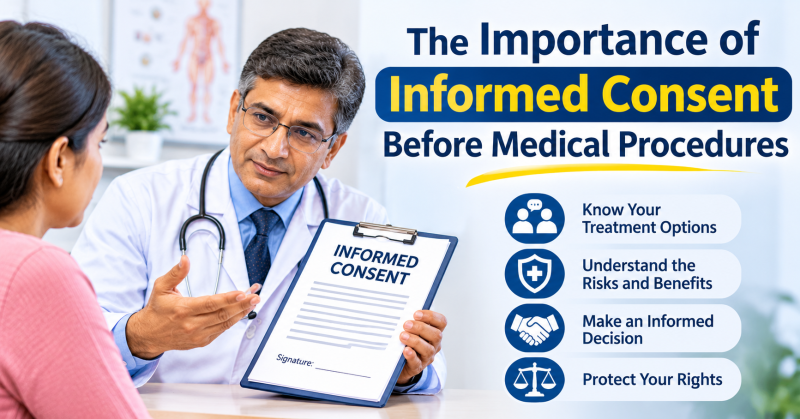
Informed consent is a patient’s voluntary permission to a procedure, given after the doctor has explained the nature, benefits, material risks, and alternatives in a way the patient understands. It is both an ethical duty and a legal safeguard. This legal compliance guide for doctors in Delhi explains what valid consent requires, where doctors commonly go wrong, and how to document consent so your records can support your clinical decisions.
What Makes Consent “Informed”?
A signature on a form is not the same as informed consent. Consent is valid when these elements are present:
- Capacity: the patient can understand and weigh the information.
- Disclosure: the doctor explains the diagnosis, the proposed procedure, its purpose, material risks, likely outcomes, and reasonable alternatives, including no treatment.
- Understanding: the patient grasps the explanation, in a language they speak.
- Voluntariness: the decision is free from pressure or coercion.
- Specificity: the consent covers the procedure actually performed.
In Samira Kohli v. Dr. Prabha Manchanda (2008), the Supreme Court of India held that consent for a diagnostic procedure does not extend to a different, more invasive therapeutic procedure, except where it is necessary to save the patient’s life or health in an emergency. The judgment also stressed that the doctor must give the patient enough information to make a real choice.
Why Consent Failures Create Legal Risk
Operating without valid consent can expose a doctor to a complaint before the state medical council, a claim under consumer protection law for deficiency in service, a civil claim for damages, or, in serious cases, criminal proceedings. The outcome depends on the facts, the medical record, and the forum. The Indian Medical Council (Professional Conduct, Etiquette and Ethics) Regulations, 2002 also address obtaining consent before operations.
Consent cannot prevent every complaint. A well-documented consent process does show that you acted openly and respected the patient’s autonomy, and that is a strong basis for any defence.
Common Consent Mistakes Doctors Make
Most consent disputes come from process problems, not bad intent.
- Treating the form as the process. Handing over a pre-printed form minutes before surgery is not a conversation.
- Delegating the discussion entirely. Junior staff or a receptionist cannot replace the treating doctor’s explanation of risks.
- Using generic forms. Blank or vague forms that do not name the procedure or its risks are weak evidence.
- Ignoring language barriers. A patient who cannot read English may sign a form they do not understand.
- Rushed timing. Seeking consent when the patient is sedated, in pain, or already on the operating table undermines voluntariness.
- Exceeding the agreed scope. Performing an additional procedure for convenience when it was not an emergency.
- Skipping risks that matter to the patient. Disclosure should cover risks a reasonable patient would consider significant, as well as risks specific to this patient.
Example: A surgeon advises a laparoscopic procedure, and the patient signs a general consent form. During surgery the surgeon converts to an open procedure for convenience rather than urgency. The patient later says the possibility was never discussed. With no notes of the conversation and a generic form, the surgeon struggles to show that the patient was told about the conversion risk.
Special Situations: Minors, Emergencies, and Incapacity
- Minors: consent is generally obtained from a parent or legal guardian. Involve the child in the discussion in an age-appropriate way.
- Emergencies: where delay would endanger life and the patient cannot consent, doctors may act in the patient’s interest. Record the emergency, the reasons, and who you tried to contact.
- Mental illness or incapacity: the Mental Healthcare Act, 2017 recognises patient autonomy and advance directives. Check its provisions before treating a patient with a mental illness.
- Telemedicine: the Telemedicine Practice Guidelines, 2020 describe how consent works in remote consultations. Review them if you consult online.
Documentation That Strengthens Your Position
Good records show that a real conversation took place.
- Name the procedure in plain language, without relying on abbreviations.
- Note the risks and alternatives you discussed, and any questions the patient asked.
- Record the date, time, language used, and who was present.
- Have the patient (or guardian) sign and date the form, and witness it where appropriate.
- Give the patient a copy and file the original with the medical record.
- Note any later changes of plan and the reasons.
A Quick Informed Consent Checklist
- Confirm the patient has capacity, or identify the proper decision-maker.
- Explain the diagnosis and the proposed procedure in simple language.
- Discuss material risks, benefits, and alternatives, including doing nothing.
- Allow time for questions and reflection.
- Use the patient’s language, with an interpreter if needed.
- Complete a procedure-specific form after the discussion, not before.
- Revisit consent if the plan changes.
Doctors who want more background can read a medico-legal resource for practising doctors alongside this checklist. A medico legal guide in Delhi is most useful when read with current regulations and advice from a qualified professional.
Conclusion: Make Consent a Conversation
Informed consent works best as a genuine dialogue rather than a last-minute formality. Explain clearly, listen to the patient, document accurately, and revisit consent whenever the plan changes. For case-specific concerns, a Delhi-based medico-legal professional such as Dr. Vimal Kant Goyal can help you assess your situation. This legal guide for doctors in Delhi is general information, not legal advice, and does not guarantee any outcome.
Frequently Asked Questions
1. Is written consent always required?Not every interaction needs a signed form, since consent can be implied for routine examinations. For surgery, invasive procedures, anaesthesia, and higher-risk interventions, written consent backed by clear notes is the safer practice.
2. Can a family member consent on behalf of an adult patient?Generally, a competent adult must consent personally. A relative may decide only when the patient lacks capacity, and the position depends on the circumstances and applicable law.
3. What if the patient refuses a recommended treatment?A competent patient has the right to refuse. Explain the consequences, record the refusal and your advice, and ask the patient to sign a refusal acknowledgement if they are willing.
4. Does consent protect me if the procedure goes wrong?Consent does not excuse negligence. It addresses the patient’s right to decide, while the standard of care is judged separately. Valid consent together with good clinical care puts you in a stronger position.
5. Can I use a standard consent form?You can use a template as a starting point, but tailor it to the specific procedure and patient, and support it with a documented discussion.
Source:
Click for the: Full Story
You might like








You Might Like this