


 Close Menu
 World
 Biography
 Health
 Education
 Business
 Lifestyle
 Sports
 Technology
 Animals
 History
 Food
 Religious
 Startups
 Movies
 Politics
 Fashion
 Covid
 Diet
 Fitness
 Marketing
 Travel
 Science
 Reviews
 Social media
 Stories
 Facts
 Art
 Entertainment
Sofiya

Health
Medical Coding Service | Operomed
 Sofiya
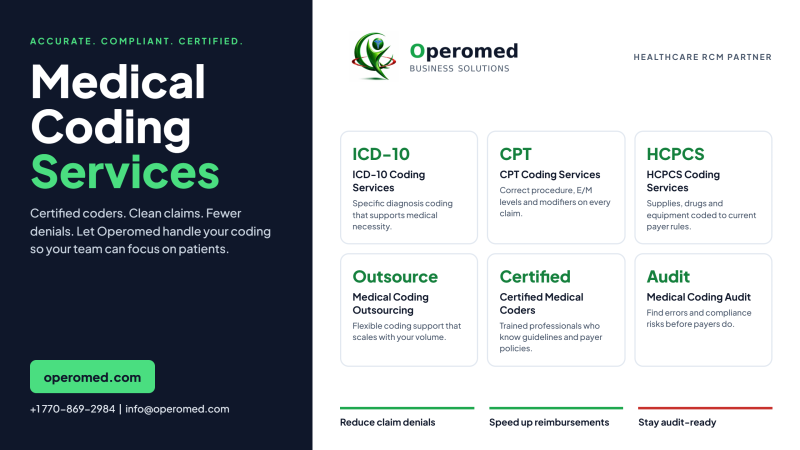
Accurate coding is the backbone of a healthy revenue cycle. Every claim a practice submits depends on codes that translate diagnoses, procedures, and supplies into a language payers understand. When the codes are right, claims are paid quickly. When they are wrong, denials, delays, and audits follow. That is why more providers are turning to professional medical coding services to protect revenue and stay compliant. In this guide, we explain what medical coding involves, how the major code sets work, why outsourcing makes sense, and how Operomed’s medical coding services help practices get claims right the first time.
What Are Medical Coding Services?
Medical coding is the process of converting clinical documentation, such as physician notes, lab results, and operative reports, into standardized alphanumeric codes. These codes drive billing, reporting, quality measurement, and reimbursement.
Professional medical coding services typically cover diagnosis coding, procedure coding, supply and drug coding, documentation review, and coding audits. Providers can manage this work in-house or hand it to a specialized partner. Many choose the second route, because medical coding outsourcing gives them access to trained experts without the expense of recruiting, training, and retaining a full coding team.
ICD-10 Coding Services
The International Classification of Diseases, Tenth Revision (ICD-10), is the standard system for reporting diagnoses. ICD-10-CM is used to code diagnoses across care settings, while ICD-10-PCS is used for inpatient hospital procedures.
ICD-10 rewards detail. A single code can capture the specific condition, the affected side of the body, the severity, and whether the visit is an initial encounter or a follow-up. When coders use a vague, unspecified code even though the documentation supports a more precise one, payers may deny the claim or reduce payment.
Reliable ICD-10 coding services focus on three things: reading the clinical record carefully, assigning the most specific code supported by the documentation, and staying current with annual code updates. Because diagnosis codes establish medical necessity, accuracy here protects every claim that follows.
CPT Coding Services
Current Procedural Terminology (CPT), maintained by the American Medical Association, describes the procedures and services providers perform. That includes office visits, surgeries, imaging, laboratory tests, and therapies.
CPT coding is more than matching a service to a number. Coders must select the right evaluation and management level, apply modifiers when circumstances change a service, and follow bundling rules that determine which procedures can be billed together. Small mistakes, like a missing modifier or an incorrect E/M level, can cause underpayment, denial, or compliance exposure.
Dedicated CPT coding services help practices code each encounter at the level the documentation supports, no higher and no lower, which keeps reimbursement accurate and defensible.
HCPCS Coding Services
The Healthcare Common Procedure Coding System (HCPCS) builds on CPT. Level II HCPCS codes cover items and services that CPT does not, including durable medical equipment, prosthetics, orthotics, injectable drugs, ambulance services, and medical supplies. These codes are especially important for Medicare and Medicaid billing.
HCPCS codes change frequently, and payer-specific rules can be strict. Experienced HCPCS coding services keep claims aligned with current code sets and coverage requirements, which reduces rejections for supplies, drugs, and equipment.
Why Certified Medical Coders Matter
Coding is a specialized skill. It requires knowledge of anatomy, medical terminology, payer policies, and ever-changing regulations. That is why working with certified medical coders is one of the most effective ways to improve claim accuracy.
Professional credentials from organizations such as AAPC and AHIMA show that a coder has been tested on coding guidelines, compliance, and documentation requirements. Certified coders are better equipped to:
- Interpret complex clinical documentation correctly
- Apply the right modifiers and sequencing rules
- Spot documentation gaps and query providers when needed
- Keep pace with annual code set and payer policy changes
- Reduce compliance risk from coding errors
Certification does not replace experience, but together they create a strong foundation for clean claims.
Benefits of Medical Coding Outsourcing
Hiring, training, and retaining in-house coders is expensive, and coding talent can be hard to find. Many practices, hospitals, and billing companies now rely on outsourced medical coding to solve these problems. The main advantages include:
- Lower costs: No salaries, benefits, software, or training expenses for a full in-house team.
- Higher accuracy: Specialized coders and quality checks reduce errors that lead to denials.
- Faster turnaround: Charts are coded quickly, shortening the time from encounter to claim submission.
- Scalability: Coding capacity can rise or fall with patient volume without hiring or layoffs.
- Compliance support: Partners stay current with regulations and code updates.
- More time for patient care: Clinical and administrative staff can focus on patients instead of paperwork.
For many providers, medical coding outsourcing is not just a cost-saving move. It is a way to improve the quality of the entire revenue cycle.
Why Medical Coding Audits Are Essential
Even strong coding teams make mistakes, and small errors can add up. A medical coding audit is a structured review of coded claims and the documentation behind them. It measures accuracy, finds patterns, and highlights risk before payers do.
Audits commonly uncover issues such as:
- Upcoding or downcoding
- Unbundling of services
- Missing or incorrect modifiers
- Unspecified diagnosis codes where specific ones were available
- Documentation that does not support the codes billed
Regular medical coding audit services help practices recover missed revenue, reduce denial rates, prepare for payer reviews, and give coders and providers targeted feedback for improvement.
How Operomed Helps with Medical Coding Services
Operomed Business Solutions is a healthcare RCM partner that supports providers with accurate, compliant coding backed by experienced professionals. Here is how Operomed helps:
- Experienced, certified coders: Charts are handled by Operomed’s certified medical coders, who understand coding guidelines, payer rules, and documentation standards.
- Complete code set coverage: From ICD-10, CPT, and HCPCS coding in one place, providers do not need separate vendors for diagnoses, procedures, and supplies.
- Quality checks and audits: Operomed’s medical coding audit support helps identify errors, strengthen documentation, and reduce compliance risk.
- Flexible outsourcing: Practices, clinics, hospitals, and billing companies can use medical coding outsourcing solutions that fit their volume and workflow.
- Fewer denials, faster payments: Clean, accurate coding at the front of the process means fewer rejected claims and a smoother path to reimbursement.
- Better focus for your team: With coding handled by experts, your staff can concentrate on patient care and practice growth.
By combining skilled coders, thorough quality review, and a commitment to compliance, Operomed’s medical coding services help providers protect revenue and build a stronger revenue cycle from the first step.
How to Choose a Medical Coding Company
If you are evaluating partners, look beyond price. A reliable medical coding company should offer:
- Certified coders with proven experience in your specialty
- Coverage of ICD-10, CPT, and HCPCS so nothing falls through the cracks
- Built-in quality assurance and audits to maintain accuracy
- Strong data security and HIPAA-compliant processes
- Clear turnaround times and reporting so you can track performance
- Scalable support that grows with your practice
Ask for details about how coders are trained, how accuracy is measured, and how the team stays updated on code changes. A transparent partner will welcome these questions.
Conclusion
Medical coding may happen behind the scenes, but its impact is visible in every part of a practice’s finances. Accurate ICD-10, CPT, and HCPCS coding reduces denials, speeds up payments, and keeps providers compliant. Whether you need ongoing coding support, regular audits, or a full outsourcing solution, the right partner makes a measurable difference.
If you are ready to improve coding accuracy and strengthen your revenue cycle, explore Operomed’s medical coding services and see how certified experts can support your practice.
Source:
Click for the: Full Story
You might like









You Might Like this