Close Menu
 World
 Biography
 Health
 Education
 Business
 Lifestyle
 Sports
 Technology
 Animals
 History
 Food
 Religious
 Startups
 Movies
 Politics
 Fashion
 Covid
 Diet
 Fitness
 Marketing
 Travel
 Science
 Reviews
 Social media
 Stories
 Facts
 Art
 Entertainment
Badal

Health
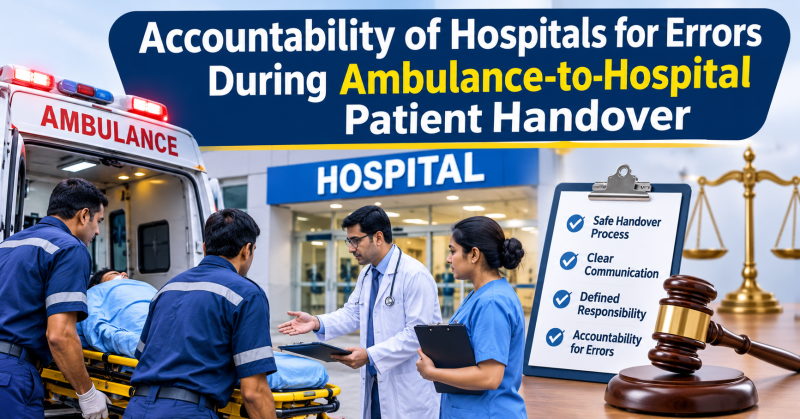
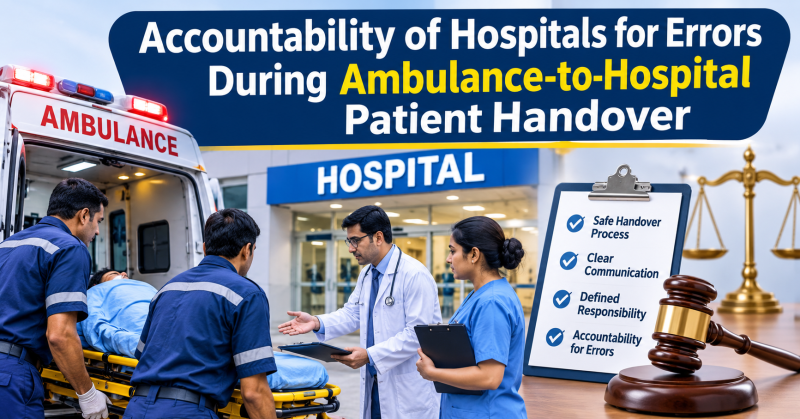
Accountability of Hospitals for Errors During Ambulance-to-Hospital Patient Handover
 Badal
A hospital can be held accountable for errors in ambulance-to-hospital handover once the patient is in its care, and sometimes earlier, depending on who had control and what was communicated. Liability usually turns on a clear transfer of responsibility, accurate documentation, and the standard of care expected of a reasonable professional. This medico legal guide in east Delhi explains where responsibility shifts, which mistakes lead to disputes, and what records protect both patients and clinicians.
Why the Handover Moment Is So Risky
Handover is a short, high-pressure window. A paramedic, a triage nurse and an emergency physician may all be speaking at once while the patient deteriorates. Details such as allergies, drug doses given en route, time of onset of symptoms or a changed Glasgow Coma Scale score can be lost in seconds.
Many complaints later come down to one question: who knew what, and when? That is hard to answer if nothing was written down.
Where Hospital Accountability Arises
Indian law generally judges medical negligence by whether a doctor or institution failed to meet the standard of a reasonably competent professional. For criminal liability, the Supreme Court in Jacob Mathew v. State of Punjab (2005) held that a higher threshold, gross negligence or recklessness, is needed. Civil and consumer claims are assessed differently, and medical services can fall within the Consumer Protection Act, 2019.
In practice, a hospital’s exposure in a handover dispute often depends on:
- Duty to treat: In Parmanand Katara v. Union of India (1989), the Supreme Court stressed the importance of immediate medical aid to injured persons. A hospital that delays emergency care over procedural issues invites scrutiny.
- Institutional responsibility: Hospitals can be answerable for the acts of staff working under them, and also for system failures such as a missing triage protocol or no designated handover process.
- Control of the patient: Responsibility generally rests with the ambulance crew until the patient is formally received. The moment of acceptance should be clear and recorded.
Whether liability actually attaches depends on the facts, so this is general information, not a prediction of any case.
Common Mistakes at Handover
Consider a patient brought in after a road accident with a suspected head injury. The paramedic mentions sedation given en route, but the receiving nurse hears only “unconscious.” The doctor later reads the drowsiness as a neurological decline and orders an unnecessary CT scan, delaying treatment for another injury.
Typical errors include:
- Verbal handover with no written record
- Missing or illegible ambulance run sheets
- Unrecorded arrival time, so the delay cannot be reconstructed
- Failing to note medications, fluids or oxygen given before arrival
- Unclear identity of the receiving clinician
- Skipping the medico-legal case (MLC) entry in accident, assault or poisoning cases
- Not recording consent, or the reason it was not possible, in an emergency
Documentation That Protects Everyone
Good records are the strongest evidence of reasonable care. Under the Indian Medical Council (Professional Conduct, Etiquette and Ethics) Regulations, 2002, registered practitioners are expected to maintain medical records, and indoor patient records are to be kept for a prescribed period. Check the current rules and your hospital policy for exact requirements.
At handover, record at minimum:
- Time of arrival and time of acceptance
- Names and designations of the handing-over and receiving staff
- Vitals, GCS and key findings on arrival
- Pre-hospital interventions and drugs, with doses and times
- Known allergies, comorbidities and history from relatives
- MLC status and police intimation where applicable
- Any deviation from protocol, with the reason
Entries should be contemporaneous, signed, timed and never altered after the fact. Corrections should be made by a dated strike-through, not erasure.
A Practical Handover Checklist
- Confirm patient identity and wristband before accepting.
- Use a structured format such as SBAR (Situation, Background, Assessment, Recommendation) or ATMIST.
- Have the receiving clinician repeat back critical items such as allergies and drug doses.
- Obtain and file the ambulance run sheet.
- Record the exact time responsibility transfers.
- Escalate and document any unresolved concern before the crew leaves.
- Review handover incidents regularly and train staff on the findings.
Hospitals that audit these steps tend to spot weak points before they become complaints. Clinicians who want a deeper look at how handover records are viewed in disputes can consult this medico-legal resource. Practitioners such as Dr. Vimal Kant Goyal, who works in forensic and medico-legal practice, regularly stress that the quality of contemporaneous records often shapes how a case is evaluated.
Conclusion
Handover errors are rarely about one person’s carelessness. They usually reflect missing systems. Clear acceptance of responsibility, structured communication and timely records reduce risk and, more importantly, improve patient safety. For clinicians seeking a reliable medico legal guide in Delhi, the best starting point is to review your own handover protocol this week and fix any gap in documentation. If you need case-specific advice, consult a qualified medico legal expert in Delhi or a healthcare lawyer. This article is for general information and is not legal advice.
Frequently Asked Questions
1. Who is responsible for the patient during ambulance handover?The ambulance crew is generally responsible until the hospital formally accepts the patient. Because disputes arise in the gap, both sides should record the time and the person who accepted.
2. Can a hospital refuse to receive an emergency patient?Hospitals should not delay emergency stabilisation over paperwork or payment, as emphasised in Parmanand Katara. Transfer, if needed, should follow proper stabilisation and documentation.
3. Is a verbal handover legally enough?There is no guarantee a verbal handover will be accepted as proof. A written, signed record is far more reliable.
4. When is a handover error treated as criminal negligence?Under the standard in Jacob Mathew, criminal liability generally requires gross negligence, not a mere error of judgment. Each case is assessed on its facts.
5. What should I do if I think a handover error has occurred?Provide care first, document facts honestly, inform your institution as per its incident process, and seek qualified legal advice before making formal statements.
Source:
Click for the: Full Story
You might like