Close Menu
 World
 Biography
 Health
 Education
 Business
 Lifestyle
 Sports
 Technology
 Animals
 History
 Food
 Religious
 Startups
 Movies
 Politics
 Fashion
 Covid
 Diet
 Fitness
 Marketing
 Travel
 Science
 Reviews
 Social media
 Stories
 Facts
 Art
 Entertainment
Badal

Health
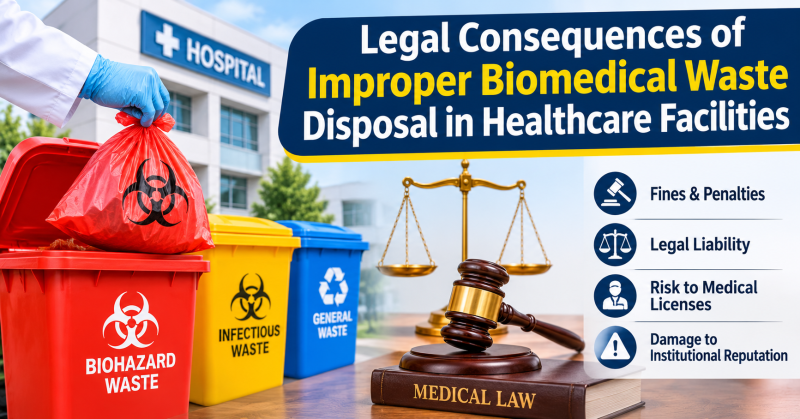
Legal Consequences of Improper Biomedical Waste Disposal in Healthcare Facilities
 Badal
Improper biomedical waste disposal can lead to regulatory action, financial penalties, loss of authorisation and, in serious cases, civil or criminal proceedings against the hospital or clinic. In India, the Bio-Medical Waste Management Rules, 2016 place the primary duty on the “occupier” of the facility. This medico legal guide in east Delhi explains who is responsible, which mistakes cause trouble, and what records help a facility show that it acted responsibly.
Why Biomedical Waste Compliance Is a Legal Issue
The Bio-Medical Waste Management Rules, 2016 (amended in 2018 and 2019) are framed under the Environment (Protection) Act, 1986. They apply to hospitals, nursing homes, clinics, dispensaries, laboratories, blood banks and similar facilities that generate such waste.
The rules require facilities to:
- Segregate waste at the point of generation
- Use the prescribed colour-coded containers and bags
- Hand over waste only to an authorised common treatment facility, or treat it on site with permission
- Hold a valid authorisation from the State Pollution Control Board (in Delhi, the Delhi Pollution Control Committee)
A small clinic is not exempt because it generates little waste. Registration and authorisation requirements still apply.
Common Mistakes That Lead to Violations
Consider a small clinic where a staff member places used syringes with needles into a general waste bin. A sanitation worker is injured while handling it. Beyond the injury, the clinic now faces questions about segregation, training and authorisation.
Typical lapses include:
- Mixing infectious and general waste
- Using the wrong colour bag or non-puncture-proof sharps containers
- Handing waste to an unauthorised collector
- Operating without valid authorisation, or letting it lapse
- Skipping staff training and vaccination for waste handlers
- Failing to maintain waste registers
- Not reporting needle-stick injuries or other accidents
- Missing the annual report to the pollution control authority
Legal Consequences You Should Know
Consequences depend on the facts and on which authority acts, so the following is a general outline rather than a prediction.
- Regulatory action: Pollution control authorities can issue show-cause notices and directions, and can refuse, suspend or cancel authorisation.
- Penalties under environmental law: The Environment (Protection) Act, 1986 provides penalties for contravening rules made under it. The penal provisions have been revised in recent years, so check the current text of the Act before relying on any figure.
- Environmental compensation: The National Green Tribunal and pollution control bodies can direct polluters to pay compensation for environmental damage.
- Civil liability: A person injured by negligent handling, such as a waste worker or patient, may pursue a claim for damages.
- Professional and reputational risk: Inspections, adverse media reports and licensing complications can follow even where no court case results.
Liability generally rests on the facility as occupier. Individual doctors or managers may still be drawn into proceedings depending on their role and conduct.
Documentation That Demonstrates Compliance
If an inspection or complaint arises, records are often the first thing reviewed. Keep, at minimum:
- A valid authorisation certificate and renewal dates
- A daily or periodic waste generation register by category
- Handover records or manifests with the authorised treatment facility
- Staff training logs and vaccination records for waste handlers
- Accident and needle-stick injury reports with the action taken
- The annual report filed with the pollution control authority
- Internal audit notes and corrective action records
Under the 2016 Rules, facilities are also expected to follow a barcoding or tracking system for waste containers where applicable. Confirm current requirements with the regulator, as rules and timelines are updated from time to time.
A Practical Compliance Checklist
- Confirm your authorisation is valid and displayed.
- Place correctly coloured bins at every point where waste is generated.
- Use puncture-proof, leak-proof containers for sharps.
- Train all clinical, housekeeping and support staff at regular intervals, and document it.
- Contract only with an authorised treatment facility and keep its credentials on file.
- Weigh or record waste consistently and reconcile it with handover records.
- Report accidents promptly and record the corrective action.
- File required annual reports before the deadline.
- Review compliance internally every quarter.
Clinicians who want to understand how compliance records are viewed in disputes can read this medico-legal resource. Medico-legal practitioners such as Dr. Vimal Kant Goyal often point out that a facility’s day-to-day paperwork frequently matters as much as its intentions when an incident is examined.
Conclusion
Biomedical waste compliance protects patients, staff, sanitation workers and the facility itself. Most violations come from weak systems: unclear segregation, untrained staff, lapsed authorisation and missing records. This week, check your authorisation validity, audit your bins and registers, and fix any documentation gaps. For clinicians looking for a reliable medico legal expert guide in Delhi, a documented and regularly reviewed compliance process is the strongest starting point. This article is for general information and is not legal advice.
Frequently Asked Questions
1. Who is legally responsible for biomedical waste in a hospital?The “occupier”, meaning the person or institution in charge of the facility, carries the main responsibility under the 2016 Rules. Staff are expected to follow the segregation and handling protocols.
2. Do small clinics and single-doctor practices need authorisation?Generally, yes. Facilities that generate biomedical waste are covered by the Rules, regardless of size. Check requirements with the relevant pollution control authority.
3. Can the hospital be penalised even if a contractor mishandles the waste?Possibly. Using an authorised facility and keeping proper handover records helps show diligence, but responsibility depends on the facts of each case.
4. What should I do after a needle-stick or waste-related injury?Provide immediate care, follow your post-exposure protocol, record the incident and report it as required. Document the steps taken.
5. Where can I get case-specific advice?A qualified medico legal expert in Delhi or an environmental law practitioner can review your facts and records.
Source:
Click for the: Full Story
You might like