Close Menu
 World
World
 Biography
 Health
 Education
 Business
 Lifestyle
 Sports
 Technology
 Animals
 History
 Food
Food
 Religious
 Startups
 Movies
 Politics
 Fashion
 Covid
Covid
 Diet
Diet
 Fitness
 Marketing
 Travel
 Science
 Reviews
 Social media
 Stories
 Facts
Facts
 Art
Art
 Entertainment
Codezeros

Technology
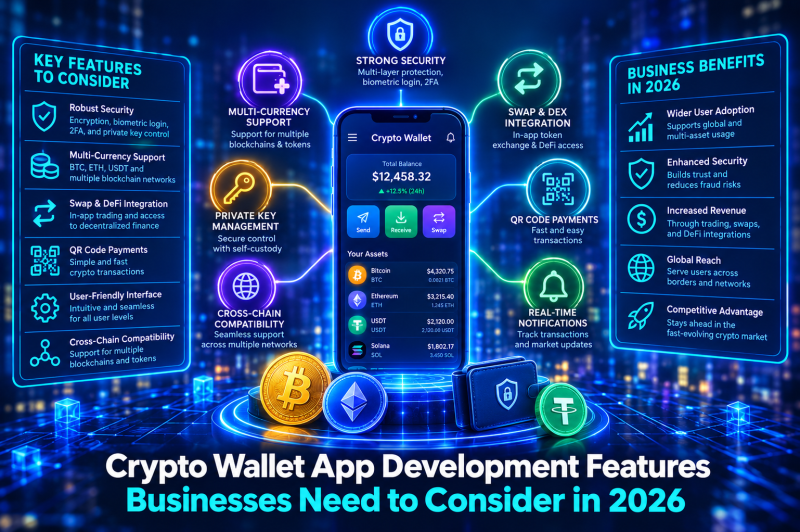
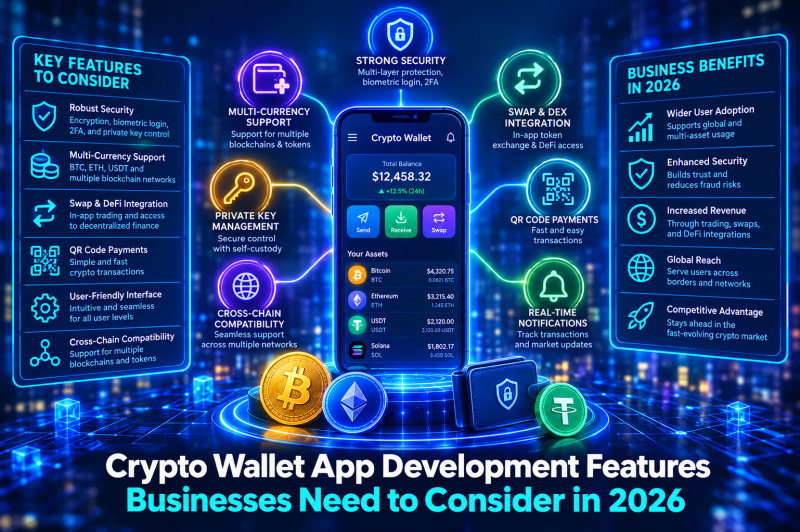
Crypto Wallet App Development Features Businesses Need to Consider in 2026
 Codezeros
Crypto wallets are becoming more than digital tools for storing and transferring assets. As Web3 adoption expands, businesses are building wallet applications that support token management, decentralized applications, staking, swaps, identity functions, cross-chain transactions, and other blockchain-based services.
In 2026, successful Crypto Wallet App Development requires careful attention to security, user experience, interoperability, automation, and evolving regulatory expectations. Businesses need wallet architecture that can support today's users while remaining adaptable as blockchain ecosystems and digital asset use cases continue to develop.
What Is Crypto Wallet App Development?
Crypto wallet app development involves designing and building software that allows users to manage blockchain-based assets and interact with decentralized networks.
Depending on the business model, a wallet can be:
- Non-custodial or custodial
- Mobile, web, or desktop based
- Single-chain or multi-chain
- Individual or enterprise focused
- DeFi-oriented or general-purpose
Modern wallets may support cryptocurrency transfers, token swaps, NFT management, staking, dApp connections, transaction history, blockchain networks, and security controls.
The appropriate architecture depends on the target audience, supported assets, required custody model, regulatory environment, and intended Web3 functionality.
Key Crypto Wallet Features Businesses Should Consider in 2026
1. Multi-Chain Asset Support
Users increasingly interact with multiple blockchain ecosystems rather than relying on a single network. A wallet that supports multiple chains can provide access to a broader range of assets and decentralized applications.
Businesses should evaluate support for relevant networks, token standards, transaction formats, network fees, and chain-specific security requirements.
Multi-chain architecture should be planned from the beginning rather than added through disconnected integrations later.
2. Strong Key and Account Security
Security remains one of the most important considerations in wallet development because private keys and signing credentials control access to digital assets.
Depending on the wallet model, businesses may consider:
- Multi-factor authentication
- Biometric authentication
- Hardware wallet integration
- Secure key storage
- Multi-signature accounts
- Transaction confirmation controls
- Session management
- Device security monitoring
For custodial products, additional controls around key management, access permissions, transaction approval, and operational security may be required.
3. Simple Transaction Experience
Blockchain transactions can be technically complex for new users. A well-designed wallet should present important information clearly before a transaction is signed.
Useful interface elements can include:
- Network and asset identification
- Estimated transaction fees
- Recipient verification
- Transaction status
- Confirmation messages
- Address management
- Human-readable transaction summaries
The objective is not to hide blockchain complexity but to present it in a way that users can understand.
4. dApp and DeFi Connectivity
A modern wallet may function as a gateway to decentralized applications. WalletConnect-style integrations, dApp browsers, smart contract interactions, DeFi protocols, and NFT marketplaces can expand wallet functionality.
However, every external interaction introduces additional security considerations. Wallet applications should clearly communicate what users are signing and which permissions are being granted.
5. Built-In Swaps and Asset Management
Many users prefer managing multiple activities within one wallet rather than moving assets between separate platforms.
Wallet App Development solutions may therefore include:
- Token swaps
- Portfolio tracking
- Asset balances
- Transaction history
- Price information
- Token discovery
- DeFi integrations
Businesses should evaluate whether these functions should be built directly into the application or connected through external infrastructure.
AI, Automation, and Wallet Trends in 2026
AI-Powered Wallet Assistance
AI can make wallet interfaces easier to navigate by helping users understand transaction details, portfolio information, network fees, and blockchain terminology.
AI-assisted systems can also organize transaction data and provide contextual explanations without directly controlling user funds.
Automated Transaction Workflows
Automation can support predefined workflows such as recurring payments, portfolio notifications, transaction monitoring, and operational reporting.
Any automated transaction functionality should use clear authorization rules and appropriate limits.
Agentic AI for Web3 Wallets
Agentic AI is becoming an important area of Web3 experimentation. AI agents can perform defined multi-step tasks, such as monitoring blockchain events, identifying relevant transactions, organizing portfolio information, or preparing actions for user approval.
For wallets, financial authority should remain tightly controlled. Agent-based systems should operate with restricted permissions and explicit user authorization where asset movement or transaction signing is involved.
Enterprise Wallet Adoption
Businesses are increasingly exploring digital assets for treasury operations, payments, tokenized assets, and blockchain applications. Enterprise wallets may therefore require role-based access, multi-signature approvals, transaction policies, audit trails, reporting, and integration with existing business systems.
Enterprise requirements can differ significantly from consumer wallet applications, making architecture and access-control planning particularly important.
How to Choose a Wallet Development Company
Choosing a Wallet Development Company requires evaluating both technical capabilities and the provider's understanding of digital asset infrastructure.
Important evaluation factors include:
- Security architecture: How are keys, accounts, authentication, and transactions protected?
- Blockchain support: Can the wallet support the networks and token standards required?
- Custody model: Does the architecture support custodial, non-custodial, or hybrid requirements?
- Integration capabilities: Can it connect with exchanges, DeFi protocols, dApps, and payment systems?
- Scalability: Can the platform support growing users and transaction volumes?
- User experience: Can complex blockchain operations be presented clearly?
- Maintenance: Is there a plan for upgrades, security monitoring, and blockchain changes?
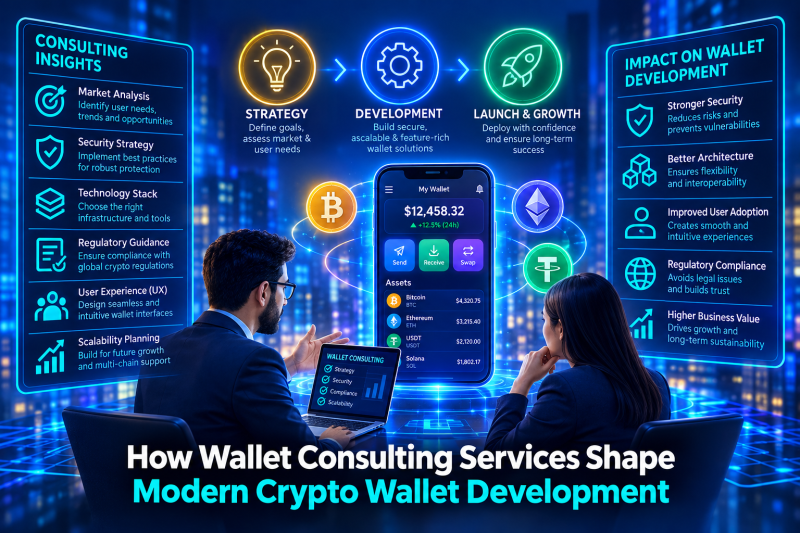
A Wallet Consulting Service can also be useful during the planning stage when businesses need to determine the appropriate architecture, custody approach, supported networks, and feature priorities before development begins.
FAQ’s
1. What features should a crypto wallet have in 2026?
Important features can include multi-chain support, strong authentication, secure key management, transaction monitoring, dApp connectivity, token swaps, portfolio tracking, and clear transaction information.
2. What is the difference between custodial and non-custodial wallets?
A custodial wallet generally involves a third party managing private keys or asset access, while a non-custodial wallet gives users direct control over their keys and transaction signing.
3. Can AI be integrated into crypto wallets?
Yes. AI can support transaction explanations, portfolio organization, blockchain analytics, monitoring, notifications, and other user-assistance functions. Financial actions should remain subject to appropriate authorization controls.
4. Why is multi-chain support important?
Multi-chain support allows users to manage assets and interact with applications across multiple blockchain networks from a single wallet environment.
5. How should businesses choose wallet development services?
Businesses should assess security, blockchain expertise, custody architecture, integrations, scalability, user experience, compliance requirements, and long-term technical support.
Conclusion
Crypto wallet applications are evolving into broader Web3 access platforms. In 2026, businesses should look beyond basic asset storage and consider security architecture, multi-chain support, dApp connectivity, transaction clarity, automation, AI-assisted functionality, and enterprise access controls.
The right Wallet Development Services should align these features with the wallet's intended users, custody model, supported blockchain networks, and long-term business objectives. Codezeros can be considered when evaluating broader cryptocurrency wallet architecture and development requirements.
For project-specific wallet requirements and technical discussions, contact us today.
Source:
Click for the: Full Story
You might like