Close Menu
 World
World
 Biography
 Health
 Education
 Business
 Lifestyle
 Sports
 Technology
 Animals
 History
 Food
Food
 Religious
 Startups
 Movies
 Politics
 Fashion
 Covid
Covid
 Diet
Diet
 Fitness
 Marketing
 Travel
 Science
 Reviews
 Social media
 Stories
 Facts
Facts
 Art
Art
 Entertainment
Codezeros

Technology
Why RWA Tokenization Is Gaining Momentum Across Enterprise Finance Markets
 Codezeros
Real-world asset tokenization is moving from a niche blockchain concept toward a broader enterprise finance strategy. Businesses and financial institutions are exploring how blockchain can represent real estate, private credit, investment funds, bonds, commodities, and other assets as digital tokens.
The growing interest is not only about creating tokens. Enterprises are looking at how tokenization can improve asset administration, create new investment structures, automate selected processes, and connect traditional financial infrastructure with digital asset networks.
As blockchain technology matures in 2026, RWA tokenization is gaining attention because it can combine programmable financial infrastructure with established asset markets.
What Is Driving Enterprise Interest in RWA Tokenization?
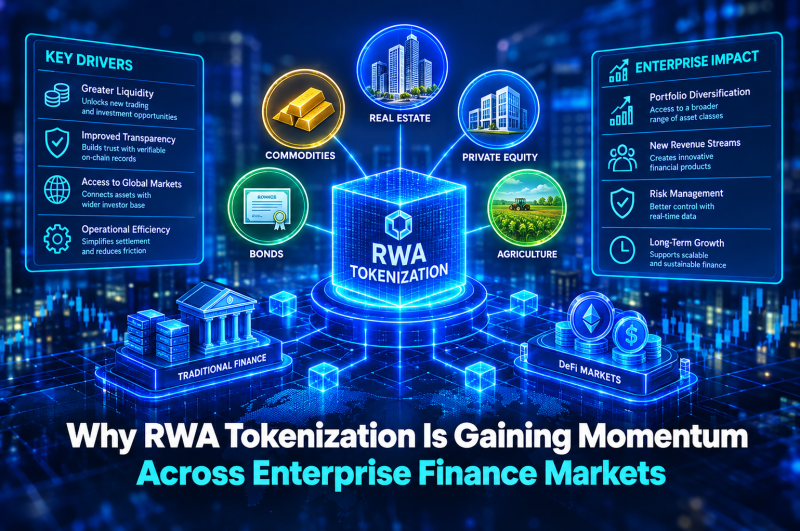
RWA tokenization allows eligible real-world assets or their economic rights to be represented through blockchain-based tokens. Depending on the legal structure, these tokens may represent ownership interests, claims on cash flows, fund units, debt instruments, or other defined rights.
Several factors are contributing to enterprise adoption.
1. Demand for More Efficient Asset Infrastructure
Traditional asset administration can involve multiple intermediaries, manual documentation, reconciliation, settlement processes, and fragmented records.
Blockchain-based infrastructure can provide a shared transaction layer where appropriate. Smart contracts can also automate predefined rules for transfers, distributions, and other activities.
The objective is not necessarily to replace existing financial systems. Instead, tokenization can complement them by introducing programmable digital infrastructure.
2. Growing Interest in Fractional Investment Models
Some assets require substantial capital commitments, making participation difficult for smaller investors or specialized investment groups.
A properly structured RWA tokenization solution can divide eligible economic interests into smaller digital units. This can support new investment models while maintaining the legal and compliance requirements associated with the underlying asset.
Real estate, private funds, infrastructure, and alternative investments are among the areas where this model is receiving attention.
3. Better Digital Recordkeeping
Tokenized asset platforms can provide transparent transaction records and programmable ownership or transfer rules.
However, blockchain records alone do not establish legal ownership. Enterprises still need appropriate legal agreements, asset custody, identity verification, and off-chain documentation that connect the digital representation with the underlying asset.
How RWA Tokenization Supports Enterprise Finance
Enterprise applications are extending beyond simple asset issuance.
Real Estate
Tokenization can support fractional investment structures, digital ownership records, controlled transfers, and automated distribution workflows for eligible property-related assets.
Investment Funds
Funds can explore tokenized representations of fund interests, potentially supporting digital subscriptions, investor records, transfer restrictions, and automated administrative processes.
Private Credit
Tokenization can represent defined interests in private credit arrangements and provide infrastructure for tracking ownership, payments, and transfers under appropriate legal structures.
Bonds and Fixed-Income Assets
Tokenized bonds can use smart contracts for selected issuance, settlement, coupon, and maturity processes. This can create more programmable workflows while still requiring established financial and regulatory controls.
The Role of RWA Tokenization Development Services
Building an enterprise-grade tokenization platform requires more than deploying a smart contract. Businesses need to connect blockchain infrastructure with legal, financial, compliance, custody, and operational requirements.
Professional RWA Tokenization Development Services may include:
- Asset and token architecture
- Smart contract development
- Token issuance infrastructure
- Investor onboarding
- KYC and AML integrations
- Wallet and custody integration
- Compliance-based transfer controls
- Portfolio management dashboards
- Payment and banking integrations
- APIs and enterprise system connectivity
- Security testing and contract audits
The right architecture depends on the asset class, target investors, jurisdiction, custody model, and business objectives.
2026 Trends Accelerating RWA Tokenization
AI-Powered Asset Intelligence
AI is becoming increasingly useful for analyzing large volumes of asset and transaction data. Tokenization platforms can use AI-assisted analytics to monitor portfolios, identify patterns, summarize financial information, and support investment research.
AI should support decision-making rather than operate without appropriate financial controls.
Automation of Financial Workflows
Automation is another major development in 2026. Investor onboarding, document processing, compliance screening, reporting, distribution calculations, and transaction monitoring can potentially be connected through automated workflows.
This can reduce repetitive administrative work while maintaining human review where regulations or risk levels require it.
Agentic AI for Asset Operations
Agentic AI introduces the possibility of AI systems carrying out multi-step tasks based on predefined objectives and permissions.
Within RWA platforms, potential applications include monitoring asset performance, preparing reports, identifying exceptions, and initiating approved operational workflows.
Because tokenized assets can represent financial value, agent permissions need to be limited, monitored, and auditable.
Enterprise and Institutional Adoption
The conversation around tokenization is increasingly shifting toward enterprise infrastructure. Financial institutions, asset managers, real estate organizations, and technology companies are evaluating how tokenized assets can fit into existing investment and operational systems.
Interoperability with traditional databases, payment systems, custody infrastructure, identity platforms, and compliance tools will therefore become increasingly important.
How to Choose an RWA Tokenization Development Company
Selecting an RWA Tokenization Development Company should involve a broader evaluation than blockchain programming expertise.
Businesses should assess whether a development partner understands:
- Asset structure: Can the technology accurately represent the underlying economic rights?
- Compliance: Can investor eligibility and transfer restrictions be incorporated?
- Security: Are smart contracts tested and independently audited?
- Interoperability: Can the platform connect with existing enterprise systems?
- Scalability: Can additional assets, investors, and networks be added?
- User experience: Can non-technical users manage tokenized assets efficiently?
- Long-term maintenance: Is there a clear strategy for upgrades, monitoring, and support?
Businesses exploring these requirements can review the capabilities of Codezeros when comparing blockchain development approaches for tokenized asset platforms.
FAQ’s
1. Why is RWA tokenization gaining popularity in 2026?
RWA tokenization is gaining attention because enterprises are exploring more programmable asset infrastructure, fractional investment models, digital settlement, automated workflows, and connections between traditional finance and blockchain networks.
2. What assets can be tokenized?
Potential assets include real estate, investment funds, private credit, bonds, commodities, infrastructure, and other assets where the legal and regulatory framework supports digital representation.
3. How does tokenization benefit enterprises?
Potential benefits include improved digital recordkeeping, automated workflows, programmable transaction rules, broader access to eligible investment structures, and integration with digital asset infrastructure.
4. What do RWA tokenization developers build?
RWA tokenization developers can build smart contracts, token issuance platforms, investor portals, wallet integrations, compliance systems, asset dashboards, APIs, and blockchain infrastructure.
Source:
Click for the: Full Story
You might like