Close Menu
 World
 Biography
 Health
 Education
 Business
 Lifestyle
 Sports
 Technology
 Animals
 History
 Food
 Religious
 Startups
 Movies
 Politics
 Fashion
 Covid
 Diet
 Fitness
 Marketing
 Travel
 Science
 Reviews
 Social media
 Stories
 Facts
 Art
 Entertainment
Deepak

Health
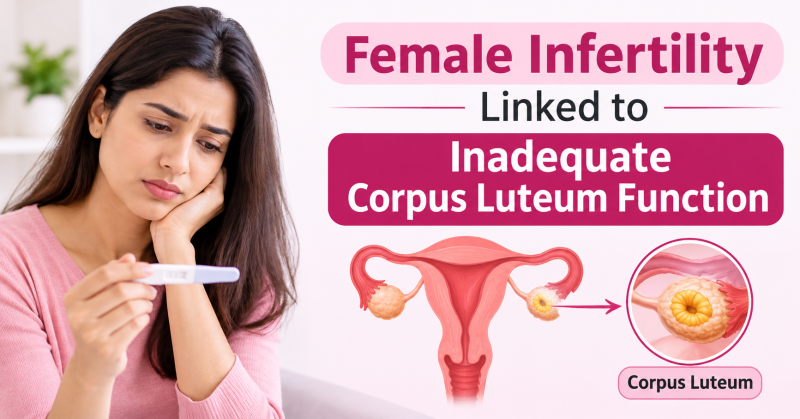
Female Infertility Linked to Inadequate Corpus Luteum Function
 Deepak
Many women who ovulate regularly still find that pregnancy does not happen. One reason can lie in what happens after the egg is released. If you are looking for the best female infertility in Delhi, understanding this phase of the cycle can help you ask better questions and recognise what a thorough evaluation should look at.
What Is the Corpus Luteum?
After ovulation, the follicle that released the egg turns into a small, temporary gland called the corpus luteum. Its main job is to make progesterone, a hormone that:
- Thickens and stabilises the uterine lining
- Makes the lining receptive to an embryo
- Supports an early pregnancy until the placenta takes over
When the corpus luteum does not produce enough progesterone, or stops working too early, the lining may not be ready to support implantation. This is commonly described as inadequate luteal function or a luteal phase defect.
How It Can Affect Fertility
Weak luteal function may be linked to:
- Difficulty with embryo implantation
- Very early pregnancy loss
- Recurrent miscarriage in some women
It is important to be balanced here. Doctors still debate how often luteal phase defect is an independent cause of infertility. It is often a sign of another issue rather than a standalone diagnosis, which is why careful assessment matters more than a quick label.
Possible Underlying Causes
Inadequate corpus luteum function usually has a reason behind it. Factors that may contribute include:
- Poor follicle development in the first half of the cycle
- Thyroid disorders
- High prolactin levels
- Polycystic ovary syndrome (PCOS)
- Reduced ovarian reserve or approaching perimenopause
- Significant stress, very low body weight or intense exercise
- Endometriosis
Because these factors overlap, evaluation of female infertility in Delhi, or anywhere else, works best when the whole hormonal picture is considered rather than progesterone alone.
Signs That May Point to a Luteal Phase Problem
Symptoms can be subtle and are not specific. Some women notice:
- Shorter menstrual cycles
- Spotting for several days before the period
- A short gap between ovulation and the next period
- Repeated early pregnancy losses
- Difficulty conceiving despite apparently regular periods
These signs do not confirm the condition on their own, and many women with them have a normal luteal phase. Please avoid self-diagnosis or starting hormones without medical advice.
How Is It Evaluated?
A gynaecologist may recommend a combination of:
- Cycle history and ovulation tracking to understand timing and regularity
- A mid-luteal progesterone blood test, taken in the second half of the cycle
- Thyroid and prolactin tests, and other hormone tests when needed
- Pelvic ultrasound to assess follicle growth and the uterine lining
- Assessment of the fallopian tubes and uterus if conception has taken long
Endometrial biopsy was once used to assess the lining, but it is no longer considered a routine test for this purpose.
Treatment Approaches
Treatment is individualised and depends on the cause, age, and how long a couple has been trying.
- Treating the underlying condition: correcting thyroid or prolactin imbalance may help restore normal luteal function.
- Ovulation induction: certain medicines may improve follicle development, which in turn influences the corpus luteum.
- Progesterone support: given as vaginal preparations, tablets or injections after ovulation or after embryo transfer, when a doctor considers it appropriate.
- Lifestyle support: balanced nutrition, healthy weight, good sleep and stress management support hormonal health.
- Assisted reproduction: IUI or IVF may be discussed when other fertility factors are present.
Outcomes vary from person to person, and no treatment can guarantee pregnancy.
What to Look for When Choosing Care
Rather than relying on reputation alone, look for care that is careful and transparent. A good evaluation should:
- Review the full history of both partners where relevant
- Explain why each test or medicine is recommended
- Avoid starting treatment without a clear reason
- Discuss realistic expectations in plain language
An experienced infertility specialist in Delhi will usually begin with targeted, simple investigations before moving to more advanced options. Dr. Poonam Goyal, a gynaecologist and fertility specialist, follows this kind of stepwise approach, focusing on identifying the cause before planning treatment.
When to Seek Medical Advice
Consider consulting a gynaecologist or fertility specialist if:
- You have been trying for 12 months (or 6 months if you are 35 or older)
- You have had two or more early pregnancy losses
- Your cycles are irregular, very short or accompanied by pre-period spotting
- You have PCOS, thyroid disease or endometriosis
Bringing your cycle records and previous reports to the appointment can make the consultation more useful.
If you want consultation regarding female infertility, you can visit Dr Poonam Goyal at:
- C-3/63A, 64A, opp. Gokulpuri police station, Block C, Panchsheel Hospital, Yamuna Vihar, Shahdara, Delhi, 110053
- HOD IVF & Infertility, Max Superspeciality Hospital, Vaishali
Conclusion
Inadequate corpus luteum function is one possible, and often treatable, factor in female infertility, but it is rarely the whole story. A careful evaluation that looks for the underlying cause usually leads to a clearer plan than treating a single hormone level. Whether you are comparing options for the best female infertility care in Delhi or simply looking for answers after months of trying, choose a clinician who listens, explains and personalises your care.
Frequently Asked Questions
1. What is inadequate corpus luteum function?
It means the corpus luteum, the gland formed after ovulation, does not produce enough progesterone or does not function long enough to support the uterine lining for implantation.
2. Can I get pregnant if I have a luteal phase problem?
Many women conceive once the underlying cause is addressed and, where appropriate, progesterone support is given. Results vary, and a doctor can advise on your individual situation.
3. Is a luteal phase defect the same as low progesterone?
They are related but not identical. Low progesterone is one marker, while the condition also depends on how well the uterine lining responds to the hormone.
4. Does it always cause miscarriage?
No. It may contribute to early pregnancy loss in some women, but miscarriage has many other possible causes, so a full evaluation is important.
5. When should I consult a fertility specialist?
After 12 months of trying (6 months if you are 35 or older), or sooner if you have irregular cycles, repeated early losses, or conditions such as PCOS, thyroid disease or endometriosis.
Source:
Click for the: Full Story
You might like