Close Menu
 World
World
 Biography
 Health
 Education
 Business
 Lifestyle
 Sports
 Technology
 Animals
 History
 Food
Food
 Religious
 Startups
 Movies
 Politics
 Fashion
 Covid
Covid
 Diet
Diet
 Fitness
 Marketing
 Travel
 Science
 Reviews
 Social media
 Stories
 Facts
Facts
 Art
Art
 Entertainment
Badal

Health
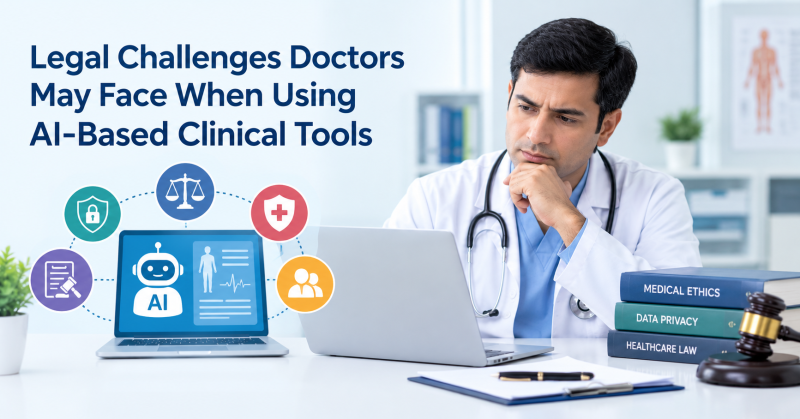
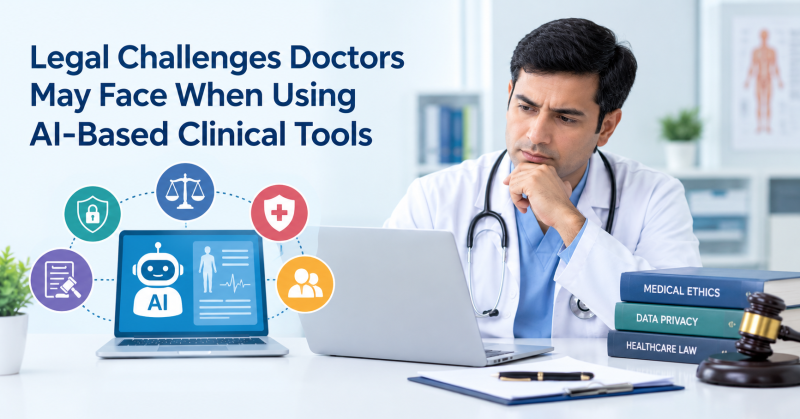
Legal Challenges Doctors May Face When Using AI-Based Clinical Tools
 Badal
Badal
AI-based clinical tools can flag abnormal scans, suggest diagnoses, draft notes and predict deterioration, but they do not take over the doctor’s professional duty. The short answer to the main legal question is this: the clinician who relies on an AI output remains responsible for the clinical decision, so treat the tool as decision support, check its output against your own judgement, and document how you used it. Medico legal help for medical professionals in Delhi is increasingly sought on this issue, because the technology is moving faster than formal guidance.
Many doctors are unsure what to disclose to patients, what to record and who is accountable if a tool gets it wrong. Medico legal advice for doctors in Delhi on this topic usually begins with the same point: a tool may assist, but it does not share your registration or replace your reasoning.
This article is general information, not legal advice. Laws, regulatory guidance and institutional policies on AI in healthcare are evolving, so confirm the current position with the National Medical Commission (NMC), your state medical council, the relevant regulators and a qualified lawyer.
Where AI Tools Create Medico-Legal Risk
AI tools appear in many places: radiology and pathology support, triage software, clinical decision support in electronic records, transcription and note-drafting tools, and patient-facing symptom checkers. Each can introduce risk.
Medical negligence is generally assessed by asking whether a duty of care existed, whether care fell below an accepted professional standard, and whether harm resulted. These questions apply whether a decision was made with or without software. Risk tends to arise when:
- A doctor accepts an output without critical review.
- A doctor ignores a tool’s alert without recording why.
- A tool is used outside its intended purpose or patient group.
- Errors in AI-drafted notes enter the record unchecked.
- Patient data is entered into tools that are not secure.
How responsibility is shared between a doctor, a hospital and a software provider depends on the facts, the contract and the law. Do not assume that liability can be passed to the vendor.
Medico Legal Help for Medical Professionals in Delhi: Questions to Ask Before Using a Tool
Before relying on an AI tool in practice, it helps to ask basic questions, ideally with your hospital’s governance team and, where needed, a medico-legal adviser.
- Purpose: What is the tool designed to do, and for which patients and settings?
- Evidence: What validation or performance information does the provider give, and is it relevant to your patient population?
- Approval and policy: Has the institution approved the tool, and is there a written policy on its use?
- Role: Is the output advisory, or does it trigger automatic actions?
- Contract: What do the vendor terms say about liability, data use and support?
- Insurance: Does your professional indemnity cover decisions made with such tools? Check with your insurer.
- Training: Have you and your team been trained, and do you know the tool’s limits?
Check current regulatory guidance directly rather than relying on summaries. Where rules are unclear, say so in your records and policies, and revisit them as guidance develops.
Informed Consent and Patient Communication
Whether and how to tell patients that an AI tool contributed to their care depends on the tool, its role and applicable rules, so take advice and follow institutional policy. As a matter of good practice, patients should not be misled about how decisions are made, and informed consent should reflect material information about their care.
Consider explaining, in plain language:
- That software may support the assessment, and that you remain responsible for decisions.
- Any significant limitations that matter to the patient’s choices.
- How their data will be used and stored.
- That they may ask questions or seek a second opinion.
Protect patient information with reference to the Digital Personal Data Protection Act, 2023, and check how it applies before entering identifiable data into any external tool. Avoid pasting patient details into general-purpose public AI chat tools.
For online consultations, record identity checks, consent, history, advice and follow-up as usual, with prescribing consistent with the Telemedicine Practice Guidelines of 2020. Read the current text directly rather than relying on summaries.
Documentation That Shows Your Reasoning
If a complaint or legal notice arrives, your notes are often the best evidence of how you used the tool. Aim to record:
- That a tool was used, its name or type, and its output in summary.
- Your own findings and clinical reasoning.
- Whether you agreed with the output, and why or why not.
- Any decision to override or disregard an alert, with reasons.
- Additional checks you performed, such as a second review or further tests.
- What the patient was told, and their questions and choices.
- Technical problems or unexpected behaviour, and how they were reported.
Entries should be dated, timed and signed with your name and registration number. If an AI tool drafts a note, read it carefully before signing, since you own the final record. Correct errors by dated addendum and never alter or back-date entries.
A realistic example: A radiology support tool marks a chest image as low risk. The doctor, who has noted persistent symptoms, orders a further review and records the reasoning. The later finding confirms an abnormality. The notes show the tool was one input, not the decision. Compare a doctor who accepts “low risk” without recording any assessment. If harm follows, there is little to show independent judgement was exercised.
Governance, Safety and Reporting
Doctors are not the only parties involved. Clinics and hospitals carry responsibility for how tools are selected and monitored. Good clinical governance and risk management include:
- A named person or committee responsible for approving and reviewing tools.
- Clear written guidance on permitted uses and limits.
- Staff training and periodic refreshers.
- A route to report errors, near-misses and unexpected results, in line with patient safety processes.
- Regular review of how the tool performs in your own setting.
- Agreement on who may switch tools on or off, and how changes are recorded.
If you notice a pattern of errors, report it through the institution’s incident process and keep a copy of your report.
Mistakes to avoid
- Treating AI output as a final answer.
- Overriding an alert without noting why.
- Using a tool outside its intended purpose.
- Entering identifiable patient data into insecure or unapproved tools.
- Signing AI-drafted notes without checking them.
- Assuming the vendor carries all responsibility.
- Seeking advice only after a complaint arrives.
Quick checklist
- Tool approved and its purpose understood
- Insurance position checked
- Output reviewed against clinical judgement
- Reasoning and overrides recorded
- Patient informed as policy requires
- Data protected
- Errors reported
When to Seek Professional Medico-Legal Guidance
Consider advice when your hospital asks you to adopt a new tool, when a vendor contract includes liability or data clauses you do not fully understand, when an adverse outcome involves an AI output, or when a complaint or legal notice arrives. Medico legal support in Delhi can help you assess contract terms, shape documentation practices and respond to complaints. If a notice arrives, do not ignore it, do not alter records, preserve all documents including tool outputs and logs, inform your insurer and seek guidance before replying.
Conclusion
AI tools can support good care, but they do not change who is accountable. Understand what each tool does, check outputs against your own judgement, record your reasoning, protect patient data and report problems early. Seeking medico legal help for medical professionals in Delhi when contracts, policies or complaints raise doubts can help you act with clarity, while clear documentation and patient-centred communication remain your strongest foundation.
Frequently Asked Questions
1. Am I responsible if an AI tool gives a wrong suggestion?Generally, the treating doctor remains accountable for clinical decisions. How responsibility is shared with the hospital or vendor depends on the facts and contracts, so avoid assuming it can be transferred.
2. Do I have to tell patients I used an AI tool?It depends on the tool, its role and applicable rules and policies. Take advice and follow institutional guidance, and avoid misleading patients about how decisions are made.
3. Should I record when I disagree with an AI output?Yes. A short note of your reasoning and any extra checks you made helps show independent clinical judgement.
4. Can I use public AI chat tools for patient notes?Be cautious. Entering identifiable patient information into unapproved or insecure tools raises confidentiality and data protection concerns. Follow institutional policy and take advice.
5. Where can I find medico legal support in Delhi for AI-related concerns?Look for a qualified professional with relevant medico-legal experience, verify credentials directly and ask what the advice will cover. Avoid anyone who guarantees outcomes.
Source:
Click for the: Full Story
You might like