Close Menu
 World
 Biography
 Health
 Education
 Business
 Lifestyle
 Sports
 Technology
 Animals
 History
 Food
 Religious
 Startups
 Movies
 Politics
 Fashion
 Covid
 Diet
 Fitness
 Marketing
 Travel
 Science
 Reviews
 Social media
 Stories
 Facts
 Art
 Entertainment
Badal

Health
Medico-Legal Responsibilities of Doctors Managing High Patient Loads in East Delhi Clinics
 Badal
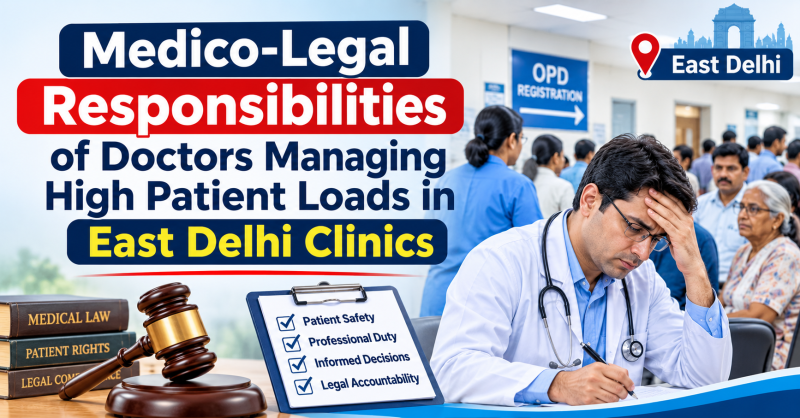
A crowded waiting room does not lower the legal standard of care. Courts, consumer commissions and medical councils ask what a reasonably competent doctor would have done in the circumstances, not how many patients were queued outside. Any medico legal guide in east Delhi has to start there. Doctors in busy neighbourhood clinics rarely face trouble because of one dramatic error. More often, trouble comes from thin records, rushed consent, and missed follow-up, weaknesses a high patient load tends to create.
Why Patient Volume Creates Medico-Legal Risk
Volume rarely causes negligence directly. It erodes the habits that prove good care. When a doctor sees patients in three-minute slots, the history is shortened, the examination is not written down, and advice given verbally never reaches the file.
Later, if the outcome is poor, the clinic has only a prescription slip. The doctor may have acted correctly, but without a record there is little to show it.
The Standard Courts and Councils Apply
Three separate routes exist, and they should not be confused.
Civil and consumer claims
Patients can seek compensation through civil courts or consumer commissions under the Consumer Protection Act, 2019. The question is whether care fell below the accepted standard and caused harm.
Criminal liability
The Supreme Court in Jacob Mathew v. State of Punjab (2005) held that criminal prosecution of a doctor requires gross negligence or recklessness, not a mere error of judgment. Under the Bharatiya Nyaya Sanhita, 2023, Section 106(1) provides a reduced maximum punishment for registered medical practitioners in cases of death caused by negligence during medical procedures. A complaint is not a conviction, and most disputes never reach this stage.
Professional discipline
A complaint against a registered doctor in Delhi can go to the Delhi Medical Council, which looks at professional conduct rather than compensation. Conduct standards have been set by the NMC's framework, which replaced the Indian Medical Council's regulations. The 2002 conduct regulations remained the reference point for years, and the 2023 NMC regulations were put in abeyance soon after notification. Doctors should check the version currently in force before relying on any clause.
Documentation That Survives a Busy Day
Under the 2002 conduct regulations, doctors are expected to maintain indoor patient records for three years and to provide records on request within 72 hours. Outpatient record rules are less uniform, so keeping outpatient notes for a similar period is sensible practice rather than a universal statutory rule. This is a professional recommendation, not a legal guarantee.
Fast documentation does not mean long documentation. A workable minimum for each visit is:
- Presenting complaint, relevant history and allergies
- Key findings, including important negatives such as "no chest pain"
- Working diagnosis and medicines with dose and duration
- Red-flag advice given, and when the patient should return
Dr. Vimal Kant Goyal's work on medico-legal awareness for doctors is a useful reminder that records written at the time of care are far more persuasive than explanations constructed afterwards. Doctors who want to see how such issues are framed for practitioners can read this medico-legal resource for Delhi doctors.
Registration rules also differ by establishment. The Clinical Establishments Act, 2010 applies only in states that have adopted it, and Delhi has historically relied on its own nursing home registration framework. A small clinic and a registered nursing home do not carry identical obligations, so confirm which applies to you.
Consent and Communication in Short Consultations
Consent is not only for surgery. Prescribing a drug with serious side effects, advising an invasive investigation or deferring a referral all involve a decision the patient should understand.
In a short consultation, a practical approach is to explain the main risk and the alternative in plain language, then record one line: "Risks of X explained; patient agreed." For procedures, written consent signed by the patient or a legally authorised person is the safer course.
Language matters in East Delhi's mixed community. If the patient or family speaks Hindi, Bengali or another language, consent given in English is weak evidence of understanding. Explain in the patient's language and note that you did.
Patient data is another growing area. The Digital Personal Data Protection Act, 2023 and its rules are being phased in, so clinics that keep digital records or share reports over messaging apps should review how consent and storage are handled.
A Realistic Scenario
This is a hypothetical illustration, not a reported case.
A clinic sees about 90 patients a day. A man in his fifties comes with indigestion and is given an antacid after a short consultation. No ECG is done, and the note reads only "acidity." He returns two days later with a cardiac event at another hospital. His family complains that the doctor missed a heart problem.
The concern is not that the first diagnosis was necessarily wrong. Acidity is a common and reasonable first impression. The gap is that there is no record of what was asked, no mention of risk factors and no advice to return if pain spread to the arm or jaw.
What a doctor should do differently
- Ask and note cardiac risk factors for any middle-aged patient with upper abdominal pain
- Record the red-flag advice given
- Refer or investigate where doubt exists, and write down the reason if the patient declines
- Use template notes or a simple EMR so documentation takes seconds, not minutes
Conclusion
High patient loads are a fact of life in East Delhi clinics, and the law does not excuse poor care because of them. The practical response is to build short, repeatable habits: a focused record for every visit, consent explained in the patient's language, clear return advice and a clinic that knows which registration rules apply to it.
Any medico legal guide in Delhi should be read as a starting point. Rules change, so check current NMC and Delhi Medical Council requirements and consult a qualified lawyer when a real dispute arises.
Frequently Asked Questions
1. Is a doctor liable for every adverse outcome?
No. Adverse outcomes and negligence are different things. Liability generally depends on whether the doctor departed from accepted practice and whether that departure caused the harm.
2. Should clinics hire staff to assist with records?
Yes, where possible. Trained assistants can record vitals, history and allergies, leaving the doctor to confirm and add clinical judgment. The doctor remains responsible for the content.
3. Can a clinic refuse to give records to a patient?
Generally no. The 2002 conduct regulations expect records to be provided on request within a set period. Refusal can itself become a professional complaint.
4. Where can a doctor find a medico legal expert guide in Delhi?
Start with official sources such as the Delhi Medical Council and NMC publications. Supplement them with qualified legal counsel and reputable practitioner-focused resources. A general guide cannot replace advice on a specific complaint.
5. Does a disclaimer on the clinic wall protect the doctor?
Not reliably. Notices stating "not responsible for outcomes" carry little weight against a negligence claim. Actual consent and good records matter more.
Source:
Click for the: Full Story
You might like