Close Menu
 World
World
 Biography
 Health
 Education
 Business
 Lifestyle
 Sports
 Technology
 Animals
 History
 Food
Food
 Religious
 Startups
 Movies
 Politics
 Fashion
 Covid
Covid
 Diet
Diet
 Fitness
 Marketing
 Travel
 Science
 Reviews
 Social media
 Stories
 Facts
Facts
 Art
Art
 Entertainment
Badal

Health
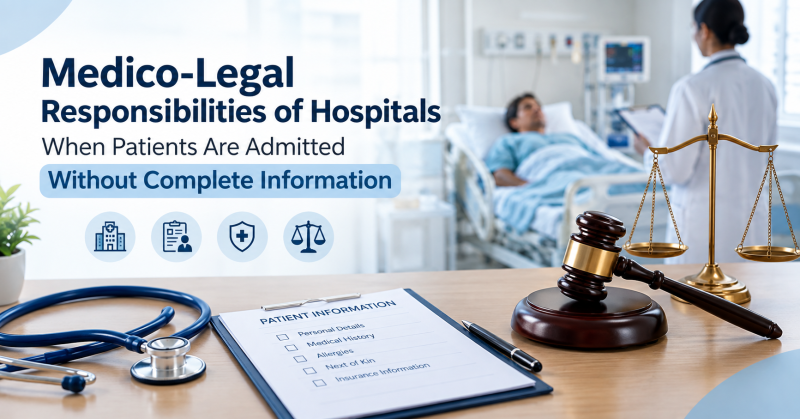
Medico-Legal Responsibilities of Hospitals When Patients Are Admitted Without Complete Information
 Badal
Badal
A patient arrives in the emergency department, unconscious or confused, with no attendant, no identification, and no medical history. Or a family member brings an elderly relative and can only say, "He has some heart problem." The hospital must act, yet it does so with gaps in what it knows. A medico legal guide for hospitals in Delhi has to address this situation squarely, because incomplete admission information is one of the most common starting points for later complaints, disputes, and legal notices.
The short answer: when information is incomplete, the hospital's responsibility is to provide appropriate care based on clinical need, make reasonable efforts to fill the gaps, and record honestly what was known, what was unknown, and what was done about it. This article is general information, not legal advice, and requirements depend on the facts and on the rules in force at the time.
Why Incomplete Admission Information Creates Medico-Legal Risk
Clinical decisions rest on history, identity, allergies, current medicines, and the patient's wishes. When these are missing, the risk of error rises, and so does the difficulty of later explaining why a decision was made.
Typical situations include:
- Unconscious or critically ill patients brought in by bystanders
- Patients arriving without relatives or a reliable historian
- Transfers from other facilities without adequate referral notes
- Patients unable to communicate because of language, age, or cognitive impairment
- Families unwilling or unable to share earlier records
The people affected include the patient, the treating team, nursing and admission staff, and hospital management. A gap that nobody documented can later look like negligence, even where care was reasonable.
What Hospitals Are Expected to Do First
In an emergency, patient safety comes first. Treatment should not be delayed for paperwork when a life or limb is at risk. Applicable rules and professional ethics guide emergency care, and hospitals should ensure their policies reflect the current legal position, which they should verify with qualified advisers.
Once the patient is stabilised, the hospital can work on closing information gaps in an organised way.
A practical sequence
- Assess and stabilise based on clinical need.
- Record what is known at the time of arrival: who brought the patient, the time, the presenting condition, and vital signs.
- Assign a temporary identifier if identity is unknown, and record how the patient can later be matched to their real identity.
- Attempt to identify and contact relatives or guardians, and note each attempt with date and time.
- Collect history from every available source: relatives, bystanders, ambulance crews, referring facilities, prior records, and medication in the patient's possession.
- Reassess and update the record as new information arrives.
- Escalate to senior clinicians or hospital management when the situation is complex or contested.
Informed Consent When Information Is Limited
Consent is often the most sensitive issue in these admissions. A patient who cannot decide, and a family that is absent or unclear, leave the team in difficult territory.
Hospitals should have a written policy, aligned with current law and ethics guidance, on how consent is handled when a patient lacks capacity, when no relative is available, and when urgent treatment cannot wait. The policy should be reviewed by legal advisers and understood by clinical staff.
Whatever the circumstances, the record should show:
- Why the patient could not give consent
- Who was asked, if anyone, and what they were told
- Why the treatment was considered necessary and urgent
- The senior clinician who took or endorsed the decision
- A plan to inform the patient or family, and to seek consent for further steps, as soon as possible
This documentation does not guarantee any legal outcome, but it makes the reasoning transparent, which is central to good clinical governance.
Documentation Hospitals Should Maintain
Records tell the story of an admission long after memories fade. In cases with incomplete information, they matter even more.
Core admission records
- Time of arrival, mode of arrival, and who accompanied the patient
- Presenting complaint and initial assessment
- Identity details, or the temporary identifier and how it was assigned
- Sources of history and their reliability
- Known and unknown allergies, medicines, and comorbidities
- Documents or belongings received with the patient
Communication records
- Every attempt to contact family, with the date, time, number or method, and outcome
- Discussions with relatives, including what was explained about condition, risks, and costs
- Referral and transfer communications
- Any refusal of treatment or leaving against medical advice
Good record practice
- Make entries at the time of events, or note the actual time of a later entry.
- Sign, date, and time each entry.
- Never overwrite or backdate. Correct errors with clearly marked amendments.
- Write facts, not assumptions. "History unavailable; patient unresponsive" is better than silence.
Common Mistakes to Avoid
- Delaying urgent care while waiting for documents or advance payments without checking the applicable legal position.
- Assuming history from limited cues and treating it as confirmed fact.
- Leaving gaps unexplained in the record, such as a missing allergy status.
- Relying on verbal instructions from relatives without noting them.
- Using blanket consent forms signed by whoever happens to be present, without confirming that person's authority.
- Failing to escalate an unclear case to a senior clinician or administrator.
- Adding to records after a complaint without marking them as late entries.
- Poor handovers between shifts, which lose critical information about the patient.
Building Systems That Reduce Risk
Individual diligence helps, but system design matters more. Risk management and healthcare compliance work best when policies are written, taught, and reviewed.
Consider these steps:
- Maintain written protocols for unidentified patients, patients lacking capacity, and emergency admissions.
- Use structured admission forms that prompt staff to record unknowns, not just knowns.
- Train front-desk, nursing, and clinical staff together on these protocols.
- Set up a clear escalation path and a named on-call administrator for difficult admissions.
- Audit a sample of admission records periodically and share findings openly.
- Track incidents and near misses, and use them to improve procedures.
- Ensure staff know how to receive and log patient complaints politely.
Hospital leaders often find that a practical medico legal guide for hospitals in Delhi is most valuable when it is used to shape these internal protocols, rather than kept as a reference on a shelf. For readers who want a structured starting point, the medico-legal guide prepared by Dr Vimal Kant Goyal outlines common risk areas that doctors and institutions can adapt to their own setting.
Quality, Governance, and Patient Trust
Handling incomplete information well is also a quality issue. A reliable hospital quality guide in Delhi would place documentation, consent processes, escalation, and audit within the wider framework of patient safety and clinical governance, not treat them as legal chores.
The same applies to any healthcare quality guide in Delhi that hospital teams consult when reviewing standards. Complete records, respectful communication, and clear accountability support both better care and a stronger position if a dispute ever arises.
Early, honest communication with families matters as well. Many complaints stem from confusion about what was known, what was done, and why. Explaining gaps and decisions openly, in plain language, often prevents escalation.
Frequently Asked Questions
1. What should a hospital do if a patient is admitted with no identification or relatives?Provide clinically necessary care, assign a temporary identifier, document all known facts, and make and record reasonable efforts to identify the patient and reach relatives. Involve senior staff and management, and follow the hospital's written policy and current legal requirements.
2. Can treatment begin before full information is available?In genuine emergencies, clinical need generally drives the immediate response. The hospital should record why treatment was urgent and what information was unavailable. Hospitals should confirm the current legal and ethical position with qualified advisers.
3. Does incomplete information automatically mean medical negligence?No. Negligence depends on the facts and the standard of care expected in the circumstances. Limited information is a factor, but clear documentation of the situation and the reasoning behind decisions helps show what the team knew and did.
4. What records matter most in these cases?Time of arrival, sources of history, identification efforts, consent reasoning, communication with relatives, and any updates as new information emerged. Complete, dated, and signed entries carry the most weight.
5. When should a hospital seek medico-legal advice?Early guidance is useful when writing admission and consent policies, after a serious adverse event, when a family disputes what happened, or on receiving a complaint or legal notice. Formal legal representation may be needed if a matter becomes contentious.
Conclusion
Admissions with incomplete information cannot always be avoided, but the risks that follow can be managed. Prioritise patient safety, stabilise before paperwork, make and record reasonable efforts to fill gaps, document consent reasoning carefully, and escalate complex cases early. A practical medico legal guide for hospitals in Delhi should help teams turn these principles into written protocols, staff training, and regular audits.
Treat every unknown as something to be recorded, not hidden. That habit strengthens patient care, supports clinical governance, and keeps the hospital better prepared if questions arise later.
This article is for general information only and does not constitute legal advice. Laws, regulations, and procedures change, so hospitals and doctors should verify current requirements and seek advice specific to their situation.
Source:
Click for the: Full Story
You might like