Close Menu
 World
 Biography
 Health
 Education
 Business
 Lifestyle
 Sports
 Technology
 Animals
 History
 Food
 Religious
 Startups
 Movies
 Politics
 Fashion
 Covid
 Diet
 Fitness
 Marketing
 Travel
 Science
 Reviews
 Social media
 Stories
 Facts
 Art
 Entertainment
Rajan

Health
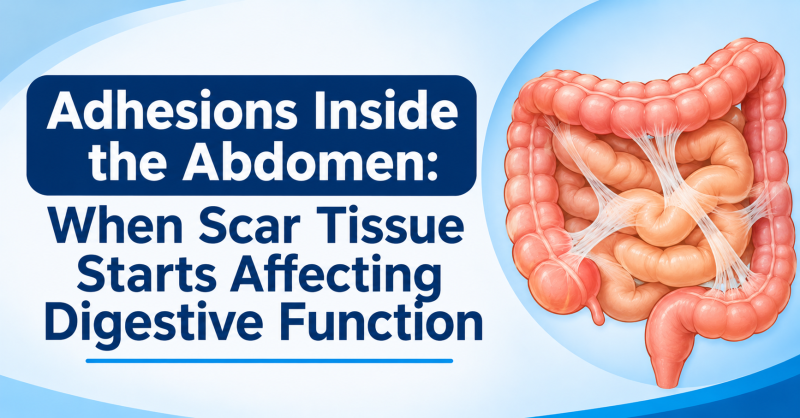
Adhesions Inside the Abdomen: When Scar Tissue Starts Affecting Digestive Function
 Rajan
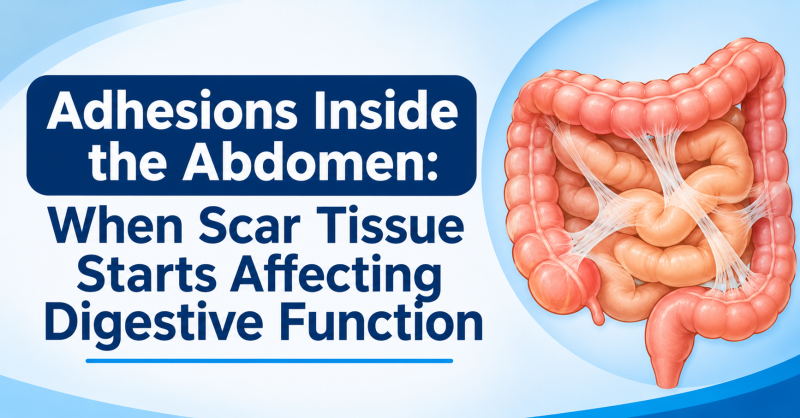
Scar tissue is part of normal healing. After surgery, infection or inflammation, the body repairs itself by laying down fibrous tissue. Sometimes, though, that tissue forms bands inside the abdomen that bind organs together, and these are called adhesions. Many people never notice them. Others develop pain, bloating, vomiting or even a bowel blockage, sometimes years after the original operation.
This article explains how adhesions form, how they interfere with digestion, and how they are diagnosed and treated. It also covers when it is time to consult a gastrointestinal surgeon in Central Delhi.
What Are Abdominal Adhesions?
Normally, the intestines and other organs inside the abdomen glide smoothly over each other. After tissue is injured, the healing process can leave sticky fibrous bands that connect loops of bowel to each other or to the abdominal wall. These bands are adhesions.
The most common causes include:
- Previous abdominal or pelvic surgery, which is by far the leading cause
- Infection or inflammation, such as appendicitis, peritonitis or pelvic infection
- Inflammatory bowel disease, including Crohn’s disease
- Endometriosis
- Radiation therapy to the abdomen or pelvis
- Abdominal injury or trauma
A single band might be harmless. Dense or widespread adhesions can distort or pull on the intestines.
How Adhesions Affect Digestive Function
The intestines move food along through wave-like contractions called peristalsis. Adhesions can disturb this process in several ways:
- Kinking: A band can bend a loop of bowel sharply, narrowing the passage.
- Twisting (volvulus): A loop can twist around an adhesive band.
- Tethering: Bowel stuck to the abdominal wall or to another loop cannot move freely, so contents pass slowly.
- Compression: Dense scarring can squeeze a segment from outside.
When the passage is partly or fully blocked, the result is a small bowel obstruction. Adhesions are the most common cause of this condition worldwide.
Symptoms to Watch For
Adhesions rarely show up on their own, and symptoms often come and go. They may include:
- Crampy abdominal pain that comes in waves
- Bloating and a swollen belly
- Nausea and vomiting
- Constipation, or difficulty passing gas
- Reduced appetite and feeling full quickly
- Chronic, vague abdominal discomfort
Some people also have long-term pain that worsens with movement or after meals.
Warning signs that need urgent care
A complete obstruction is an emergency. Go to a hospital immediately if you have:
- Severe, constant or worsening abdominal pain
- Repeated vomiting, especially if it is green or brown
- Inability to pass stool or gas
- A rapidly swelling abdomen
- Fever or a fast heartbeat
Delay can lead to a loss of blood supply to the bowel, which is dangerous.
How Are Adhesions Diagnosed?
Adhesions themselves do not appear clearly on most scans. Doctors usually diagnose them by putting together the history, examination and imaging:
- History and examination: Past surgeries, the pattern of symptoms and abdominal tenderness or distension.
- Blood tests: To check hydration, infection and organ function.
- X-ray or CT scan: These show dilated bowel loops or the point where a blockage occurs, and a CT scan is the most useful test in suspected obstruction.
- Contrast studies: Sometimes used to see how material moves through the bowel.
Laparoscopy is occasionally used to look for adhesions directly when chronic pain has no other explanation.
Treatment Options
Conservative management
Many partial obstructions settle without surgery. Treatment generally involves:
- Resting the bowel (nothing by mouth) for a period
- Intravenous fluids and electrolytes
- A nasogastric tube to relieve pressure from the stomach
- Close monitoring with repeat examinations and imaging
Patients are usually admitted for this, because a partial blockage can become complete.
Surgery
Surgery is considered when a blockage does not resolve, when it is complete, or when there are signs of reduced blood flow to the bowel. The operation is called adhesiolysis. The surgeon releases the bands, frees the bowel and checks it for damage. A damaged segment may need to be removed.
Where possible, this can be done laparoscopically through small incisions, which may mean less pain and a faster recovery. If adhesions are very dense or the bowel is badly distended, open surgery may be safer. The choice depends on the individual situation and is made by the operating surgeon.
Surgery for adhesions carries its own risks. Operating can create new adhesions, and freeing stuck bowel can injure it. For this reason, surgery is reserved for cases where it is truly needed.
Can Adhesions Be Prevented?
They cannot be prevented entirely, but the risk can be reduced:
- Choosing minimally invasive surgery when it is appropriate
- Handling tissue gently and keeping operations as short as practical
- Using adhesion-barrier products in selected cases
- Treating infections such as appendicitis promptly
- Walking early after surgery to encourage bowel movement
Choosing the Right Surgeon
If you have recurring bowel symptoms and a history of abdominal surgery, a specialist assessment is worthwhile. When comparing doctors, consider:
- Experience with both laparoscopic and open abdominal surgery
- Willingness to explain whether surgery is truly needed
- Access to emergency care and imaging at the hospital
- Clear communication about risks and follow-up
Dr. Tarun Mittal is a general and laparoscopic surgeon who works at Sir Ganga Ram Hospital, located at Sir Ganga Ram Hospital Marg, Old Rajinder Nagar, New Rajinder Nagar, New Delhi, Delhi, 110060. Patients who would like an expert opinion on recurrent abdominal pain, bloating or suspected obstruction can [consult an experienced abdominal and laparoscopic surgeon to understand whether their symptoms are linked to adhesions and what the next step should be. For people living or working nearby, a gastrointestinal surgeon in Rajinder Nagar offers the advantage of being close to a major hospital with emergency facilities, which matters if symptoms suddenly worsen.
Conclusion
Abdominal adhesions are a common and often silent result of healing, but when they kink, twist or tether the bowel, they can seriously disturb digestion and lead to obstruction. Recognising the symptoms early, knowing the red-flag signs and getting a proper assessment can prevent complications.
Many cases are managed without an operation, while others need careful surgical release. If you have unexplained digestive symptoms after abdominal surgery, consider an evaluation with a gastrointestinal surgeon in Central Delhi who can explain your options honestly and guide you toward the safest course.
Disclaimer: This article is for general information only and is not a substitute for professional medical advice. Please consult a qualified doctor for diagnosis and treatment.
Frequently Asked Questions
1. Can adhesions cause pain years after surgery?
Yes. Adhesions can stay silent for years and then cause symptoms, sometimes decades after the original operation.
2. Do adhesions show up on a CT scan?
Usually not directly. A CT scan shows the effects, such as dilated bowel or a transition point, and the doctor infers adhesions from that along with your history.
3. Do all adhesions need surgery?
No. Most adhesions cause no problem at all, and many partial obstructions settle with hospital-based conservative treatment. Surgery is needed when the blockage persists or is complete.
4. Can adhesions come back after being cut?
Yes. Any surgery can form new adhesions, which is why operating is avoided unless necessary and why minimally invasive techniques are preferred when suitable.
5. When should I see a doctor?
See a doctor if you have recurring cramps, bloating or vomiting, particularly after previous abdominal surgery. Seek emergency care for severe pain, repeated vomiting or being unable to pass stool or gas.
Source:
Click for the: Full Story
You might like