Close Menu
 World
 Biography
 Health
 Education
 Business
 Lifestyle
 Sports
 Technology
 Animals
 History
 Food
 Religious
 Startups
 Movies
 Politics
 Fashion
 Covid
 Diet
 Fitness
 Marketing
 Travel
 Science
 Reviews
 Social media
 Stories
 Facts
 Art
 Entertainment
Rajan

Health
Pilonidal Sinus With Multiple Openings: Treatment Challenges and Surgical Options
 Rajan
Most people picture a pilonidal sinus as a single small pit near the tailbone. In reality, many patients have several openings spread across the natal cleft, sometimes with tracts running sideways under the skin. This pattern is harder to treat, easier to misjudge and more likely to return after surgery.
If you have more than one opening, you are probably asking whether a simple procedure will be enough. This article explains why multiple openings matter, what makes treatment difficult, and which surgical options exist. It also explains when it makes sense to see an endoscopic pilonidal sinus surgeon in Central Delhi.
Why Multiple Openings Change the Picture
A pilonidal sinus forms when loose hair and debris collect in the skin of the natal cleft and trigger infection. Over time, the body forms tracts, which are small tunnels, to drain the infected material. Each opening on the skin is the visible end of one of these tunnels.
The number of openings usually reflects how long the disease has been present and how far it has spread. Several openings often suggest:
- A network of connected or branching tracts beneath the skin
- Repeated abscesses that have found new routes to drain
- Chronic inflammation and scarring
- Hair embedded deep inside the cavity
What you see on the surface is often only a small part of the real problem.
The Main Treatment Challenges
Hidden and branching tracts
Not every tract opens onto the skin. Some run laterally or upward and can be missed during a standard operation. A tract left untreated is a common reason for recurrence.
Retained hair and infected tissue
Hair is the underlying trigger. If even a small amount of hair or infected lining remains, the sinus can reform.
The trade-off between thoroughness and wound size
To be sure every tract is removed, a surgeon may need to cut away a wide area. A bigger excision means a larger wound, slower healing and a longer recovery. This is the central dilemma in multi-opening disease.
Slow healing in a difficult location
The natal cleft is warm, moist and subject to friction and pressure, so wounds there heal slowly. A large open wound can take weeks or months to close, and it can become infected along the way.
Recurrence
Complex disease recurs more often than simple disease. Treatment therefore has to be thorough, and it must be followed by proper aftercare.
Surgical Options for Pilonidal Sinus With Multiple Openings
There is no single correct operation. The right choice depends on how extensive the disease is, whether there is an active abscess, the condition of the skin, and whether you have had surgery before.
1. Incision and drainage
This is used for an acute abscess. It relieves pain and pressure quickly but is rarely a cure on its own. Drainage is usually followed by a definitive procedure once the infection settles.
2. Wide local excision
All the diseased tissue is removed, and the wound is either left open to heal or closed. It is effective for extensive disease but leaves a large wound with a long healing time.
3. Flap procedures
Procedures such as the Limberg or Karydakis flap remove the diseased area and reshape the cleft with a skin flap, so that the wound is closed and flattened. They are often used for recurrent or extensive disease. They are major procedures and need an experienced surgeon.
4. Minimally invasive and endoscopic techniques
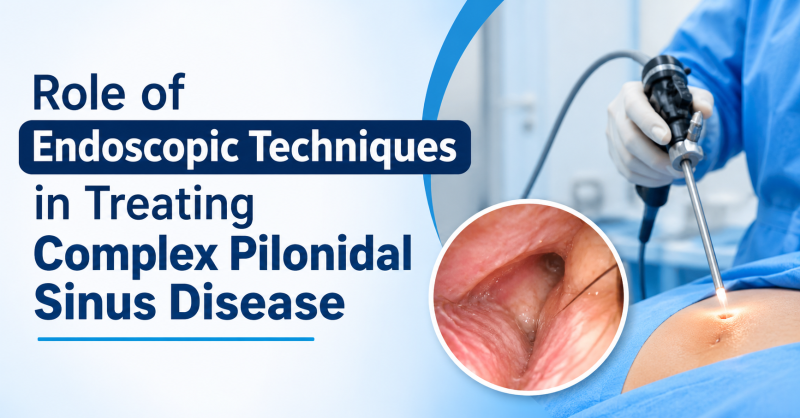
Endoscopic Pilonidal Sinus Treatment (EPSiT) uses a fistuloscope, a thin camera, to look inside the tract system on a monitor. The surgeon removes hair and infected tissue and destroys the lining from within. Healthy tissue is spared, and the wounds are small.
For patients with multiple openings, the advantage is visibility. The camera can follow branches that would be hard to find through external cuts alone. Laser-assisted and other minimally invasive variations are also used in some centres.
How Do the Options Compare?
OptionBest suited forWound sizeRecoveryIncision and drainageAcute abscessSmallQuick, but not definitiveWide excisionExtensive diseaseLargeLongerFlap procedureRecurrent or extensive diseaseModerateModerateEndoscopic (EPSiT)Chronic, multi-tract disease with reasonably healthy skinVery smallGenerally shorter
Endoscopic treatment is not suitable for everyone. It works best when the skin is not badly damaged, and an active abscess usually has to be treated first. Extensive disease with severe skin involvement may still need a flap or excision. A good surgeon will explain these limits and will not push one technique for every patient.
What to Expect After Surgery
Recovery varies by procedure, but some principles apply to all of them:
- Keep the area clean and follow your dressing instructions
- Control hair growth in the cleft with regular shaving or laser hair removal
- Avoid prolonged sitting and friction early on
- Attend follow-up visits until the wound is fully healed
Hair control is as important as the operation itself. Without it, the cycle that caused the sinus can begin again.
Choosing a Surgeon for Complex Disease
Experience matters when a sinus has several openings. Useful questions to ask include:
- How often does the surgeon perform endoscopic or flap procedures for pilonidal disease?
- Will they explore all tracts, or only treat the visible openings?
- What happens if the planned technique proves unsuitable during surgery?
- What is the follow-up plan, and how is recurrence monitored?
Dr. Tarun Mittal is a general and laparoscopic surgeon who works at Sir Ganga Ram Hospital, located at Sir Ganga Ram Hospital Marg, Old Rajinder Nagar, New Rajinder Nagar, New Delhi, Delhi, 110060. The area is easy to reach from much of Central Delhi. Patients with more than one opening who want to know whether a keyhole approach could suit them can speak with a surgeon who performs minimally invasive pilonidal procedures and have the sinus examined before deciding.
Awareness of endoscopic pilonidal sinus treatment in Delhi has grown in recent years, but suitability is always individual, so an in-person examination is the only reliable way to decide.
Conclusion
A pilonidal sinus with multiple openings is more than a cosmetic or minor problem. It often means branching tracts, retained hair and a higher risk of recurrence. The difficulty is removing every diseased channel without creating a large wound that heals slowly.
Modern options, from flap procedures to endoscopic techniques, offer ways to balance thoroughness with tissue preservation. If you are considering an endoscopic pilonidal sinus surgeon in Central Delhi, choose someone who will examine you carefully, explain the realistic options and tailor the plan to your sinus. Then follow the aftercare closely, especially hair control, to give the treatment its best chance of lasting.
Disclaimer: This article is for general information only and is not a substitute for professional medical advice. Please consult a qualified surgeon for diagnosis and treatment.
Frequently Asked Questions
1. Does having multiple openings mean my pilonidal sinus is severe?
Not always, but it usually indicates a more developed or longer-standing condition with branching tracts. An examination, and sometimes imaging, shows how extensive it really is.
2. Can multiple openings be treated in a single procedure?
Often yes. Whether through excision, a flap or an endoscopic approach, the aim is to deal with all tracts in one sitting, although in some cases an abscess has to be drained first.
3. Is endoscopic treatment possible when there are several openings?
Frequently, particularly in chronic disease with reasonably healthy skin. The camera allows the surgeon to follow each tract. The final decision depends on your examination.
4. Will the sinus come back after surgery?
Recurrence can happen with any technique, and it is more common in complex disease. Complete clearance of tracts and hair, along with good hair control afterwards, lowers the risk.
5. How long does recovery take?
It depends on the procedure. Endoscopic treatment generally allows a quicker return to routine than wide excision, while flap surgery falls in between. Your surgeon will give an individual estimate.
Source:
Click for the: Full Story
You might like