Close Menu
 World
 Biography
 Health
 Education
 Business
 Lifestyle
 Sports
 Technology
 Animals
 History
 Food
 Religious
 Startups
 Movies
 Politics
 Fashion
 Covid
 Diet
 Fitness
 Marketing
 Travel
 Science
 Reviews
 Social media
 Stories
 Facts
 Art
 Entertainment
Deepak

Health
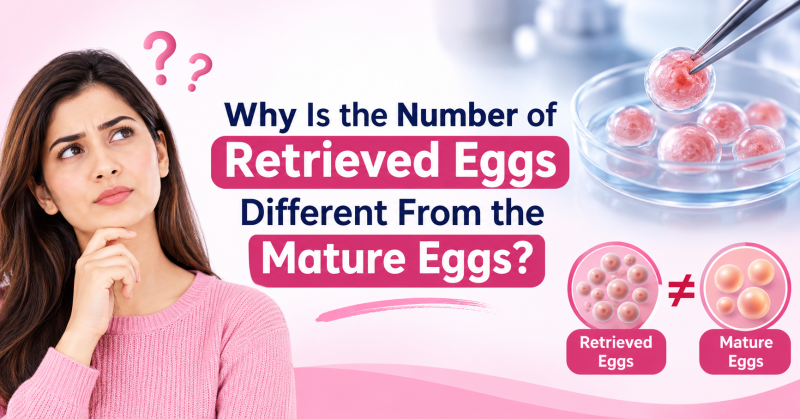
Why Is the Number of Retrieved Eggs Different From the Number of Mature Eggs?
 Deepak
After egg retrieval, many couples are surprised by the numbers. A woman may be told that 12 eggs were collected, yet only 8 or 9 were mature. It is natural to wonder whether something went wrong.
In most cases, nothing did. Retrieved eggs and mature eggs are two different counts, and the gap between them is a normal part of IVF. Understanding why can help you read your report with less worry and ask better questions at your next visit.
What Is the Difference Between Retrieved Eggs and Mature Eggs?
Retrieved eggs are all the eggs collected from your ovarian follicles during the egg retrieval procedure. Mature eggs are the ones that have completed their final stage of development and are ready to be fertilised. Embryologists call these eggs MII (metaphase II) eggs.
Only mature eggs can be fertilised through conventional IVF or ICSI. So the mature egg count, not the retrieved count, is what guides the next step in the laboratory.
Why Do Some Retrieved Eggs Remain Immature?
An egg does not simply appear ready. It goes through a gradual maturation process, and a few factors decide how many complete it by the time of retrieval.
- Follicles grow at different speeds. Within one stimulation cycle, some follicles are ahead and others lag behind. Eggs from smaller follicles may be collected before they have finished maturing.
- Trigger injection timing. The trigger injection prompts the final stage of egg maturation. Retrieval is planned about 34 to 36 hours later. If follicles were not at the ideal size when the trigger was given, fewer eggs may mature.
- Individual response to medication. Two women on similar doses can respond quite differently, depending on age, ovarian reserve, hormone levels and underlying conditions.
- Natural variation in eggs. Some eggs stop short of maturity for reasons that are biological rather than something anyone did wrong.
- Conditions such as PCOS or endometriosis. These can influence how follicles develop and how eggs mature, though not in every patient.
What Do the Terms in Your Report Mean?
Reports often use embryology terms. Here is a plain-language guide:
- MII (mature): Ready for fertilisation.
- MI (metaphase I): Nearly mature but not yet ready.
- GV (germinal vesicle): An earlier, immature stage.
- Degenerated or abnormal: Eggs that cannot be used.
Some MI eggs may complete maturation in the laboratory after a few hours of culture, and the embryology team may then use them. However, eggs matured outside the body do not always perform the same way as eggs that matured naturally, and the outcome varies from case to case.
Is a Lower Mature Egg Count a Sign of Poor Egg Quality?
Not necessarily. Maturity and quality are related but not the same.
Maturity describes the stage of development. Quality is about the egg’s chromosomal health and its potential to fertilise and become a healthy embryo. A woman can have a high number of immature eggs and still have good-quality mature ones. In the same way, a large retrieval number does not guarantee that many embryos will result.
For this reason, an IVF specialist looks at the whole cycle rather than a single number.
How Does a Fertility Specialist Interpret the Numbers?
A careful review usually considers:
- The number and size of follicles during monitoring scans
- Hormone levels such as estradiol during stimulation
- The stimulation protocol and the dose of medication
- The timing and type of trigger injection used
- The woman’s age, AMH, antral follicle count and previous cycle history
If a cycle produces many eggs but a low proportion of mature ones, the doctor may look closely at trigger timing or stimulation strategy. Adjustments in the next cycle are sometimes possible, though they depend on the individual case and cannot be promised in advance. This kind of structured review is what many couples look for when searching for the best IVF doctor in Delhi, since an honest explanation of the report matters as much as the procedure itself.
What Happens After Retrieval?
Once eggs are collected, the embryology team assesses them and separates the mature ones. Fertilisation is then attempted, either by conventional insemination or ICSI, depending on the clinical situation. The fertilised eggs are monitored over the following days, and your doctor shares updates on how many have fertilised and developed.
At each stage the numbers usually reduce. This is expected in IVF, not a sign that the treatment is failing. Eggs retrieved, eggs mature, eggs fertilised and embryos developed are four separate figures, and each is naturally smaller than the one before.
Questions Worth Asking Your IVF Doctor
If your retrieval numbers differ from what you expected, you may find these questions helpful:
- How many of the retrieved eggs were mature, and how many were immature?
- Was the trigger timing suitable for my follicle sizes?
- Would a change in protocol be considered in a future cycle?
- What do these numbers mean for fertilisation and embryo development?
A good IVF doctor in Delhi will take the time to answer these clearly and explain what the findings mean for your next steps.
Choosing Where to Continue Your Treatment
Egg maturity depends on careful monitoring, correct trigger timing and a skilled embryology laboratory working together. When comparing the best IVF centre in Delhi options, consider whether the clinic offers individualised stimulation plans, transparent reporting after retrieval and open communication about outcomes. Success rates alone do not tell the full story, since every patient’s circumstances differ.
When to Seek Guidance
Consider speaking with a fertility specialist if:
- Your retrieval showed a low proportion of mature eggs in more than one cycle
- You are unsure how to interpret your egg retrieval report
- You are planning a repeat cycle and want to understand what could be adjusted
- You have had a poor response to stimulation in the past
Every cycle offers information. A thorough review of your results can help shape a more suitable plan for the next one.
If you want consultation regarding IVF treatment, you can visit Dr Poonam Goyal at:
- C-3/63A, 64A, opp. Gokulpuri police station, Block C, Panchsheel Hospital, Yamuna Vihar, Shahdara, Delhi, 110053
- HOD IVF & Infertility, Max Superspeciality Hospital, Vaishali
FAQs
1. Is it normal for retrieved eggs and mature eggs to be different in number?
Yes. It is common for some retrieved eggs to be immature or unsuitable for fertilisation. The difference varies from person to person and from cycle to cycle.
2. Can immature eggs still be used in IVF?
Some immature eggs may mature in the laboratory after a few hours of culture and can then be used. Their results may differ from eggs that matured naturally, so this depends on the individual case.
3. Does a low number of mature eggs mean my egg quality is poor?
Not always. Maturity refers to the stage of development, while quality relates to the egg’s genetic health and potential. They are assessed separately.
4. Can the number of mature eggs improve in the next IVF cycle?
It may, depending on the cause. Your doctor can review trigger timing, stimulation protocol and your response to medication to decide whether adjustments are appropriate. Outcomes cannot be guaranteed.
5. Why is the trigger injection timing so important?
The trigger injection starts the final maturation of the egg. If it is given too early or too late relative to follicle size, fewer eggs may reach maturity by retrieval.
Source:
Click for the: Full Story
You might like