Close Menu
 World
World
 Biography
 Health
 Education
 Business
 Lifestyle
 Sports
 Technology
 Animals
 History
 Food
Food
 Religious
 Startups
 Movies
 Politics
 Fashion
 Covid
Covid
 Diet
Diet
 Fitness
 Marketing
 Travel
 Science
 Reviews
 Social media
 Stories
 Facts
Facts
 Art
Art
 Entertainment
Rajan

Health
Can Exercise Make a Hernia Worse? Activities to Avoid and Safer Options
 Rajan
Rajan
If you have a hernia, or suspect one, staying active can feel confusing. You may worry that a workout will make the bulge bigger, yet avoiding movement altogether isn't healthy either. The truth sits in between. The right kind of activity is usually safe and even helpful, while the wrong kind can strain a weak abdominal wall. Many people also ask the best hernia doctor in Central Delhi for exactly this guidance, so here is a practical breakdown of what to avoid, what to try, and when to stop exercising and get examined.
How a Hernia Reacts to Exercise
A hernia develops when tissue, usually part of the intestine or fat, pushes through a weak spot in the abdominal wall. Exercise doesn't create that weak spot in most cases, but it can aggravate one that already exists.
The key factor is intra-abdominal pressure. Heavy lifting, intense core work, and breath-holding raise the pressure inside your abdomen. When that pressure pushes against an already weakened area, the hernia can enlarge, become painful, or occasionally get trapped.
So the answer to "can exercise make a hernia worse?" is yes, but it depends on the type, intensity, and technique of the activity, as well as the size and location of your hernia.
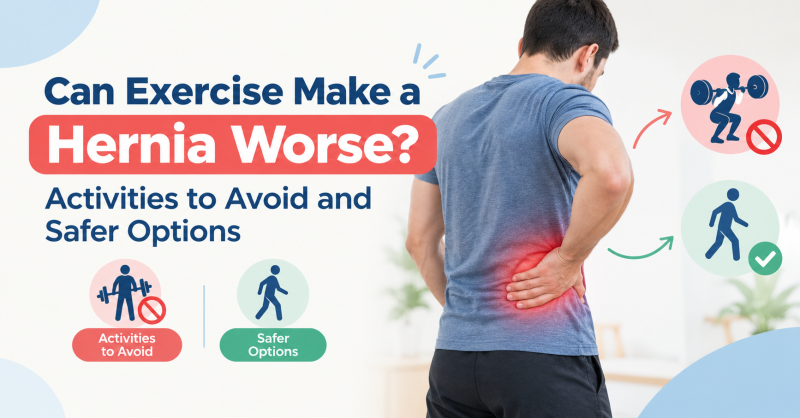
Exercises and Activities to Avoid
If you have a diagnosed hernia, or an unexplained bulge you haven't had checked, be cautious with the following:
- Heavy weightlifting: deadlifts, squats with heavy loads, and overhead presses create sudden pressure spikes
- Crunches, sit-ups, and leg raises: these directly load the abdominal wall
- Planks and intense core circuits: especially if held until your abdomen visibly bulges
- High-impact workouts: jump training, HIIT, and sprinting can aggravate groin hernias
- Contact sports: a direct blow to the area can cause pain and complications
- Straining during exercise: holding your breath while pushing or pulling (the Valsalva manoeuvre)
- Lifting heavy household or gym equipment without help
Different hernias react differently. Inguinal hernias often worsen with lifting and running, umbilical hernias with crunches and planks, and incisional hernias with any core strain near a surgical scar.
Safer Exercise Options
You don't have to stop moving. Many gentle activities support overall health, weight control, and bowel regularity, all of which help hernia management.
- Walking: low-impact and easy to adjust to your comfort level
- Swimming or water walking: water supports the body and reduces strain
- Stationary cycling: keep the resistance low and posture upright
- Gentle stretching and mobility work: avoid deep twisting or abdominal compression
- Light resistance training: low weights, higher repetitions, and steady breathing, only if your doctor approves
- Breathing exercises: exhale during effort and never hold your breath
A simple rule helps: if an activity makes the bulge appear, increases pain, or forces you to strain, stop and reassess.
Warning Signs During or After Exercise
Pay attention to your body. Contact a doctor promptly if you notice:
- A bulge that grows or appears more often
- Pain, burning, or a dragging sensation at the site
- A bulge that doesn't go back in when you lie down
- Redness, warmth, or a bluish or purple tint over the swelling
- Nausea, vomiting, or constipation with a painful bulge
A hard, painful, discolored lump with vomiting could mean a trapped or strangulated hernia, which is an emergency requiring immediate hospital care.
Why Exercise Alone Cannot Fix a Hernia
A common misconception is that strengthening your core will close a hernia. It won't. A hernia is a structural gap or tear in the muscle or connective tissue, and exercise cannot stitch that gap closed. Abdominal binders and supports may reduce discomfort temporarily, but they don't repair the defect.
Surgery is the only definitive treatment. Modern repairs, often done laparoscopically with mesh reinforcement, are usually day-care or short-stay procedures. Many people return to light activity within days and to normal exercise gradually over several weeks, depending on the hernia type and technique.
Choosing the Right Doctor for Safe Activity Guidance
Because every hernia is different, generic fitness advice isn't enough. A surgeon should examine you, identify the hernia type and size, and tell you which activities are acceptable before and after any repair. When searching for the best hernia doctor in Delhi, look for someone who explains options clearly, discusses both surgical and non-surgical approaches, and gives practical advice about lifestyle and recovery.
Tips for Exercising Safely with a Hernia
- Get a proper diagnosis before starting or resuming a workout routine
- Warm up gently and increase intensity gradually
- Maintain good posture and bend your knees when lifting
- Exhale on exertion and avoid breath-holding
- Manage constipation with fiber and fluids to prevent straining
- Maintain a healthy weight, as excess weight increases abdominal pressure
- Avoid smoking, which weakens tissue and slows healing
Frequently Asked Questions
1. Can I go to the gym if I have a hernia?
Light activity may be fine, but heavy lifting and intense core exercises are best avoided until a surgeon has examined you. Always get advice specific to your hernia type.
2. Is walking safe with a hernia?
In most cases, yes. Walking is low-impact and generally well tolerated. Stop if you feel pain or see the bulge enlarge.
3. Can exercise cause a hernia?
Exercise rarely causes a hernia by itself, but straining with heavy lifts or poor technique can expose an existing weakness or contribute to a new one.
4. When can I exercise after hernia surgery?
Light walking usually starts within a day or two. Heavy lifting and strenuous exercise are typically restricted for several weeks. Follow your surgeon's timeline, as it varies by technique and hernia size.
5. Does a hernia belt help during workouts?
A support belt may ease discomfort, but it doesn't treat the hernia or make heavy exercise safe. Discuss it with your doctor before relying on one.
Conclusion
Exercise can make a hernia worse when it involves heavy lifting, abdominal straining, or high-impact movement, but staying active in a controlled way is usually possible and beneficial. Choose gentle activities, breathe properly, and watch for warning signs like growing size, increasing pain, or a bulge that won't go back in. Because exercise cannot repair the underlying defect, getting an accurate diagnosis is essential. Consulting the best hernia doctor in Central Delhi can help you understand your options, stay safely active, and decide whether surgery is the right step for you.
Disclaimer: This article is for general information only and does not replace personal medical advice. Please consult a qualified surgeon for diagnosis and treatment.
Source:
Click for the: Full Story
You might like