Close Menu
 World
 Biography
 Health
 Education
 Business
 Lifestyle
 Sports
 Technology
 Animals
 History
 Food
 Religious
 Startups
 Movies
 Politics
 Fashion
 Covid
 Diet
 Fitness
 Marketing
 Travel
 Science
 Reviews
 Social media
 Stories
 Facts
 Art
 Entertainment
Deepak

Health
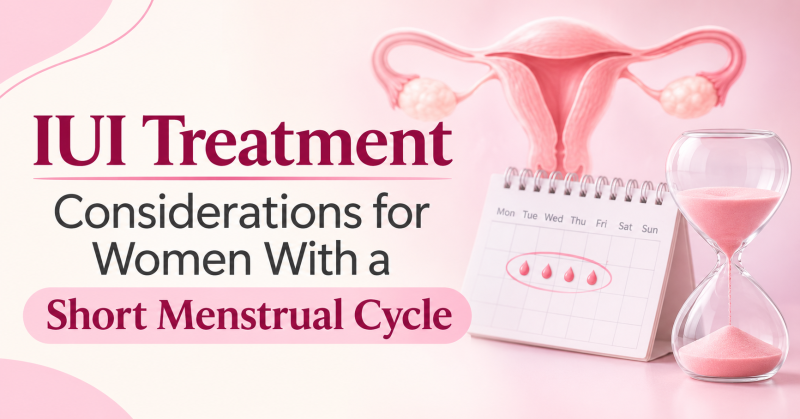
IUI Treatment Considerations for Women With a Short Menstrual Cycle
 Deepak
If your periods arrive every three weeks or sooner, you may have wondered whether this affects your chances with intrauterine insemination (IUI). A short cycle does not automatically rule out IUI, but it changes how the treatment is timed and monitored. Women looking for the Best iui centre in Delhi often ask whether their cycle length matters, and the honest answer is that it can, depending on why the cycle is short.
What Counts as a Short Menstrual Cycle?
A menstrual cycle is counted from the first day of one period to the first day of the next. According to the International Federation of Gynecology and Obstetrics (FIGO), a normal cycle in adults usually falls between 24 and 38 days. Cycles that are consistently shorter than 24 days are considered frequent or short.
It is also worth checking whether every bleed is truly a period. Mid-cycle spotting or bleeding from a polyp or hormonal imbalance can sometimes be mistaken for a new cycle, making it appear shorter than it is.
Why Cycle Length Matters for IUI Timing
IUI works by placing washed sperm into the uterus close to the time of ovulation. The procedure is only useful if the timing matches the release of a mature egg. This is where a short cycle creates practical challenges.
The follicular phase may be shorter
The first half of the cycle, when the follicle grows, is called the follicular phase. In many women with short cycles, this phase is compressed, so ovulation happens earlier than the textbook day 14. If monitoring starts too late, the dominant follicle may already have ruptured before insemination is planned.
The luteal phase may be shorter
The second half of the cycle, after ovulation, is the luteal phase. Progesterone produced during this time prepares the uterine lining for implantation. A luteal phase that is consistently very short may leave less time for the lining to support an embryo, although the role of a "luteal phase defect" as a cause of infertility is still debated in medical literature.
Possible Reasons Behind a Short Cycle
Identifying the cause helps shape the IUI plan. Common factors include:
- Changing ovarian reserve: As reserve declines, often with age, FSH levels may rise and follicles may develop faster, shortening the follicular phase.
- Thyroid disorders: Both underactive and overactive thyroid function can affect cycle regularity.
- Raised prolactin levels: These can interfere with ovulation and progesterone production.
- Anovulatory cycles: Bleeding may occur without ovulation, sometimes at shorter intervals.
- Structural causes: Polyps or fibroids may cause bleeding that mimics frequent periods.
Tests Usually Done Before Planning IUI
Before recommending IUI Treatment in Delhi, a fertility specialist typically arranges:
- Day 2–3 hormonal tests such as FSH, LH, and estradiol
- AMH and antral follicle count to assess ovarian reserve
- Thyroid function and prolactin levels
- A pelvic ultrasound to look at the uterus, ovaries, and lining
- A tubal patency test, since IUI requires at least one open fallopian tube
- A semen analysis for the male partner
These results help determine whether IUI is suitable or whether another approach may be more appropriate.
How IUI Can Be Adapted for a Short Cycle
Earlier and closer monitoring
Instead of starting follicle scans around day 10 or 11, the first scan may be scheduled earlier. Some women may need scans every one or two days as the follicle approaches maturity, to avoid missing ovulation.
Ovulation induction medicines
Oral medicines such as letrozole or clomiphene, or injectable gonadotropins, may be used to support follicle growth. These are usually started early in the cycle. The dose and choice depend on ovarian reserve, previous response, and the risk of multiple follicles developing.
Trigger injection and insemination timing
An hCG trigger injection is often given once the follicle reaches a suitable size, helping time ovulation more predictably. Insemination is then planned accordingly. In women prone to an early natural LH surge, urine or blood LH testing may also be used alongside ultrasound.
Luteal phase support
Progesterone support after insemination may be considered in some cycles, particularly when injectable medicines are used. Evidence for routine luteal support in IUI cycles with oral medicines is less clear, so this is decided individually.
Realistic Expectations
A short cycle on its own does not determine IUI success. Factors such as age, ovarian reserve, tubal health, sperm quality, and duration of infertility usually play a larger role. If tests show significantly reduced reserve, a specialist may discuss whether moving to IVF sooner could be more appropriate. Like all fertility treatments, IUI does not guarantee pregnancy, and more than one cycle may be needed.
Professional Guidance for Cycle-Based Planning
Dr. Poonam Goyal, a Gynecologist and Fertility Specialist in Delhi, evaluates cycle patterns, hormonal reports, and ultrasound findings before tailoring IUI monitoring for women with short cycles. For women in East Delhi seeking the Best IUI Doctor In Yamuna Vihar Delhi, nearby access to frequent scans can make closely timed monitoring easier to manage.
Keeping a record of your cycle dates for a few months before consultation, including any spotting, can help your doctor understand your pattern more accurately.
Final Thoughts
A short menstrual cycle mainly changes the timing and monitoring of IUI rather than ruling it out. Understanding the reason behind the shorter cycle, whether hormonal, age-related, or structural, allows treatment to be planned around your body's actual rhythm. A thorough evaluation remains the most reliable starting point.
If you want consultation regarding IUI treatment, you can visit Dr Poonam Goyal at:
- C-3/63A, 64A, opp. Gokulpuri police station, Block C, Panchsheel Hospital, Yamuna Vihar, Shahdara, Delhi, 110053
- HOD IVF & Infertility, Max Superspeciality Hospital, Vaishali
Frequently Asked Questions
1. Can I have IUI if my cycle is only 21 days long?
Yes, IUI may still be possible. Monitoring usually starts earlier in the cycle so that ovulation is not missed, and the cause of the short cycle is evaluated first.
2. When is ovulation likely in a short menstrual cycle?
Ovulation often occurs earlier than day 14, sometimes around day 7 to 10, depending on the length of the follicular phase. Ultrasound monitoring gives a more reliable estimate than calendar counting.
3. Does a short cycle mean low egg reserve?
Not always. While declining ovarian reserve can shorten cycles, thyroid problems, prolactin imbalance, and other factors can also be responsible. AMH and antral follicle count help clarify this.
4. Is progesterone needed after IUI in women with short cycles?
It depends on the individual case and the medicines used. Your doctor may recommend progesterone support in certain cycles, especially if a short luteal phase or injectable stimulation is involved.
5. How many IUI cycles should I try with a short menstrual cycle?
The number varies based on age, test results, and response to treatment. Your fertility specialist will review progress after each cycle and discuss whether to continue IUI or consider other options.
Source:
Click for the: Full Story
You might like