Close Menu
 World
 Biography
 Health
 Education
 Business
 Lifestyle
 Sports
 Technology
 Animals
 History
 Food
 Religious
 Startups
 Movies
 Politics
 Fashion
 Covid
 Diet
 Fitness
 Marketing
 Travel
 Science
 Reviews
 Social media
 Stories
 Facts
 Art
 Entertainment
Badal

Health
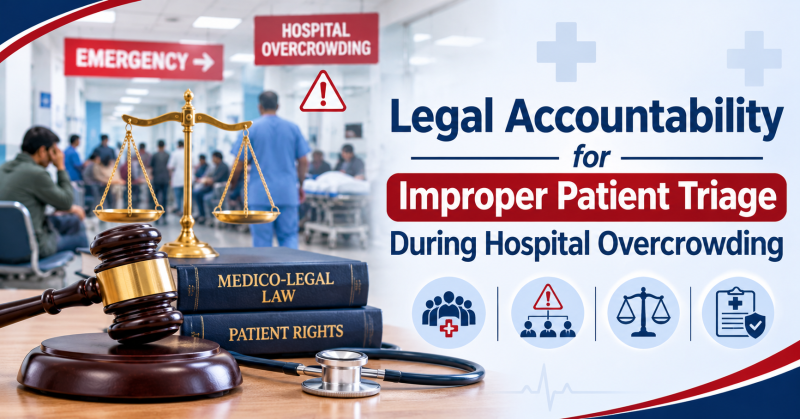
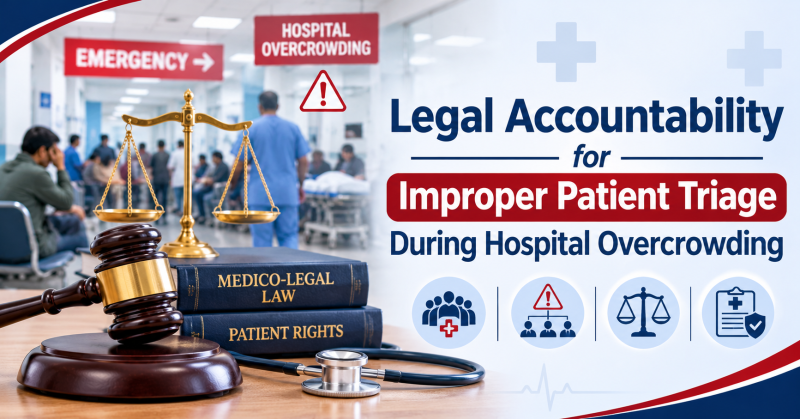
Legal Accountability for Improper Patient Triage During Hospital Overcrowding
 Badal
Overcrowding does not suspend a hospital's legal duties. When a department is overwhelmed, the question a forum asks is not whether the situation was difficult, but whether the triage decision was reasonable, documented and consistent with accepted practice. Hospitals that seek medico legal support in Delhi often do so after a triage dispute has started, when the record is already fixed. This article explains where accountability can arise, who may be answerable, and how to build safeguards before the next surge.
What "Improper Triage" Means in Legal Terms
Triage is the structured prioritisation of patients by clinical urgency. A decision becomes legally relevant when a patient is under-triaged, delayed, redirected or turned away, and then comes to harm.
The legal standard does not change because the ward is full. In Jacob Mathew v. State of Punjab (2005), the Supreme Court held that criminal liability of a doctor requires gross negligence or recklessness, not an error of judgment. Civil and consumer proceedings apply a lower threshold: whether the doctor or hospital acted as a reasonably competent practitioner would in similar circumstances. Overcrowding can be relevant context in that assessment, but it is not a guaranteed defence.
A useful distinction: a wrong triage category assigned in good faith with a documented rationale is very different from no assessment at all.
The Duty to Provide Emergency Care
The most significant authority here is Pt. Parmanand Katara v. Union of India (1989), where the Supreme Court held that doctors and hospitals have a duty to provide immediate medical aid to an injured person and that procedural formalities, including police or medico-legal paperwork, should not delay it. The Court also observed that the duty to preserve life takes precedence.
Later, in Paschim Banga Khet Mazdoor Samity v. State of West Bengal (1996), the Supreme Court held that failure by government hospitals to provide timely emergency treatment can violate the right to life under Article 21. That case arose from a government-hospital context, so administrators should not assume it applies identically to every private establishment. Still, it sets a strong expectation of emergency care.
Hospitals should also check whether state or local rules, or the registration framework applicable to their facility, add further obligations. In Delhi, nursing homes are regulated under the Delhi Nursing Homes Registration Act, 1953, whereas the Clinical Establishments (Registration and Regulation) Act, 2010 applies only in states that have adopted it.
Who Can Be Held Accountable
Accountability is rarely limited to one person.
- The triage nurse or doctor may face questions about the quality of the initial assessment.
- The treating consultant may be asked about response time and escalation.
- The hospital can face consumer proceedings for deficiency in service, and may be vicariously liable for staff, following Indian Medical Association v. V.P. Shantha (1995), which brought medical services within consumer law.
- Management may face scrutiny where systemic failures, such as no surge protocol or inadequate staffing, contributed.
Disciplinary complaints before the Delhi Medical Council look at professional conduct, while consumer commissions consider compensation. These are separate processes and can run in parallel. Administrative lapses, such as an incomplete triage register, should not be confused with negligence, though they weaken a defence by making the record appear unreliable.
A Realistic Scenario: The Chest Pain Labelled "Non-Urgent"
This is an illustrative example, not a reported case.
On a busy evening, a 52-year-old man arrives at a hospital emergency room complaining of chest discomfort. The department is full. A triage nurse records him as lower priority without an ECG and without recording vital signs. He waits several hours and collapses in the waiting area.
The weaknesses are plain. There was no ECG within a defined time frame, no documented rationale for the category and no re-triage while he waited. The overcrowding was real, but the missing steps were not caused by it. A hospital with a rule requiring an ECG for chest pain within a fixed time, and periodic reassessment of waiting patients, would be far better placed to explain what happened.
Practical Safeguards for Hospitals
Build triage into policy, not memory
- Adopt a written triage protocol and train all emergency staff on it.
- Set defined reassessment intervals for waiting patients.
- Give nurses clear authority to escalate to a senior doctor.
Prepare for surges
- Maintain a written overcrowding or surge plan, including bed-release steps and call-in procedures for additional staff.
- Define when and how a patient may be transferred, and require stabilisation and proper handover first.
- Record the reason for any diversion or delay.
Document in real time
Time-stamped triage category, vital signs, the assessing person and every re-triage should appear on the record. If a late entry is needed, label it as such.
Informed medico-legal awareness among clinicians and administrators is increasingly seen as part of good governance, and professionals such as Dr. Vimal Kant Goyal have emphasised why they should understand these frameworks before a dispute arises. Readers who want further reference can consult this medico-legal resource for emergency and hospital practice. Many doctors also look for medico legal help for medical professionals in Delhi once a complaint arrives, though it is most effective when built into protocols and staff training beforehand.
Conclusion
Overcrowding explains a difficult situation but does not excuse a missing assessment. The strongest protection is a hospital that can show a written triage protocol, trained staff, timely reassessment, a surge plan and contemporaneous records. None of these guarantees that a complaint will not arise, but they make decisions easier to explain and defend. Laws and judicial guidance evolve, so verify the current position and seek qualified legal advice for case-specific questions.
Frequently Asked Questions
1. Can a hospital refuse an emergency patient because it is full?A hospital should not simply turn away a patient in need of emergency care. If it genuinely lacks capacity, the safer course is to stabilise the patient first, arrange transfer to a suitable facility and document the handover. Refusal without stabilisation carries serious risk.
2. Does a medico-legal case (MLC) formality justify delaying treatment?No. The Supreme Court in Pt. Parmanand Katara made clear that paperwork should not delay emergency treatment. Treat first, then complete the formalities.
3. Is a triage nurse personally liable for a wrong decision?Possibly, depending on the facts, but an honest judgement made within protocol and properly recorded is treated very differently from a careless or undocumented one. Hospitals also carry responsibility for training and supervision.
4. Does overcrowding protect a hospital from a negligence claim?Not automatically. It may be relevant context, but a forum will still ask whether reasonable steps, such as escalation, re-triage and surge planning, were taken.
5. Should hospitals keep a triage policy for private patients and government schemes alike?Yes. Clinical priority should be based on urgency, not payment source. Any difference in treatment based on ability to pay would be hard to defend, both legally and ethically.
Source:
Click for the: Full Story
You might like