Close Menu
 World
 Biography
 Health
 Education
 Business
 Lifestyle
 Sports
 Technology
 Animals
 History
 Food
 Religious
 Startups
 Movies
 Politics
 Fashion
 Covid
 Diet
 Fitness
 Marketing
 Travel
 Science
 Reviews
 Social media
 Stories
 Facts
 Art
 Entertainment
Badal

Health
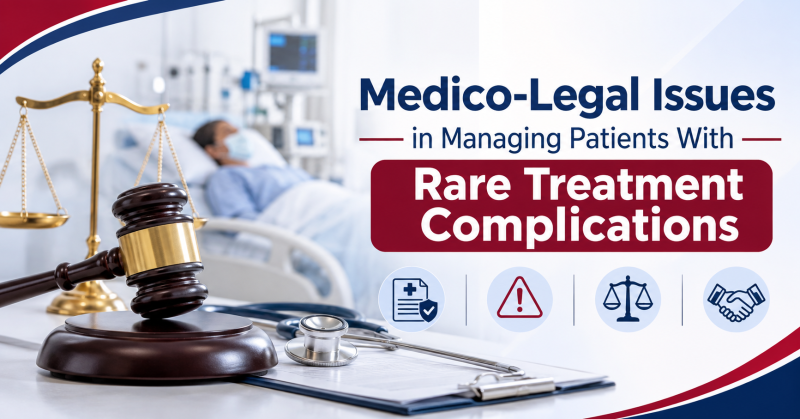
Medico-Legal Issues in Managing Patients With Rare Treatment Complications
 Badal
A rare complication is not automatically negligence, but how it is explained, recognised, documented and managed often decides whether it becomes a dispute. This medico legal expert guide in Delhi looks at where doctors and hospitals are most exposed when an uncommon adverse outcome occurs, and what practical steps reduce that exposure.
Why Rare Complications Carry Disproportionate Legal Risk
Patients rarely complain about a complication they were told about, understood and saw handled promptly. They complain when it comes as a surprise, or when it seems to have been ignored.
Indian courts have long separated an adverse outcome from a negligent one. In Jacob Mathew v. State of Punjab (2005), the Supreme Court held that criminal liability of a doctor requires gross negligence or recklessness, not merely an error of judgment or an unfortunate result. Civil and consumer liability uses a lower threshold, but still asks whether the doctor acted as a reasonably competent practitioner in that specialty.
The practical consequence is that the clinical record, not the outcome alone, tells the story. A medico legal expert in Delhi reviewing a complication will usually look at three things: what the patient was told beforehand, how quickly the complication was recognised, and what was done once it was.
Consent: Disclosing Risks That Are Uncommon but Serious
Many practitioners assume that a risk of 1 in 2,000 need not be mentioned. That assumption is the weakest point in most complication-related disputes.
In Samira Kohli v. Dr. Prabha Manchanda (2008), the Supreme Court stressed that valid consent requires the patient to be told the nature of the procedure, its alternatives and its material risks. A risk can be material because it is severe, even if it is rare. Injury to a major structure, permanent nerve damage or an anaesthetic complication are examples.
What good consent documentation looks like
- A procedure-specific form, not a generic "all risks explained" stamp.
- The specific serious risks named, with the doctor's own handwritten or typed notes where the patient has individual risk factors.
- A record of the discussion itself, including questions the patient asked.
- Consent from the patient or the legally authorised person, in a language the patient understands.
A signed form helps, but it does not replace a real conversation. Courts look at whether the patient actually understood.
Documentation When the Complication Occurs
The hours after a complication are where records most often go wrong. Common errors include late entries made without time stamps, overwritten notes, and missing nursing observations.
Records should be contemporaneous, dated, timed and signed. If a late entry is necessary, it should be labelled as such rather than slipped into an earlier note. Under the Indian Medical Council (Professional Conduct, Etiquette and Ethics) Regulations, 2002, doctors are expected to maintain indoor patient records for at least three years and to supply them on request within 72 hours. The National Medical Commission notified fresh professional conduct regulations in 2023, but their operation was subsequently put on hold, so practitioners should confirm which version is currently in force before relying on any specific provision.
Doctors reading this should also remember that hospital policy may require longer retention than the regulatory minimum. Where litigation or a complaint is anticipated, records should be preserved well beyond that period.
A Realistic Scenario: The Delayed Recognition Problem
This is an illustrative example, not a reported case.
A surgeon performs a routine laparoscopic procedure on a patient with no unusual risk factors. On the second post-operative day, the patient develops fever and worsening abdominal pain. The resident attributes it to expected post-surgical discomfort and notes "stable" without repeat examination. The next morning, imaging reveals a rare bowel injury.
The injury itself may be a known, uncommon complication. The weakness is different: the early warning signs were not escalated, the consent form listed no organ injury risk, and the nursing chart has a gap of several hours.
What should have been done differently is fairly clear. Consent should have named visceral injury as a risk. Persistent fever and pain should have triggered consultant review and repeat investigation. The patient's family should have been told promptly and plainly, with the conversation recorded.
Complaints, Forums and What Each One Examines
A single complication can lead to several parallel proceedings, each with a different question.
- Medical council: In Delhi, complaints about professional misconduct go to the Delhi Medical Council, which asks whether the doctor met professional standards. Outcomes can include warnings or, in serious cases, removal of the name from the register.
- Consumer commission: Under the Consumer Protection Act, 2019, medical services fall within the definition of "service", as the Supreme Court held in Indian Medical Association v. V.P. Shantha (1995). The commission considers deficiency in service and compensation. Complaints are generally to be filed within two years of the cause of action.
- Criminal complaint: Section 106 of the Bharatiya Nyaya Sanhita, 2023 deals with death caused by negligence and prescribes a lower maximum sentence for registered medical practitioners. The Jacob Mathew standard of gross negligence continues to guide how such complaints are approached.
Not every complaint is a legal claim, and administrative lapses such as incomplete forms or missing registers should not be confused with negligence. Still, they weaken a defence because they make the whole record look unreliable.
Regulatory obligations also vary by establishment. The Delhi Nursing Homes Registration Act, 1953 governs nursing homes in the capital, while the Clinical Establishments (Registration and Regulation) Act, 2010 applies only in states that have adopted it. Administrators should confirm which framework applies to their facility.
Informed medico-legal awareness among clinicians is increasingly recognised as part of good practice. Specialists such as Dr. Vimal Kant Goyal have written and spoken on why doctors should understand these frameworks before a dispute arises. Readers who want further reference material can consult this medico-legal resource on complication management and documentation.
Conclusion
Rare complications will happen even in well-run practices. What separates a manageable event from a damaging dispute is usually preparation: specific consent, timely escalation, honest communication and clean, contemporaneous records. Doctors and administrators should treat consent, documentation and incident reporting as clinical safeguards, not paperwork. Laws and regulations change, so verify the current position before relying on any provision, and consult a qualified legal professional for case-specific advice.
Frequently Asked Questions
1. Should I inform the patient immediately if a complication occurs?Yes, promptly and plainly. Explain what has happened, what is being done and what to expect. Document the conversation. Candour is part of professional ethics and generally reduces mistrust, though it does not remove the possibility of a complaint.
2. Does a signed consent form protect me if a rare complication occurs?Not by itself. It is evidence that a discussion took place, but courts examine whether the risk was disclosed meaningfully and whether the treatment itself met the expected standard. Consent addresses disclosure, not negligent execution.
3. Can I be held liable if I followed standard protocol?Following accepted protocol is a strong point in defence, but it is not an absolute shield. If the patient's condition called for a departure from protocol, or warning signs were missed, a forum may still find deficiency.
4. Should a hospital inform its insurer straight away?Generally yes. Professional indemnity policies often require prompt notification of an incident or likely claim. Check the policy wording, since late notice can complicate cover.
5. When should I seek medico-legal advice?Early, ideally when the complication is identified rather than after a legal notice arrives. Early advice helps with record preservation, communication with the family and responding to the first notice. Doctors looking for medico legal advice for doctors in Delhi should seek someone who understands both clinical practice and procedure before the relevant forum.
Source:
Click for the: Full Story
You might like