Close Menu
 World
 Biography
 Health
 Education
 Business
 Lifestyle
 Sports
 Technology
 Animals
 History
 Food
 Religious
 Startups
 Movies
 Politics
 Fashion
 Covid
 Diet
 Fitness
 Marketing
 Travel
 Science
 Reviews
 Social media
 Stories
 Facts
 Art
 Entertainment
Badal

Health
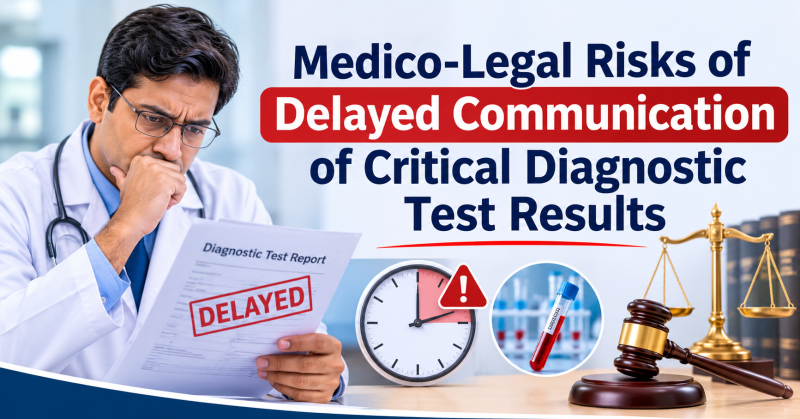
Medico-Legal Risks of Delayed Communication of Critical Diagnostic Test Results
 Badal
A delayed critical result is rarely a laboratory problem. It is a communication problem, and in Indian healthcare it is one of the most avoidable sources of patient harm and disputes. Any experienced medico legal advisor in Delhi will tell you that complaints often start when a result was available but the treating doctor or patient did not act on it in time. Whether the delay amounts to negligence depends on the facts, but a clear, documented and timely process is the best protection for both patients and practitioners.
Why Critical Results Become a Medico-Legal Flashpoint
A critical result is a finding that signals a possible immediate threat to life or health. Examples are a very high potassium level, a positive blood culture, a sharply raised troponin, or an imaging finding such as a suspected pulmonary embolism. Unlike routine abnormal results, these need action within minutes or hours, not days.
The legal exposure comes from the gap between "the result existed" and "the right person acted on it". In a dispute, the questions usually asked are:
- When was the result generated?
- Who was told, and how?
- Is there a record of that communication?
- What was done afterwards?
If the answer to any of these is unclear, the facility is on weak ground even when clinical care was reasonable.
Where the Communication Chain Usually Breaks
Inside the facility
Delays tend to happen at handovers: the technician to the pathologist, the pathologist to the ward, the ward nurse to the on-call doctor. Night shifts, verbal reports that are never written down, and phone calls to a unit that is busy with another emergency are common weak points.
Outside the facility
Stand-alone diagnostic centres often report to the patient or a referring clinic, not directly to the treating doctor. A referring physician may then see the report days later. Some reports reach only the patient, who may not understand their urgency.
Unclear ownership
When no one is named as responsible for acknowledging a critical result, everyone assumes someone else has done it. This diffusion of responsibility is the single most useful thing to fix.
What Indian Law and Standards Actually Say
It helps to separate what is mandatory from what is good practice.
No single statute prescribes a time limit. To my knowledge, there is no Indian law that fixes how many minutes a critical result must be communicated within. Expectations come from the general standard of care, professional ethics and accreditation norms. Readers should confirm current requirements with the relevant authority.
Negligence is judged by the standard of a reasonably competent practitioner. In Jacob Mathew v. State of Punjab (2005), the Supreme Court held that criminal liability for medical negligence requires gross negligence or recklessness, not mere error of judgment. Civil and consumer proceedings use a lower threshold than criminal ones.
Consumer and criminal routes differ. Patients can approach consumer commissions under the Consumer Protection Act, 2019, where the claim is deficiency in service. Criminal complaints for death by negligence are now dealt with under the Bharatiya Nyaya Sanhita, 2023, which has a specific provision for registered medical practitioners. Disciplinary complaints may go to the State Medical Council or the National Medical Commission.
Record-keeping duties exist. The Indian Medical Council (Professional Conduct, Etiquette and Ethics) Regulations, 2002 require maintenance of patient records. The status of newer NMC conduct regulations has changed over time, so check what is currently in force.
Accreditation standards go further. NABH standards for hospitals expect a defined process for reporting critical results. This applies to accredited hospitals, not to every clinic.
Registration rules vary by place. The Clinical Establishments Act, 2010 applies only in states and Union Territories that have adopted it, so a facility's obligations depend on its location and registration. Delhi-based facilities should confirm their applicable registration framework.
Not every delay is negligence. A late result with no harm may be an administrative lapse. A late result that changes the outcome is a different matter.
A Realistic Scenario
This is an illustrative example, not a reported case.
A 58-year-old man visits a clinic with chest discomfort. The doctor orders a troponin test at an external lab and sends him home to await the report. The lab calls the clinic's front desk at 7 p.m. after the doctor has left, and the receptionist notes it on a slip. The doctor sees it the next morning.
The errors were: no named recipient for critical results, an unrecorded handover, and no after-hours escalation route. The concern is that the delay could be viewed as a failure to act on available information. The clinic should have had a direct line to the doctor, a written escalation rule, and a recorded call-back to the patient.
Building a Critical Result Protocol
A workable protocol does not need to be complicated. These steps help:
- Define critical values by test, with the lab and clinicians agreeing on thresholds.
- Name the receiver. Specify who accepts the call and who is the backup.
- Use read-back. The receiver repeats the value, patient name and ID.
- Record the details. Note the time of reporting, the person told, the time of acknowledgement and the action taken.
- Set an escalation path. If the treating doctor is unreachable within a defined time, the call moves to a covering doctor or department head.
- Cover external labs. Agree in writing how outside laboratories will reach you, including after hours.
- Audit regularly. Review the time from result to action and discuss the delays.
Medico-legal awareness helps here. Resources by practitioners such as Dr. Vimal Kant Goyal show why doctors are better protected when they understand documentation and consent expectations before a dispute arises. For readers who want a broader view of how such cases are assessed, this medico-legal guidance resource offers further background.
Conclusion
Delayed critical results are best handled as a systems issue. The key points are:
- Define what counts as critical.
- Name who receives and who acts.
- Document every step.
- Cover external labs and after-hours gaps.
- Audit the process.
Legal outcomes always depend on facts, so use this as general education, not legal advice. For a specific situation, consult a qualified medico legal expert in Delhi or your legal counsel.
FAQs
1. Who is responsible when an outside lab reports a critical value to the patient instead of the doctor?Responsibility usually depends on who ordered the test and what was agreed. The ordering doctor generally has a duty to follow up on tests they requested. Make the arrangement explicit: tell the lab whom to contact and tell the patient when to expect the result.
2. Is a phone call enough, or must critical results be in writing?No law I am aware of prescribes the mode. A phone call is the fastest, but it should be followed by a written entry in the record. Without documentation, it is hard to prove the call happened.
3. Can a clinic be liable if the patient never returned for the result?Possibly, but attempts to contact the patient matter. Record each attempt, including calls, messages and the number used. Documented, reasonable efforts strengthen your position, though no outcome is guaranteed.
4. How do I choose a medico legal expert in Delhi for policy review?Look for someone who understands both clinical practice and Indian procedure, and who gives qualified rather than absolute assurances. Anyone presenting themselves as the top medicolegal advisor in Delhi should be able to explain their reasoning clearly. A good reviewer will examine your protocols, forms and escalation processes against current rules.
5. Does having a protocol protect me from liability?No. It reduces risk and shows diligence, but protection depends on whether the protocol is followed in practice, not just on paper.
Source:
Click for the: Full Story
You might like