Close Menu
 World
 Biography
 Health
 Education
 Business
 Lifestyle
 Sports
 Technology
 Animals
 History
 Food
 Religious
 Startups
 Movies
 Politics
 Fashion
 Covid
 Diet
 Fitness
 Marketing
 Travel
 Science
 Reviews
 Social media
 Stories
 Facts
 Art
 Entertainment
Badal

Health
Legal Implications of Medical Treatment Provided Through Corporate Healthcare Camps
 Badal
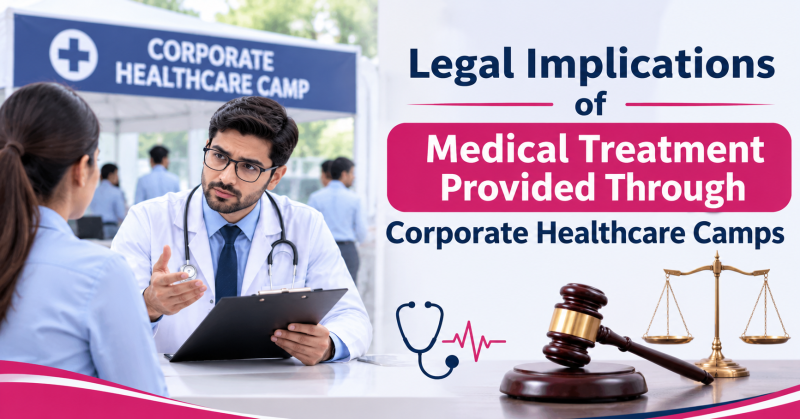
Doctors who treat patients at corporate healthcare camps owe the same duty of care as in a clinic: assess properly, stay within your competence, obtain consent, record what you did, and arrange follow-up for anything the camp cannot resolve. Medico legal support in Delhi often becomes relevant when a camp finding is missed, a referral is not made, or a participant later alleges harm. This article explains the legal exposure, the common mistakes, and practical steps for camp doctors and the organisations that engage them.
Why Corporate Camps Carry Distinct Legal Risk
Corporate camps, such as health check-ups, vaccination drives, eye or dental screenings, and wellness days, are usually short, crowded, and time-limited. A doctor may see dozens of employees in a few hours, with limited equipment, no access to previous records, and little privacy.
These conditions do not lower the standard of care. Indian courts judge medical negligence against the standard of a reasonably competent practitioner. In Jacob Mathew v. State of Punjab (2005), the Supreme Court held that criminal liability against doctors requires a high degree of negligence and that an adverse outcome alone does not establish it. Medical services may also be examined under consumer law, as recognised in Indian Medical Association v. V.P. Shantha (1995), though whether a particular free or employer-sponsored service falls within it depends on the facts. Doctors may also face inquiries before the Delhi Medical Council. Confirm the current position for your specific situation.
Who Is Responsible?
A camp usually involves several parties: the treating doctor, the healthcare provider or hospital that organises it, the corporate that hosts it, and any diagnostic or vaccine vendor. Responsibility depends on the facts, the contract, and the applicable law, and it is not always clear in advance.
Doctors should therefore know who engaged them, who is responsible for equipment and consumables, who handles records, and who is accountable for follow-up. These points are best settled in writing before the camp, not after a complaint.
Common Mistakes at Healthcare Camps
- Working without a written agreement defining roles, scope, and responsibilities
- Offering services beyond the camp’s equipment or the doctor’s competence
- Treating a screening as a diagnosis, or the reverse
- Taking no consent, or relying on a blanket sign-up form
- Keeping no record, or only a tick-box sheet with no findings
- Failing to inform participants of abnormal results and the need for follow-up
- Not referring a participant with concerning findings, or not noting that advice was given
- Using unlicensed or expired drugs, vaccines, or consumables
- Handing employee health data to the employer without proper consent
A Realistic Example
At a company wellness camp, a visiting physician measures a participant’s blood pressure, which is markedly high. The participant is in a hurry, and the doctor advises him to see a physician soon. Nothing is written down. Months later, the employee suffers a serious event, and the family alleges that the camp ignored a clear warning.
If the doctor had recorded the reading, the advice to seek early review, the urgency stated, and the participant’s acknowledgement, the camp could show a reasoned response. With no record, the family’s account stands unanswered. The clinical conversation may have been identical. The record determines how it is judged.
Practical Checklist for Camp Doctors and Organisers
- Sign a written agreement covering scope, roles, indemnity, and follow-up
- Verify your registration and the licences of staff, labs, and suppliers
- Define what the camp will and will not do, and tell participants clearly
- Take specific consent for examinations, tests, and vaccines, and note any refusal
- Maintain an individual record for each participant, with date, time, findings, and advice
- Give participants a written summary of abnormal findings and a referral note
- Keep emergency arrangements ready, including a nearby hospital and ambulance contact
- Store drugs, vaccines, and samples correctly, and keep batch details
- Protect participants’ health data and share it with the employer only as consent and applicable data protection law allow
- Keep corrections as dated, signed addenda, never by overwriting
When to Seek Specialist Advice
Seek advice before accepting a camp engagement with unclear terms, when a participant reports harm, or when you receive a notice or complaint. Do not alter any record after a complaint, and take advice before replying in writing. Doctors seeking medico legal help for medical professionals in Delhi can consult specialists such as Dr. Vimal Kant Goyal, whose medico-legal resources for doctors and healthcare organisations explain how to approach agreements, records, and complaints. A dependable medico legal guide in Delhi should also be candid about its limits and should never promise a particular outcome.
Conclusion
Camp medicine is real medicine. Agree roles in writing, stay within scope, take consent, keep individual records, communicate abnormal findings, and protect health data. Review your camp templates before each engagement and after any incident. Reliable medico legal support in Delhi can help you assess your arrangements and respond properly if a dispute arises. This article provides general information and is not legal advice for any specific case. If a complaint or notice arrives, consult a qualified medico-legal professional.
Frequently Asked Questions
1. Does the same standard of care apply at a camp as in a clinic?Yes. The setting may limit what can be done, but you are still expected to act as a reasonably competent practitioner, stay within your competence, and refer when needed.
2. Do I need written consent at a camp?Consent is required for examinations and procedures, and written or clearly recorded consent is safer, especially for tests, vaccines, and any invasive step. A blanket sign-up sheet alone is weak evidence.
3. Who is responsible for follow-up after abnormal findings?This should be decided in the agreement. In practice, the doctor should still record the finding, inform the participant, and advise follow-up, even if the organiser handles the administration.
4. Can the employer see employees’ medical results?Not automatically. Share individual health information only with valid consent and in line with applicable law. Aggregated, anonymised data is generally less sensitive.
5. What should I do if a participant complains after a camp?Secure the camp records, do not alter any entry, gather the agreement and consent documents, and seek professional advice before replying.
Source:
Click for the: Full Story
You might like