Close Menu
 World
 Biography
 Health
 Education
 Business
 Lifestyle
 Sports
 Technology
 Animals
 History
 Food
 Religious
 Startups
 Movies
 Politics
 Fashion
 Covid
 Diet
 Fitness
 Marketing
 Travel
 Science
 Reviews
 Social media
 Stories
 Facts
 Art
 Entertainment
Deepak

Health
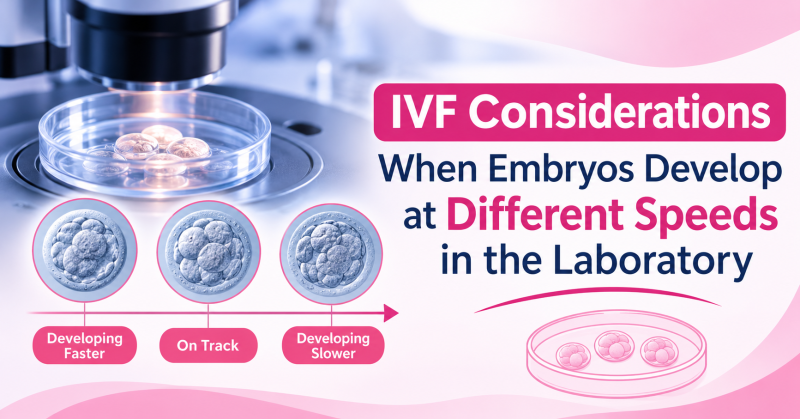
IVF Considerations When Embryos Develop at Different Speeds in the Laboratory
 Deepak
During an IVF cycle, couples often receive daily or periodic updates about their embryos. It can be unsettling to hear that one embryo is growing faster than another, or that several are developing more slowly than expected. If you are searching for the best IVF doctor in Delhi, understanding what these differences mean can help you ask better questions and feel more prepared.
The short answer is that embryos rarely develop in perfect step with one another. Variation is common, and speed alone does not decide an embryo's potential.
How Embryos Normally Develop in the Laboratory
After eggs are fertilised, the embryology team observes the embryos over several days. In general terms:
- Day 1: Fertilisation is checked.
- Day 2–3: The embryo divides into multiple cells (cleavage stage).
- Day 4: Cells begin to compact together.
- Day 5–6: A fluid-filled structure called a blastocyst may form.
These timelines are typical guides, not strict deadlines. Embryos from the same cycle, and even from the same batch of eggs, can reach each stage at slightly different times.
Why Do Embryos Develop at Different Speeds?
Several factors may play a role, and often more than one is involved.
Egg Maturity and Quality
Eggs retrieved together can differ in maturity and cellular health. This influences how efficiently an embryo divides and grows.
Sperm Factors
Sperm contribute genetic material and cellular signals after fertilisation. Differences in sperm quality may influence early development in some cases.
Chromosomal Differences
Some embryos have chromosomal variations that can slow their growth or cause them to stop developing. This is a natural biological process and is not caused by anything a couple did or did not do.
Laboratory Conditions
Temperature, air quality, culture media and handling all affect development. This is one reason laboratory standards are important, though even in an excellent laboratory, variation will still occur.
Individual Biology
Some embryos simply take longer to reach a stage and still develop normally. Others progress quickly but may not implant. Speed is one observation among many.
Fast, Slow, or On Time: What Does It Mean?
Slower embryos: A slower embryo may still become a good-quality blastocyst, sometimes on day 6 instead of day 5. Some slower embryos do result in pregnancy, although on average, outcomes can differ from those of embryos that develop on the expected schedule. This varies from patient to patient.
Faster embryos: Quick development is not automatically better. Embryos are assessed on cell number, symmetry, fragmentation and blastocyst structure, not on speed alone.
Uneven batches: When some embryos advance while others lag, it usually reflects natural biological variability within that cycle.
How an IVF Doctor Uses This Information
Laboratory observations help guide decisions rather than make them in isolation. An IVF doctor in Delhi will typically consider embryo development alongside your age, ovarian response, hormone levels, uterine lining and medical history.
Possible considerations include:
- Extended culture: Allowing embryos to grow to day 5 or 6 helps the team see which ones reach the blastocyst stage.
- Fresh versus frozen transfer: If a day 6 embryo or an out-of-sync uterine lining is involved, freezing embryos for a later transfer may be considered.
- Choosing which embryo to transfer: Selection is based on overall grading and development, not just timing.
- Genetic testing: In certain situations, such as recurrent loss or advanced maternal age, preimplantation genetic testing may be discussed, along with its benefits and limitations.
- Reviewing the protocol: If development is consistently slow across cycles, the doctor may revisit stimulation medicines, trigger timing or sperm preparation methods.
What Couples Can Do
- Ask for clear updates. Request an explanation of your embryo reports in simple language.
- Avoid comparing with others. Every cycle and every couple is different.
- Follow medication and lifestyle advice. Balanced nutrition, adequate sleep and avoiding smoking and excess alcohol support overall reproductive health.
- Seek emotional support. Waiting for embryo updates can be stressful; talking with your partner, a counsellor or your care team can help.
Choosing the Right Care Team
Embryo development depends on a combination of medical expertise and laboratory quality. When selecting the best obstetrics and gynecology in Delhi for fertility care, look for a team that:
- Explains your results honestly, including uncertainties
- Individualises treatment rather than using one standard plan
- Discusses realistic expectations without guaranteeing outcomes
- Coordinates closely between the clinician and embryology laboratory
Dr. Poonam Goyal, a gynecologist and fertility specialist in Delhi, approaches IVF with careful evaluation of each patient's history and test results, so that decisions about embryo transfer or freezing are made with the couple's full understanding.
When to Seek Guidance
Consider speaking with a fertility specialist if you have had:
- Repeated cycles with slow or arrested embryo development
- Few embryos reaching the blastocyst stage
- Unexplained implantation failure
- Concerns about egg or sperm quality
A detailed review of previous cycle records can often reveal useful patterns and options for the next step.
If you want a consultation regarding IVF treatment, you can visit Dr Poonam Goyal at:
- C-3/63A, 64A, opp. Gokulpuri Police Station, Block C, Panchsheel Hospital, Yamuna Vihar, Shahdara, Delhi, 110053
- HOD IVF & Infertility, Max Superspeciality Hospital, Vaishali
FAQs
Q1. Is it normal for embryos from the same IVF cycle to grow at different speeds?
Yes. Embryos from one cycle commonly develop at different rates because of differences in egg maturity, sperm contribution, chromosomes and individual biology.
Q2. Can a slow-growing embryo still lead to pregnancy?
Sometimes, yes. Some embryos that reach the blastocyst stage on day 6 can result in a healthy pregnancy. Chances may differ from embryos that develop on day 5, and your doctor can explain what applies to you.
Q3. Does a faster-developing embryo always have a better chance?
Not necessarily. Embryos are assessed on several features, including cell structure and blastocyst quality, and not just on how quickly they grow.
Q4. Why might my doctor suggest freezing embryos after slow development?
Freezing allows the embryo to be transferred in a later cycle, when the uterine lining can be prepared in step with the embryo's stage. It may also give time to review test results.
Q5. Can the IVF protocol be changed if embryos repeatedly develop slowly?
Often, the stimulation approach, trigger timing or sperm preparation methods can be reviewed. Any change should be based on your cycle records and your doctor's assessment.
Source:
Click for the: Full Story
You might like