Close Menu
 World
 Biography
 Health
 Education
 Business
 Lifestyle
 Sports
 Technology
 Animals
 History
 Food
 Religious
 Startups
 Movies
 Politics
 Fashion
 Covid
 Diet
 Fitness
 Marketing
 Travel
 Science
 Reviews
 Social media
 Stories
 Facts
 Art
 Entertainment
Badal

Health
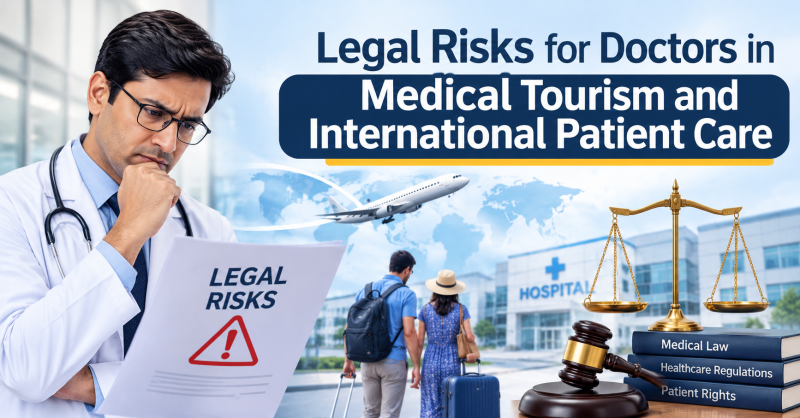
Legal Risks for Doctors in Medical Tourism and International Patient Care
 Badal
International patients bring revenue and prestige, but they also bring legal exposure that domestic practice rarely does. Doctors who treat foreign nationals face the same negligence and consent standards as always, plus visa-linked paperwork, cross-border disputes, and treatment restrictions that apply only to non-citizens. Seeking early legal help for doctors in Delhi, before a dispute starts, is often the cheapest way to manage these risks. The sections below explain where the real exposure lies and how to reduce it.
How Medical Tourism Differs From Routine Practice
A foreign patient is not simply a domestic patient with a passport. Three things change.
First, the care is rarely a single visit. Diagnosis may happen remotely, treatment in India, and follow-up in another country, so responsibility is spread across several people.
Second, intermediaries are involved. Facilitators, agents and overseas referral partners often sit between patient and doctor, and their conduct can create problems for the clinician.
Third, expectations differ. A patient who has paid for travel, accommodation and a procedure often expects a guaranteed outcome, which makes disputes more likely when results fall short.
None of this creates a separate liability regime. Indian law generally treats the patient's treatment in India under the same framework: professional conduct rules enforced by the National Medical Commission and state councils such as the Delhi Medical Council, civil and consumer remedies, and, in serious cases, criminal law. What changes is how easily things go wrong.
Paperwork, Visas and Consent
Visa and identity documentation
Foreign nationals generally enter India for treatment on a medical visa, often with a medical attendant visa for a companion. Hospitals usually keep copies of the passport, visa and referral records. Whether a particular obligation (for example, reporting or registration with immigration authorities) rests on the hospital, the doctor or the patient depends on the visa type and length of stay, so administrators should confirm the current requirements with the relevant authority rather than assume.
An administrative lapse here is typically a compliance problem, not medical negligence. It can still delay discharge, complicate insurance and damage a hospital's standing.
Consent that survives a dispute
Language is the most overlooked gap. A consent form in English signed by a patient who reads only Arabic or Russian is weak evidence of informed consent. Good practice includes:
- Using a qualified interpreter and recording the interpreter's name.
- Explaining risks, alternatives and realistic outcomes, not just the procedure.
- Documenting the discussion in the case notes, since the form alone proves little.
A realistic scenario: A clinic performs a cosmetic procedure on a visiting patient. The surgeon's explanation was verbal, through the patient's relative, and the file holds only a generic form. When the patient complains of an unsatisfactory result on returning home, the clinic cannot show what was explained. The clinical work may have been sound, but the documentation gap makes the case hard to defend. The fix is a recorded, interpreter-assisted discussion and a note of what was said.
Consent templates are a sensible place to involve a lawyer. Many clinics find that legal help for doctors in Delhi pays for itself at this stage, when forms are reviewed for language, risk disclosure and outcome wording before any patient signs.
Treatments With Special Statutory Limits
Some procedures are more heavily regulated, and rules can be stricter where foreign nationals are involved. Doctors should not assume a procedure available to Indian residents is equally open to foreign patients.
- Organ transplantation: The Transplantation of Human Organs and Tissues Act, 1994 requires authorisation-committee scrutiny of donor–recipient relationships, and the process is particularly strict where foreign nationals are involved. Facilitating an unauthorised arrangement can bring serious criminal consequences.
- Surrogacy: The Surrogacy (Regulation) Act, 2021 prohibits commercial surrogacy and places restrictions on who may seek surrogacy in India. Clinics should verify eligibility before accepting such patients.
- Sex determination: The PCPNDT Act, 1994 applies regardless of nationality or the patient's home-country rules.
These laws are amended and interpreted over time, which is why any legal guide for doctors in Delhi, including this one, should be treated as a starting point. Confirm the current position with the relevant authority or a qualified legal professional before accepting such cases.
Liability, Jurisdiction and Cross-Border Follow-Up
Not every failure carries the same weight, and it helps to separate them:
- Administrative non-compliance: missing records, incomplete forms.
- Professional misconduct concerns: raised before the medical council, such as accepting commissions for referrals, which the 2002 Professional Conduct Regulations restrict.
- Civil or consumer disputes: claims for compensation. Medical services fall within the Consumer Protection Act, 2019, and the Act does not on its face limit complaints to Indian citizens, though procedural questions can arise.
- Criminal liability: reserved for conduct beyond ordinary negligence. In Jacob Mathew v. State of Punjab (2005), the Supreme Court set a high threshold of gross negligence for prosecuting doctors.
A foreign patient may also try to sue or complain in their home country. Whether such proceedings succeed against an Indian doctor is a complex question of private international law, and doctors should not assume immunity.
Post-treatment follow-up deserves care. Advising a patient abroad by video call raises unsettled questions about which rules govern, including how India's Telemedicine Practice Guidelines (2020) apply and whether the doctor is permitted to advise someone located in another country. Keep follow-up advice conservative, document it, and refer the patient to a local clinician for hands-on care.
Patient data is another exposure point. India's Digital Personal Data Protection Act, 2023 is being brought into force in phases, and overseas patients' data may also attract their home country's rules. Check the current commencement status before designing data-sharing arrangements. Ongoing education in this area matters. Practitioners such as Dr. Vimal Kant Goyal have highlighted how informed medico-legal awareness helps doctors avoid disputes that arise from documentation rather than clinical error.
A Practical Risk Checklist
Before accepting an international patient, doctors and administrators can work through the following:
- Verify identity, visa category and referral source.
- Review any agreement with a facilitator for fee-sharing or outcome promises.
- Confirm the proposed treatment is permitted for this patient.
- Arrange an interpreter and record the consent discussion.
- Obtain prior records and document what was and was not reviewed.
- Agree a written follow-up and escalation plan with the patient's home doctor.
- Keep a clear price estimate and record any changes.
For a structured overview of these obligations, medico-legal guidance for practising doctors can help clinicians understand where documentation and compliance gaps typically arise.
Conclusion
Medical tourism does not create new legal duties so much as raise the stakes on existing ones. Clear consent, accurate records, lawful treatment choices and careful dealings with intermediaries do most of the protective work. Doctors should also distinguish paperwork lapses from professional or legal risks, and respond proportionately to each. Taking advice before accepting complex cases is a practical step, not an admission of weakness.
This article is for general information and is not legal advice.
Frequently Asked Questions
1. Are doctors personally liable if a facilitator makes false promises?Possibly, if the doctor adopted, endorsed or benefited from them. Distance yourself in writing, avoid outcome guarantees and make sure your own consent discussion states realistic results.
2. Does a signed waiver protect the doctor from claims?Not reliably. A waiver may help show that risks were disclosed, but it generally cannot excuse negligence. Treat it as one piece of evidence alongside detailed notes.
3. Can a Delhi doctor treat a patient referred by an overseas doctor?Yes, in principle, if the treatment is lawful and the doctor is registered. Obtain the referral records, but make independent clinical decisions and document them.
4. What should a hospital do if a foreign patient complains after returning home?Preserve the complete record, respond in writing and promptly, and involve legal counsel early. A medico legal consultant in Delhi can help assess whether the issue is administrative, disciplinary or a potential claim.
5. Who regulates the doctor if the patient is a foreigner?The doctor remains answerable to the medical council where registered, which in Delhi is the Delhi Medical Council, along with the courts and statutory authorities that govern the procedure.
Source:
Click for the: Full Story
You might like