Close Menu
 World
 Biography
 Health
 Education
 Business
 Lifestyle
 Sports
 Technology
 Animals
 History
 Food
 Religious
 Startups
 Movies
 Politics
 Fashion
 Covid
 Diet
 Fitness
 Marketing
 Travel
 Science
 Reviews
 Social media
 Stories
 Facts
 Art
 Entertainment
Badal

Health
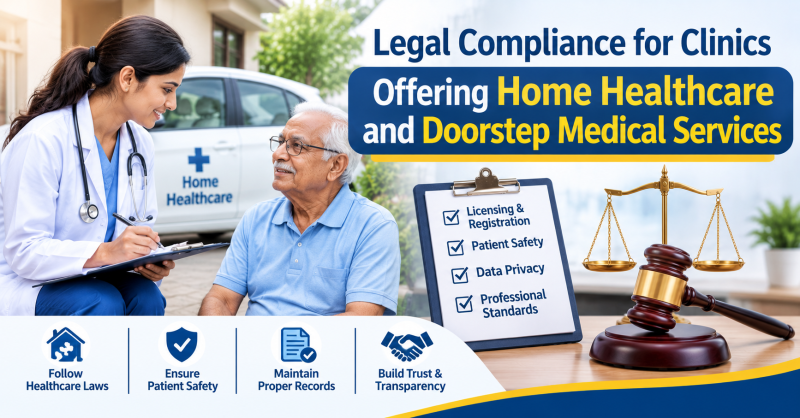
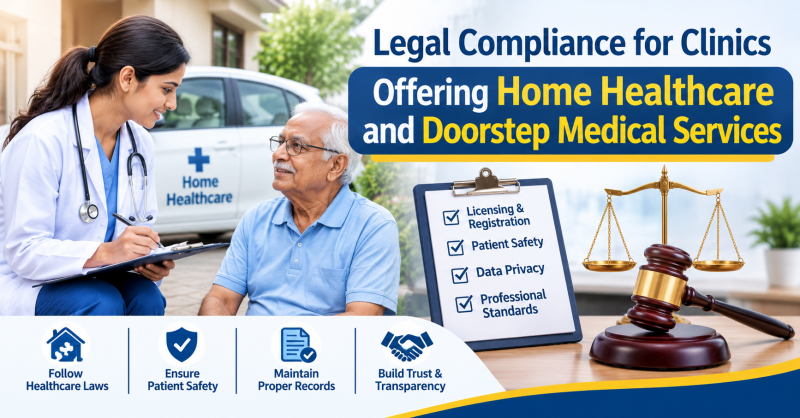
Legal Compliance for Clinics Offering Home Healthcare and Doorstep Medical Services
 Badal
Home visits, doorstep nursing, and at-home diagnostics are now a regular part of clinic practice, but the law has not caught up with the model. Delhi has no single statute for home healthcare, so compliance is built from registration rules, professional conduct requirements, waste rules, consent, and record-keeping. This legal compliance guide for doctors in Delhi explains which of these apply, where clinics commonly go wrong, and what to put in place before the first visit.
Why Home Care Raises Different Legal Questions
A clinic is a controlled setting. A patient's home is not. The doctor cannot control infection risk, the available equipment, who is present or how quickly an emergency can be escalated. Several things also shift:
- The "premises" is the patient's address, which does not fit neatly into registration frameworks designed for fixed establishments.
- Work is often delegated to nurses, physiotherapists or technicians who act without the doctor present.
- Documentation is easily left incomplete when it is done on a phone, in a car or after the visit.
None of this removes a doctor's usual duties. The standard of care, consent and professional conduct apply wherever treatment happens. The practical difficulty is proving compliance when the evidence sits in a patient's living room.
Registration and Licensing in Delhi
Is the clinic itself registered?
This is the first question to settle, and the answer is less straightforward in Delhi than elsewhere. The Clinical Establishments (Registration and Regulation) Act, 2010 is reported not to apply in the NCT of Delhi because the Delhi Nursing Homes Registration Act, 1953 is listed in its schedule. The 1953 Act has a limited scope, covering only hospitals and nursing homes of the allopathic system. Reports have noted that clinics, laboratories and AYUSH establishments are not regulated under it.
Two conclusions follow. A solo practitioner or small clinic may not need nursing-home registration, but a provider running a bedded or hospital-like home-care model should check its position carefully. Whether a home-care service counts as a "nursing home" is a question to put to the Delhi Health Department or a lawyer, not to assume. The legal position is also under discussion and could change.
Who is allowed to do what?
Every doctor must hold valid registration with the relevant medical council, and nurses and other staff must hold the registrations appropriate to their role. Clinics should keep a written record of who may perform which task independently, such as injections, wound care or catheter changes, and who needs doctor supervision. Delegating beyond a person's qualification is a professional conduct risk and weakens the clinic's position if something goes wrong.
Consent, Records and Prescribing at the Patient's Home
A realistic scenario: A clinic sends a nurse to give a long-term patient IV medication at home on a doctor's phone instructions. The nurse notes the visit on a messaging app. The patient develops a reaction, and the family says the risks were never explained. The clinic has no signed consent, no written order and no record of vitals. The treatment may have been correct, but the clinic cannot show that it was properly authorised or monitored.
What should have happened:
- A written consent covering the nature of home treatment, its limits and when the patient should go to a hospital.
- A signed or electronically recorded order before any prescription-only intervention.
- A same-day visit note with time, findings, vitals, medicines given and the person present.
On conduct, the National Medical Commission's 2023 conduct regulations were put in abeyance, and the Indian Medical Council (Professional Conduct, Etiquette and Ethics) Regulations, 2002 were made effective. Confirm whether this remains the current position, as the regulations are under review. Under either framework, doctors should maintain proper records and avoid misleading claims about outcomes.
Where part of the care is delivered remotely, India's Telemedicine Practice Guidelines (2020) may also apply. Doctors should not assume that a phone instruction substitutes for a proper clinical assessment.
Biomedical Waste, Equipment and Medicines in the Field
Home care generates sharps, dressings and other waste that is easy to overlook. Under the Bio-Medical Waste Management Rules, 2016, an occupier handling such waste is required to obtain authorisation irrespective of the quantity. The 2016 Rules were also described as covering healthcare activity undertaken outside the facility. A clinic should therefore treat waste from home visits as its own responsibility, not the patient's, and confirm the exact requirements with the Delhi Pollution Control Committee.
In practice this means carrying colour-coded containers, puncture-proof sharps boxes and returning waste to the clinic for disposal through the authorised route, not leaving it in household bins.
Equipment and medicines need similar care:
- Keep calibration and maintenance records for portable equipment.
- Store drugs under proper conditions during transport, particularly temperature-sensitive ones.
- Do not carry or administer controlled substances without checking the applicable drug and narcotics rules.
An insight worth noting: most clinics have a waste policy for the clinic building, but none for the vehicle. Auditors and complainants rarely ask about the clinic's waste bins. They ask what happened to the used syringe after the home visit.
Liability, Data and Risk Management
Where complaints come from
A home-care dispute may reach the medical council, a consumer forum under the Consumer Protection Act, 2019, or in serious cases the criminal courts. These are different tracks. A missing consent form is usually a documentation and conduct issue, not automatic negligence, but it makes any defence harder. Criminal liability requires a much higher threshold, as the Supreme Court's Jacob Mathew (2005) ruling made clear for medical negligence.
Data and communication
Patient information often travels through messaging apps and shared phones. The Digital Personal Data Protection Act, 2023 is being brought into force in stages, so check its current status and keep health data in secure, access-controlled systems.
A pre-launch checklist
- Confirm the clinic's registration status with the Delhi Health Department.
- Document staff qualifications and the scope of tasks each can perform.
- Prepare consent forms for home treatment and an escalation plan with named hospitals.
- Set up an authorised waste route for home-visit waste.
- Check that professional indemnity insurance covers home visits.
- Maintain a visit log with time, location, staff present and findings.
For readers who want a broader reference on documentation and risk, medico-legal guidance for practising doctors covers where compliance gaps typically begin. Informed medico-legal awareness is something practitioners such as Dr. Vimal Kant Goyal have discussed as a practical safeguard, and it matters most where, as here, the law offers no single rulebook.
Conclusion
Home healthcare is lawful and valuable, but a clinic that offers it must build its own compliance structure, since no single Delhi rule does it for them. Settle the registration question first, define who may do what, record consent and every visit, and manage waste, equipment and data as seriously as in the clinic. Rules in this area are still developing, so review the position periodically and take legal advice when the service model changes.
This article is for general information and is not legal advice.
Frequently Asked Questions
1. Do home visits by a single doctor need separate registration?Not necessarily. A doctor visiting patients usually needs valid medical registration, but whether a separate establishment registration is needed depends on the model. Check with the Delhi Health Department.
2. Can a nurse give injections at home on phone instructions?Practically risky. A written or recorded order, a clear scope of work and a visit note make the arrangement defensible. A verbal instruction alone leaves the clinic exposed.
3. What should a clinic do if a patient deteriorates during a home visit?Stabilise within the team's competence, call emergency services or arrange transfer, and record the sequence of events. A medico legal guide in Delhi can help clinics prepare an escalation protocol before this happens.
4. Is a signed waiver enough to cover home-care risks?No. A waiver may show that risks were explained, but it generally does not excuse negligence or replace a proper consent discussion.
5. Who is responsible if a partner agency or staffing provider sends the nurse?The clinic can remain answerable to the patient. Written agreements covering qualifications, supervision and indemnity matter, but they do not remove the clinic's own duties.
Source:
Click for the: Full Story
You might like