Close Menu
 World
World
 Biography
 Health
 Education
 Business
 Lifestyle
 Sports
 Technology
 Animals
 History
 Food
Food
 Religious
 Startups
 Movies
 Politics
 Fashion
 Covid
Covid
 Diet
Diet
 Fitness
 Marketing
 Travel
 Science
 Reviews
 Social media
 Stories
 Facts
Facts
 Art
Art
 Entertainment
Badal

Health
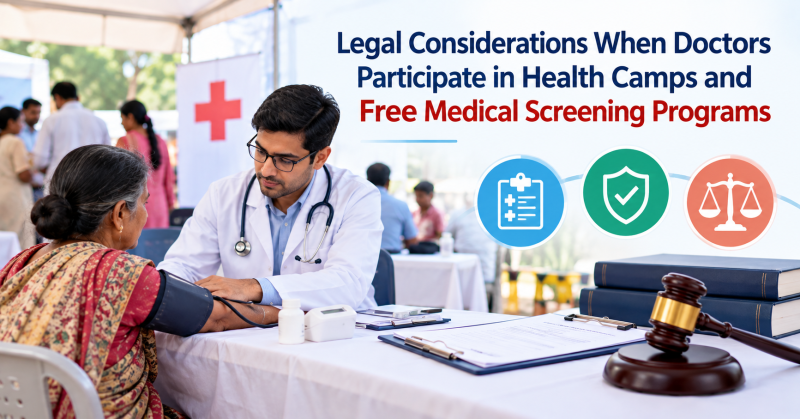
Legal Considerations When Doctors Participate in Health Camps and Free Medical Screening Programs
 Badal
Badal
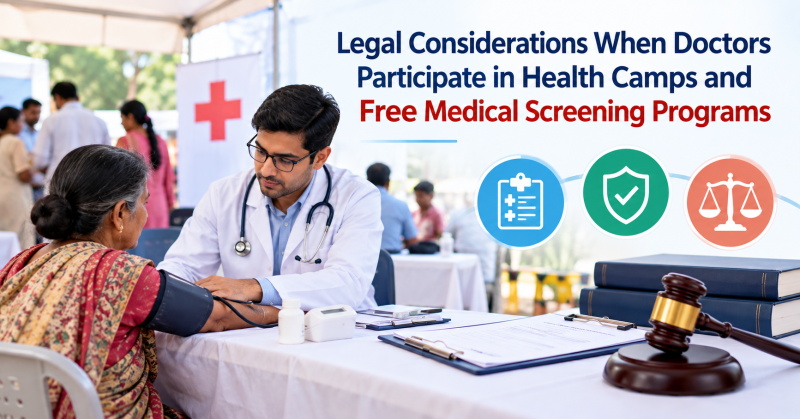
Doctors who volunteer at health camps carry the same professional and legal responsibilities as they do in their own clinics. The setting may be a community hall, the service may be free and the event may be informal, but the duty of care, the need for consent and the expectation of proper records remain. This Legal Guide for Doctors in Delhi explains what to check before you attend, what to document on the day and how to handle referrals responsibly.
Camps are valuable public health work, but they carry medico-legal risk. Queues are long, time per patient is short and records are often thin. Sound medico legal advice for doctors in Delhi starts with one principle: volunteering does not suspend professional accountability, and preparation is the best risk management.
This article is general information, not legal advice. Rules and regulatory guidance change, so confirm the current position with the National Medical Commission (NMC), your state medical council and a qualified lawyer.
A Legal Guide for Doctors in Delhi: Do the Same Duties Apply at a Health Camp?
Yes. A doctor at a camp is expected to act as a reasonably competent practitioner would in that situation. Medical negligence is generally assessed by asking whether a duty of care existed, whether care fell below an accepted professional standard, and whether harm resulted. A service being free does not remove that duty, or your obligations under medical ethics and professional conduct rules.
Whether a particular forum can hear a complaint may depend on the facts, including whether any payment or benefit was involved. Do not assume "free" means "outside the reach of complaints." Patients can still approach a medical council, and civil or criminal proceedings are separate possibilities.
Those affected include:
- Attendees who may treat a screening result as reassurance.
- Volunteer doctors, specialists and support staff.
- Hospitals, NGOs, companies or resident associations that organise or sponsor the camp.
Before the Camp: Organiser, Permissions and Your Own Cover
Many problems begin before the first patient arrives. Ask these questions in advance and keep the answers in writing:
- Who is organising the camp, and is the purpose service, promotion or both?
- Are the venue and any local permissions in order?
- Which services will be offered, and which are outside scope?
- Who is the medical practitioner in charge, and are other staff suitably qualified?
- Where will patients be referred if they need further care?
- Who will hold the records afterwards, and how will data be protected?
- How will biomedical waste, such as sharps, be handled under applicable rules?
- Does your professional indemnity cover camp activities? Check with your insurer.
Be careful about publicity. Banners or social media posts naming you or promoting your practice can raise questions under professional conduct rules on advertising. Check current NMC and state council rules, and ask the organiser not to use your name or credentials without your approval.
Informed Consent, Privacy and Clinical Documentation
Consent in a screening setting
Consent matters even for simple tests. Before a blood sample, ECG or examination, patients should understand:
- What is being done and why.
- That screening is not a diagnosis. A normal result does not rule out disease, and an abnormal one needs confirmation.
- How their information will be stored and shared with the organiser or sponsors.
- That follow-up is their choice, and where they can go for it.
Record consent on a short form or camp register signed by the patient. For minors or patients lacking capacity, note who consented and their relationship. Ensure reasonable privacy during examinations. The Digital Personal Data Protection Act, 2023 is relevant to how camp data is collected and used, so check how it applies.
Records you should maintain
Camp records are often the weakest link. Aim to capture:
- Date, venue, organiser, and your name and registration number.
- Patient name, age, sex and contact details.
- Consent.
- Relevant history, allergies and current medicines.
- Findings, measurements and test results.
- Your assessment and advice, including the limits of screening.
- Referral advice given, with the patient's acknowledgement.
- Any adverse event or emergency and how it was handled.
Keep a copy of your records, or confirm in writing where the master copy is held and how you can access it. Corrections should be dated addenda, not overwriting.
Screening Limits, Referral and Follow-Up
The most common medico-legal trap at camps is false reassurance or unclear advice. Screening flags possible problems. It does not complete the clinical picture.
- Avoid definitive diagnoses on the basis of limited tests.
- Prescribe only what you can do safely without a full history, examination or follow-up.
- Give abnormal findings in writing, with clear instructions on what to do and how soon.
- Explain warning symptoms in plain language, in the patient's own language where possible.
- Have an emergency plan: basic resuscitation equipment, a way to call an ambulance and an agreed nearby hospital.
A realistic example: At a blood pressure and diabetes camp, a patient's reading is high. The doctor says "get it checked" and moves on, with no note and no written referral. If the patient later has a complication and disputes what was said, there is little to show. A brief entry of the reading, a written referral and a line recording that the patient understood would have served both of them.
Common Mistakes, Preventive Steps and a Practical Checklist
Mistakes to avoid
- Assuming free services carry a lower standard.
- Attending without knowing who the organiser is or what is expected.
- Skipping consent because queues are long.
- Keeping no records, or leaving them entirely with the organiser.
- Giving verbal-only advice on abnormal results.
- Working beyond your competence or what the setting allows.
- Sharing patient photographs or data on personal messaging apps.
Step-by-step preventive actions
A short routine, as any Legal Guide for Doctors in Delhi would suggest, makes camps safer for everyone:
- Confirm the organiser, objectives and scope in writing.
- Check your registration, scope of practice and insurance cover.
- Agree records, data-sharing and referral arrangements beforehand.
- Brief the team on consent, privacy and emergency steps.
- Use a standard form for every patient.
- Give written referral advice for abnormal findings.
- Record any incident promptly and factually.
- Secure your copy of the records after the camp.
Camp checklist
- Organiser and purpose verified
- Insurance cover checked
- Consent recorded
- Records complete and retained
- Referral pathway and emergency plan ready
- Use of your name in publicity agreed
- Patient data protected
When to seek legal help for doctors in Delhi
Consider guidance if you are asked to sign an agreement with an organiser or sponsor you do not fully understand, if an adverse event occurs, or if you receive a complaint or legal notice. Legal help for doctors in Delhi is most useful early, before replies are sent. Dr Vimal Kant Goyal has published a medico-legal guide for doctors that explains in practical terms how such matters are typically approached.
Conclusion
Health camps serve a genuine need, and doctors can take part confidently when they prepare properly. Verify the organiser, record consent, document findings, give referral advice in writing and confirm your insurance cover. This Legal Guide for Doctors in Delhi is a starting point, not a substitute for advice on your own circumstances. When a concern arises, timely medico legal advice for doctors in Delhi can help you respond calmly and keep patient safety at the centre.
Frequently Asked Questions
1. Can a doctor be held responsible for care given free at a camp?Free service does not remove the duty of care or professional obligations. Whether a given forum can hear a complaint depends on the facts, so do not assume immunity.
2. Is written consent needed for simple screening tests?Even where a test seems routine, recording consent is sensible. A short signed form or register entry shows the patient understood what was done and its limits.
3. Who should keep the records of a health camp?Agree this with the organiser beforehand, in writing. Ideally you retain a copy or can access the master record, and patient data is stored securely.
4. What should I do if a camp patient later complains?Do not ignore it and do not alter any records. Preserve forms, registers and messages, and inform your indemnity insurer. Legal help for doctors in Delhi can help you review the complaint and respond within the stated time.
5. Can I promote my own clinic at a health camp?Professional conduct rules restrict advertising and solicitation. Check current NMC and state council rules before allowing your name or practice details to appear in camp publicity.
Source:
Click for the: Full Story
You might like