Close Menu
 World
World
 Biography
 Health
 Education
 Business
 Lifestyle
 Sports
 Technology
 Animals
 History
 Food
Food
 Religious
 Startups
 Movies
 Politics
 Fashion
 Covid
Covid
 Diet
Diet
 Fitness
 Marketing
 Travel
 Science
 Reviews
 Social media
 Stories
 Facts
Facts
 Art
Art
 Entertainment
Badal

Health
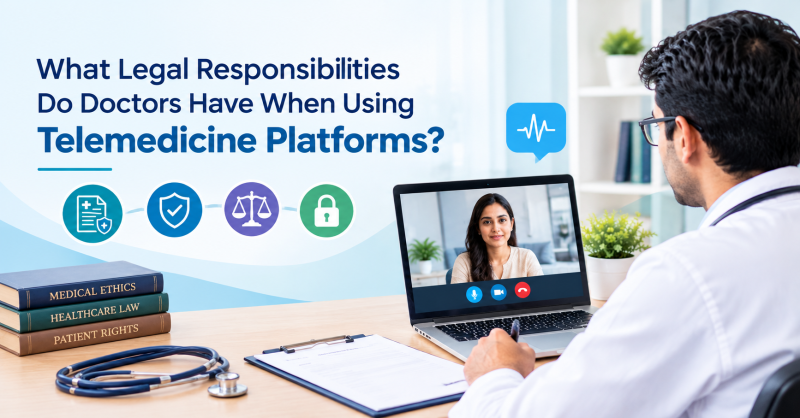
What Legal Responsibilities Do Doctors Have When Using Telemedicine Platforms?
 Badal
Badal
Doctors who consult patients by video, phone or chat carry the same professional and legal duties as they do in a clinic. The medium changes, but the standard of care, the duty to obtain consent and the obligation to keep proper records do not. This Legal Guide for Doctors in Delhi explains what those duties look like in practice, what to document, and where practitioners commonly go wrong.
Teleconsultation is now routine for many clinics and hospitals, so medico legal advice for doctors in Delhi increasingly covers remote care. Without a physical examination, the risk of a missed diagnosis, a disputed prescription or a patient complaint can be higher. A clear, repeatable process protects both patients and practitioners.
This article is general information, not legal advice. Telemedicine rules and regulatory guidance are revised from time to time, so confirm the current position with the National Medical Commission (NMC), your state medical council and a qualified lawyer.
A Legal Guide for Doctors in Delhi: Your Core Responsibilities in Telemedicine
The short answer is that a doctor using a telemedicine platform remains fully accountable for the care given. In India, the Telemedicine Practice Guidelines issued in 2020 are the main reference point. They expect that doctors:
- Hold valid registration and practise within their scope of competence.
- Identify themselves and verify the patient's identity.
- Obtain appropriate consent.
- Judge whether a remote consultation is suitable for the patient's problem.
- Maintain records and prescribe responsibly.
Beyond these guidelines, the general principles of medical negligence apply. A claim or complaint generally turns on whether the doctor owed a duty of care, whether the care fell below an accepted professional standard, and whether harm resulted. A video call does not lower that standard. It does mean the doctor must decide, and be able to show, that the technology was adequate for the clinical question.
Patients, treating doctors, clinics, hospitals and the platform operators that employ or contract doctors are all affected. Institutions should treat telemedicine as part of their clinical governance and risk management, not as an informal add-on.
Informed Consent and Patient Identification
Consent is the foundation of lawful practice. Under the 2020 guidelines, consent can be implied when the patient initiates the consultation, and should be explicit when the doctor initiates it. Even when consent is implied, recording it is good practice.
A sound telemedicine consent process includes:
- Confirming the patient's name, age, location and contact details at the start.
- Explaining that the consultation is remote and that it has limits, such as no physical examination.
- Telling the patient when they may need an in-person visit, tests or referral.
- Explaining how records and personal data will be stored and who may access them.
- Noting the patient's agreement in the record, whether in writing, by message or verbally on a recorded line.
If the patient is a minor or lacks capacity, document who is giving consent and their relationship to the patient. Doctors should also take care with patient privacy. Consult from a private setting, use a secure platform, and avoid sharing patient details over unsecured messaging. Data protection law, including the Digital Personal Data Protection Act, 2023, is relevant here, so check how current rules apply to your practice.
Clinical Documentation and Medical Records
If a complaint or legal notice arrives months later, your records are usually the strongest evidence of what happened. Medical records for a teleconsultation should be as complete as for any clinic visit. Doctors should maintain:
- Date, time, mode of consultation (video, audio or text) and the platform used.
- The patient's identity details and consent.
- Presenting complaint, relevant history, allergies and current medicines.
- What information was reviewed, such as photographs, reports or images shared by the patient.
- Clinical assessment, advice given and the reasoning behind it.
- The prescription, with your name and registration number.
- Follow-up instructions, red-flag warnings and referral advice.
- Any technical problems, such as a dropped call or poor video, and how they were handled.
Records should be legible, dated and not altered after the event. If an entry must be corrected, add a dated addendum rather than overwriting the original. Keep digital records secure, backed up and retrievable.
Prescribing and Clinical Limits in Remote Care
Prescribing is where telemedicine carries some of its greatest medico-legal risk. The 2020 guidelines classify medicines into categories that govern what may be prescribed by tele-consultation, and they restrict certain drugs, including those under Schedule X and narcotic and psychotropic substances. The permitted scope also depends on whether the consultation is a first consult or a follow-up. Doctors should read the current guidelines directly and not rely on summaries.
Some practical principles apply:
- Prescribe only when you have enough information to do so safely.
- Do not prescribe if the clinical picture needs a physical examination or investigations you cannot arrange.
- Avoid prescribing for conditions outside your expertise.
- Make sure the patient understands dose, duration, side effects and when to seek urgent help.
Doctors should also be careful about their relationship with any platform. A platform cannot take over the doctor's professional responsibility. Be wary of arrangements that involve incentives for prescribing particular drugs or tests, as these raise serious questions of medical ethics and professional conduct.
Visit:
Medico legal guide in east Delhi
Common Mistakes, Preventive Steps and a Practical Checklist
Common mistakes doctors should avoid
Many disputes come from ordinary lapses, not dramatic errors:
- Treating a patient whose symptoms need an in-person examination.
- Skipping consent or identity verification because the consultation is brief.
- Writing minimal or no notes for "quick" consultations.
- Prescribing restricted medicines remotely.
- Failing to warn the patient about danger signs or to arrange follow-up.
- Using personal messaging apps with weak privacy protections for clinical information.
A realistic example: a patient reports chest discomfort during a short video call, and the doctor advises antacids without recording the history, red-flag advice or a recommendation for an ECG. If the patient later has a cardiac event, the lack of documentation makes the doctor's reasoning hard to demonstrate. Referring the patient promptly and recording that advice is the safer course, both clinically and legally.
Step-by-step preventive actions
- Confirm your registration and check the current guidelines before offering teleconsultation.
- Choose a platform with secure data handling and reliable audio and video.
- Verify identity and record consent at the start of every consultation.
- Decide whether the problem is suitable for remote care, and say so in your notes.
- Take a focused history and note what you could not assess.
- Prescribe within permitted limits and include your registration number.
- Give clear follow-up and referral advice, and document it.
- Store records securely and review your process regularly.
Telemedicine compliance checklist
- Registration and scope of practice verified
- Patient identity confirmed
- Consent recorded
- Suitability for remote care assessed
- Clinical notes completed
- Prescription compliant and signed
- Red-flag and follow-up advice documented
- Data stored securely
When to seek legal help
Doctors should consider professional guidance when they receive a legal notice or a complaint to a medical council or consumer forum, when a patient suffers an unexpected adverse outcome, or when they are asked to sign a platform agreement they do not fully understand. Legal help for doctors in Delhi is most valuable early, before replies are sent or records are discussed with others. An organised medico-legal guide for doctors can help practitioners understand how complaints and notices are typically handled, and this article was written by Dr Vimal Kant Goyal with that practical aim.
Conclusion
Telemedicine changes how care is delivered, not what doctors owe their patients. Verify identity, record consent, judge suitability for remote care, prescribe within the rules, and keep clear, timely records. A careful process is the most practical form of risk management, and this Legal Guide for Doctors in Delhi is meant as a starting point, not a substitute for advice on your own circumstances. Review your telemedicine practice regularly, keep up with regulatory changes, and seek qualified guidance when a concern arises.
Frequently Asked Questions
1. Do telemedicine consultations carry the same legal standard as in-person visits?Yes. The duty of care, consent requirements and record-keeping expectations apply regardless of how the consultation is delivered. What counts as reasonable care may differ because of the limits of remote assessment, but the doctor must still act as a reasonably competent practitioner would.
2. Is written consent always required for teleconsultation?Not necessarily. Under the 2020 guidelines, consent may be implied when the patient initiates the consultation, though explicit consent is expected when the doctor initiates it. Recording consent in your notes is sensible either way.
3. How long should telemedicine records be kept?Retention requirements depend on the applicable regulations and institutional policy, so check current NMC and state council guidance. Do not delete records early, particularly if a complaint or dispute is possible.
4. What should I do if I receive a legal notice about a teleconsultation?Do not ignore it, and do not alter any records. Preserve all notes, prescriptions, messages and call logs, and inform your indemnity insurer if you have one. Legal help for doctors in Delhi can help you review the notice and prepare a measured response within the stated time.
5. Can the telemedicine platform take responsibility for my clinical decisions?No. A platform may supply technology and administrative support, but the treating doctor remains professionally responsible for clinical judgement, advice and prescriptions.
Source:
Click for the: Full Story
You might like