Close Menu
 World
World
 Biography
 Health
 Education
 Business
 Lifestyle
 Sports
 Technology
 Animals
 History
 Food
Food
 Religious
 Startups
 Movies
 Politics
 Fashion
 Covid
Covid
 Diet
Diet
 Fitness
 Marketing
 Travel
 Science
 Reviews
 Social media
 Stories
 Facts
Facts
 Art
Art
 Entertainment
Badal

Health
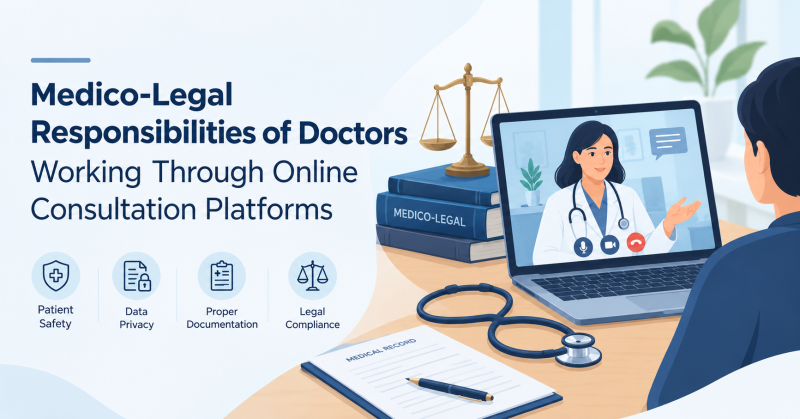
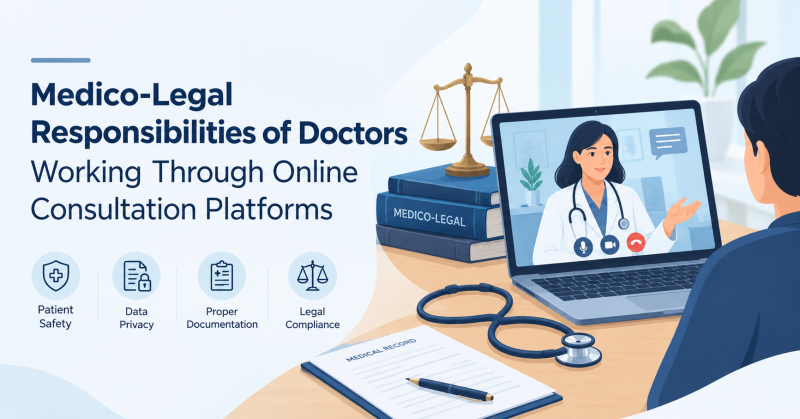
Medico-Legal Responsibilities of Doctors Working Through Online Consultation Platforms
 Badal
Badal
Doctors who consult through an online platform remain personally responsible for the advice they give, whoever owns the app and whatever the platform's terms say. Medico legal support in Delhi increasingly begins with this point, because many practitioners assume the platform shares their risk. In practice, the duty of care, consent, record-keeping and prescribing rules stay with the treating doctor. This article explains what those responsibilities look like and how to manage them.
Platform work brings its own pressures: short consultations, patients you may never see again, and records stored on systems you do not control. A practical medico legal guide in Delhi therefore has to cover both clinical conduct and the doctor's relationship with the platform itself.
This article is general information, not legal advice. Telemedicine rules and regulatory guidance change, so confirm the current position with the National Medical Commission (NMC), your state medical council and a qualified lawyer.
Who Is Responsible When a Platform Is Involved?
The treating doctor is. A platform typically provides technology, patient access, scheduling and payments. It does not replace the doctor's clinical judgement. Medical negligence is generally assessed by asking whether a duty of care existed, whether care fell below an accepted professional standard, and whether harm resulted. These questions apply equally to a video consultation and a clinic visit.
Several parties are affected:
- Doctors, who answer to their medical council and, depending on the facts, to civil, consumer or criminal forums.
- Patients, who may rely on brief remote advice for serious symptoms.
- Platform operators and the hospitals or clinics that contract with them, who have their own compliance and clinical governance obligations.
How liability is shared between a doctor and a platform depends on the contract and the facts, so do not assume either way.
Medico Legal Support in Delhi: Checks Before You Join a Platform
Many disputes trace back to arrangements made before the first consultation. Before signing up, review:
- Whether your registration and scope of practice are accurately shown to patients.
- Who owns and controls patient records, and whether you can access them later.
- How patient data is stored, secured and shared, with reference to the Digital Personal Data Protection Act, 2023.
- Whether the platform's workflow allows you to record consent and take a proper history.
- Any clause that limits your clinical discretion, sets time targets per consultation, or ties payment to prescriptions or tests.
- Whether your professional indemnity cover extends to online practice. Check with your insurer.
- What happens to records and complaints if the agreement ends.
Be careful with any incentive structure that could influence what you prescribe or advise. This raises issues of medical ethics and professional conduct, and the NMC's rules on conduct should guide you.
Informed Consent and Clinical Documentation
Consent in remote care
Under the Telemedicine Practice Guidelines of 2020, consent may be implied when the patient initiates the consultation and should be explicit when the doctor initiates it. Recording it is good practice either way. Patients should understand that the consultation is remote, that it has limits such as no physical examination, and that they may need an in-person visit.
Records you should maintain
If a patient complaint or legal notice arrives later, your notes are often the best evidence of what occurred. Keep:
- Date, time, mode of consultation and the platform used.
- Patient identity, location and consent.
- Presenting complaint, history, allergies and current medicines.
- Reports or images reviewed.
- Your assessment, advice and reasoning.
- Prescription with your name and registration number.
- Red-flag warnings, follow-up and referral advice.
- Technical problems, such as a dropped call, and how you handled them.
Do not rely only on the platform's system. Confirm how you can retrieve your own records, and make corrections as dated addenda rather than overwriting.
Prescribing, Suitability and Patient Safety
The 2020 guidelines place limits on what may be prescribed through tele-consultation, including restrictions on certain categories of drugs and differences between first consultations and follow-ups. Read the current text directly rather than relying on summaries or platform instructions.
Practical principles:
- Prescribe only when you have enough information to do so safely.
- If the problem needs an examination or investigation you cannot arrange, advise an in-person visit.
- Do not let platform targets or patient pressure change your clinical judgement.
- Tell the patient what to do if symptoms worsen.
A realistic example: A patient on a short app consultation describes breathlessness. The doctor prescribes an inhaler without recording the history or advising urgent assessment. If the patient deteriorates, the absence of notes and escalation advice makes the decision hard to defend. A brief history, a recommendation for in-person care and a documented explanation would have been safer for the patient and the doctor.
Common Mistakes, Preventive Steps and a Checklist
Mistakes to avoid
- Assuming the platform carries the legal responsibility.
- Accepting terms without reading clauses on records, data and indemnity.
- Writing minimal notes for brief consultations.
- Prescribing outside permitted limits.
- Continuing a consultation when the connection is too poor for safe assessment.
- Using personal messaging apps for clinical information.
Step-by-step preventive actions
- Read the platform agreement fully before signing.
- Check your insurance and scope of practice.
- Verify patient identity and record consent each time.
- Decide whether remote care is suitable, and note why.
- Take a focused history and record what could not be assessed.
- Prescribe within permitted limits.
- Document red-flag advice and follow-up.
- Secure your own copy of records and review your process regularly.
Quick checklist
- Platform terms reviewed
- Registration and cover confirmed
- Consent and identity recorded
- Suitability assessed
- Notes and prescription complete
- Follow-up advice documented
- Records retrievable
When to Seek Medico Legal Help for Medical Professionals in Delhi
Consider guidance when you receive a legal notice or complaint, when a patient has an unexpected adverse outcome, or when you are asked to sign an agreement you do not fully understand. Medico legal help for medical professionals in Delhi is most useful early, before replies are sent or records are discussed. Dr Vimal Kant Goyal has published a medico-legal guide for doctors that explains in practical terms how such matters are commonly approached.
Conclusion
Working through a platform changes the delivery of care, not the doctor's duties. Understand the agreement, record consent, judge suitability for remote care, prescribe within the rules and keep your own clear records. Medico legal support in Delhi is most effective when sought early and used alongside careful everyday practice. Review your process regularly, keep up with regulatory changes, and put patient safety first.
Frequently Asked Questions
1. Can a platform be held responsible instead of the doctor?Not as a substitute for the doctor's own responsibility. Liability depends on the contract and facts, but the treating doctor remains professionally accountable for clinical decisions.
2. Do online consultations have a lower standard of care?No. The same duty applies, though what counts as reasonable care takes account of the limits of remote assessment.
3. Who should keep records of platform consultations?Both the platform and the doctor may hold records, but you should confirm in writing how you can access yours, and keep them secure.
4. What should I do if I receive a notice about an online consultation?Do not ignore it and do not alter records. Preserve notes, prescriptions, messages and call logs, and inform your indemnity insurer. Medico legal help for medical professionals in Delhi can help you review the notice and respond within the stated time.
5. Should I read the platform agreement before joining?Yes. Pay attention to clauses on records, data, indemnity, payment and termination, and seek advice if anything is unclear.
Source:
Click for the: Full Story
You might like