Close Menu
 World
World
 Biography
 Health
 Education
 Business
 Lifestyle
 Sports
 Technology
 Animals
 History
 Food
Food
 Religious
 Startups
 Movies
 Politics
 Fashion
 Covid
Covid
 Diet
Diet
 Fitness
 Marketing
 Travel
 Science
 Reviews
 Social media
 Stories
 Facts
Facts
 Art
Art
 Entertainment
Badal

Health
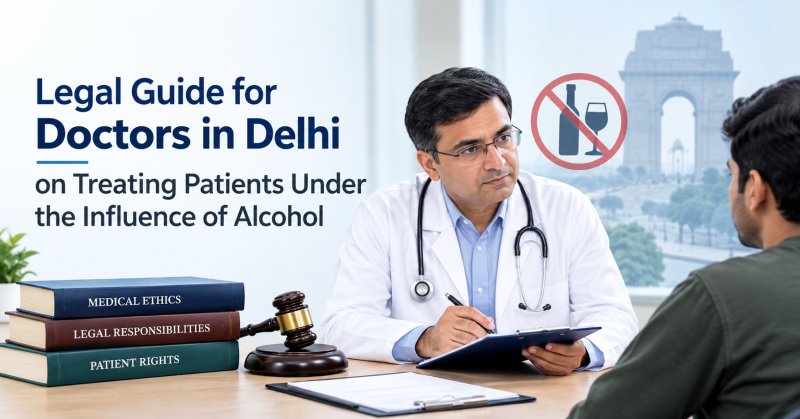
Legal Guide for Doctors in Delhi on Treating Patients Under the Influence of Alcohol
 Badal
Badal
Short answer: Yes, you should treat an intoxicated patient who needs care, and in an emergency alcohol is not a reason to hold back treatment. Legal trouble usually comes from what surrounds the treatment: a missed diagnosis, unclear consent, thin notes, or an unsafe discharge. This legal guide for doctors in Delhi covers how to handle each of these in practice.
Casualty departments and clinics see intoxicated patients all the time: road accident victims, people hurt in fights, patients in withdrawal, or someone found collapsed on the street. Many cannot give a reliable history, and some are hostile. Medico legal advice for doctors in Delhi often starts from one idea: when a patient cannot speak for themselves, your record has to.
Why Intoxicated Patients Carry Extra Medico-Legal Risk
Alcohol can hide or imitate serious illness. Head injury, low blood sugar, stroke, infection, and internal bleeding are easily dismissed as “just drunk.” If the patient later deteriorates, the first question is usually whether anyone looked beyond the alcohol.
Those most exposed include:
- Casualty and emergency doctors
- Junior residents on night duty with limited backup
- Clinic doctors who see walk-ins late in the day
- Hospitals and nursing homes without a clear MLC or discharge protocol
A Practical Legal Guide for Doctors in Delhi: The Bedside Approach
- Stabilise first. Airway, breathing, circulation, and a quick glucose check come before any discussion of alcohol.
- Look past the smell. Examine fully, especially for head and neck trauma. Ask those accompanying the patient about the time of injury, what was consumed, and any known illness or medication.
- Investigate as the picture demands. Order tests or imaging where the findings justify it, and note why you did or did not.
- Reassess at intervals. A patient who grows more drowsy over time may have something other than intoxication.
- Call a senior early if unsure, and record that you did.
- Decide the next step deliberately: admit, observe, refer, or discharge, and write down why.
If your facility lacks what the patient needs, such as ICU or neurosurgical care, arrange a safe transfer instead of turning the patient away. Record the time, the reason, and who accepted the patient. Follow your hospital’s emergency policy and the rules applicable to your facility.
Consent, Capacity and Refusal of Treatment
Capacity means the patient can understand the information, weigh it, and communicate a decision. Alcohol can reduce it, though not always completely.
- Emergencies: Where delay could risk life or cause serious harm, doctors generally act in the patient’s best interest. Record that the patient lacked capacity and that the treatment was urgent.
- Non-urgent care: If the patient cannot follow the explanation, it is usually safer to wait until they can, unless waiting would cause harm.
- Family: Involve relatives where possible and note their names, relationship, and what was explained. A relative’s signature does not solve every consent problem.
- Refusal: An intoxicated patient’s refusal may not be valid. Assess capacity, reassess later, involve family, and document each step.
- Aggression: Staff and patient safety come first. Use security and de-escalation steps, avoid unnecessary force, and record the behaviour factually.
Write down what you observed that led to your view on capacity, not just the conclusion.
What to Document
Notes made at the time of care carry far more weight than explanations given months later. A practical checklist:
- Arrival time, who brought the patient, and the history given
- Signs of intoxication described objectively (speech, gait, odour, alertness)
- Vital signs, blood glucose, and Glasgow Coma Scale score
- Injuries, with site and description
- Investigations ordered and their results
- Your reasoning, including other causes considered
- Capacity assessment and consent or refusal details
- Treatment given and the response
- Reassessment times and findings
- The final decision and the advice given
Use plain wording. “Shouting, unsteady gait, slurred speech” is better than “drunk and abusive.” If you must add to a record later, mark it clearly as a dated late entry.
Common Mistakes and When to Seek Help
Mistakes that appear repeatedly
- Blaming every symptom on alcohol without a full examination
- Waiting for the patient to “sober up” during a genuine emergency
- Discharging without reassessment or a responsible adult, particularly after a head injury
- Treating a likely medico-legal case as routine
- Writing opinions about fault or blame in clinical notes
- Writing notes long after the event
Many intoxicated patients arrive after assaults or accidents. Handle these under your hospital’s MLC procedure and the requirements that apply in Delhi, including informing the police through the proper channel. Describe injuries neutrally, handle samples only through the established process, and issue certificates only on what was actually examined or tested.
Before discharge, confirm that the patient has been reassessed, that serious injury has been reasonably excluded, and that someone can take them home. Give written advice on warning signs and against driving. If the patient leaves against advice, record the risks explained and who was present.
When legal help for doctors in Delhi is worth seeking
Consider guidance if you receive a complaint, legal notice, police query, or request for records, or if a patient dies or is seriously harmed after an intoxicated presentation. Secure the complete record first, inform your hospital administration or indemnity provider, and avoid informal replies. Early legal help for doctors in Delhi can prevent inconsistent statements that create confusion later.
Conclusion
Treating a patient under the influence of alcohol is routine practice, and the safest approach pairs sound clinical judgment with careful records. Look beyond the alcohol, check capacity before relying on consent, reassess before discharge, and write notes that explain your reasoning. Applied consistently, these habits form a practical legal guide for doctors in Delhi, and they protect patients as much as practitioners.
If you would like to consult Dr. Vimal Kant Goyal in person, you can visit him at C-3/62A, 63A, 64A, Block C, Yamuna Vihar, Delhi, 110053.
This article is for general information only and is not a substitute for advice on a specific case.
Frequently Asked Questions
1. Can a doctor refuse to treat a patient who is drunk?Intoxication alone is generally not a safe reason to refuse care, especially in an emergency. If you genuinely lack the facilities, arrange a referral and record the reasons.
2. Who gives consent if the patient is too intoxicated?In an emergency, doctors usually act in the patient’s best interest and document the urgency. For non-urgent treatment, waiting is usually better. Involve relatives and record the discussion.
3. Is every intoxicated patient a medico-legal case?Not necessarily. Intoxication alone does not always make a case medico-legal, but injuries from assault, accidents, or suspected criminal activity usually do. Follow your hospital’s MLC policy.
4. What if the patient wants to leave before assessment is complete?Assess capacity, explain the risks, involve family, and document everything. If the patient lacks capacity and is at risk, follow your hospital’s policy and involve a senior.
5. Where can I get legal help for doctors in Delhi after a complaint?Secure the full patient record, inform your administration or indemnity provider, and consult a medico-legal professional before responding to any notice.
Source:
Click for the: Full Story
You might like