Close Menu
 World
 Biography
 Health
 Education
 Business
 Lifestyle
 Sports
 Technology
 Animals
 History
 Food
 Religious
 Startups
 Movies
 Politics
 Fashion
 Covid
 Diet
 Fitness
 Marketing
 Travel
 Science
 Reviews
 Social media
 Stories
 Facts
 Art
 Entertainment
Badal

Health
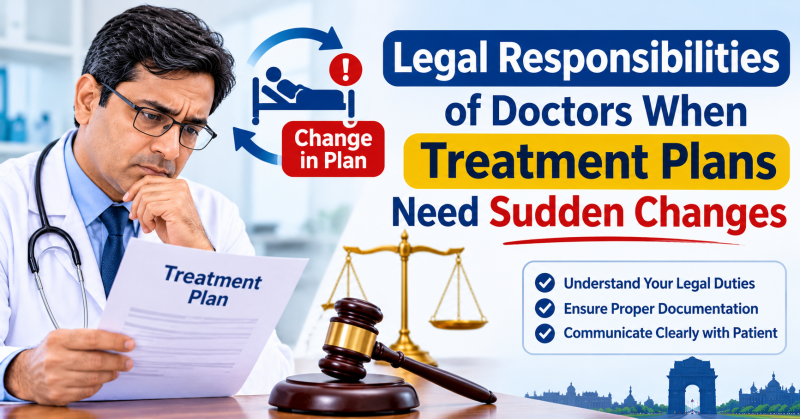
Legal Responsibilities of Doctors When Treatment Plans Need Sudden Changes
 Badal
A doctor who changes a treatment plan mid-course must be able to show a clinical reason, tell the patient or family about the change, obtain fresh consent where the risks differ materially, and record all of it at the time. This Legal Guide for Doctors in Delhi explains what the law and professional standards generally expect when a plan has to change suddenly, which mistakes create exposure, and how to protect both the patient and your practice.
Why Sudden Changes Carry Legal Risk
Plans change for good reasons: a drug reaction, an unexpected finding on imaging, a deteriorating vital sign, or a surgical surprise. The change itself is rarely the problem. Trouble starts when the reason, the communication, or the consent is missing from the record.
In Jacob Mathew v. State of Punjab (2005), the Supreme Court held that a doctor is not criminally liable merely because a treatment went wrong, and that negligence is judged against what a reasonably competent practitioner in the same field would have done. In Bolam v. Friern Hospital Management Committee (1957), an English case often cited in Indian discussions, the test was whether the doctor acted in line with a responsible body of medical opinion. These principles protect sound judgment, but only if you can show that judgment was exercised.
Core Responsibilities When You Change a Plan
Act on a documented clinical reason. Note the new finding, the risk of continuing the old plan, and why the new one is better.
Tell the patient or family. The patient has a right to know that the plan has changed and why. Where the change involves new risks, the principle of informed consent applies again. In Samira Kohli v. Dr. Prabha Manchanda (2008), the Supreme Court emphasised that consent must be given after the patient understands the nature of the procedure, its material risks, and alternatives.
Obtain fresh consent where needed. Consent given for one procedure does not automatically cover a different one. If the change is non-urgent, pause and take consent. In a genuine emergency where delay would endanger life and consent cannot be obtained, the law recognises that necessary action may be taken, but the circumstances should be recorded in detail. Confirm how this applies to your specific case.
Coordinate with the team. Nurses, anaesthetists, and covering doctors should know about the change through a written order, not a hallway conversation.
Common Mistakes That Create Problems
- Changing medication or procedure without recording the reason
- Relying on the original consent form for a materially different intervention
- Informing only a relative who is not authorised, or no one at all
- Giving verbal orders and never writing them down
- Writing the explanation hours later, or after a complaint
- Failing to review and record the patient’s response to the new plan
- Not documenting that the patient declined the new option
A Realistic Example
A surgeon begins a planned laparoscopic procedure and finds adhesions that make the keyhole approach unsafe. Converting to an open procedure is clinically sound. If the original consent mentioned the possibility of conversion, and the notes record the finding, the reasoning, and the post-operative discussion with the family, the decision is easy to defend. If consent never mentioned conversion and the notes say only “converted to open,” the same decision looks harder to justify. The surgery is identical. The paperwork differs.
Practical Checklist for Mid-Treatment Changes
- Date and time of the decision
- New finding or event that triggered the change
- Options considered and why the chosen one was selected
- Risks and alternatives explained, and to whom
- Consent obtained, or the emergency circumstances if it could not be
- Written orders communicated to the team
- Patient’s response and monitoring plan
- Second opinion or specialist input, if sought
- Any refusal by the patient, recorded in their own words where possible
Use contemporaneous entries. If you must add something later, label it as a dated and signed addendum without changing the original.
When to Seek Professional Guidance
Get advice promptly if a change leads to an adverse outcome, a family raises concerns, or you receive a notice from a consumer forum, the Delhi Medical Council, or a police authority. Do not alter the file or discuss the case informally on social media. Doctors seeking medico legal advice for doctors in Delhi can consult specialists such as Dr. Vimal Kant Goyal, whose medico-legal guidance for practitioners covers how to approach notices and complaints. Early legal help for doctors in Delhi often makes it easier to respond accurately and calmly.
Conclusion
Sudden changes are part of real clinical practice. The safest approach is to treat every change as a three-step habit: decide with a clear reason, communicate and consent where required, and document at the time. Use this Legal Guide for Doctors in Delhi to review your own consent forms and note templates, and make sure your team knows how to record urgent changes. This article provides general information and is not legal advice for any specific case. If a dispute arises, consult a qualified medico-legal professional.
Frequently Asked Questions
1. Do I need new consent every time I change a treatment plan?Not for every minor adjustment, such as a routine dose titration within the discussed plan. You generally need fresh consent when the change introduces materially different risks, a different procedure, or a different goal of treatment.
2. What if the patient is unconscious and the plan must change urgently?Where delay would endanger life and no authorised person can be reached in time, doctors generally act in the patient’s best interest. Record the emergency, the attempts to contact family, the second opinion if available, and the reasoning.
3. Is a verbal explanation enough?Verbal explanation is part of consent, but it is hard to prove later. Record what was explained, to whom, and the questions asked, and obtain a signature where appropriate.
4. Can a changed plan be treated as negligence by itself?Not automatically. Courts look at whether the decision was one a reasonably competent doctor could have made and whether the patient was properly informed. The record is central to showing this.
5. Should I inform the patient if the change was due to my own error?Honest disclosure is a core ethical principle. Seek professional advice on how to communicate and document it, but do not conceal or alter records.
Source:
Click for the: Full Story
You might like